 logo

According to Harvard, a firm’s future relies on continuous innovation because it provides competitive advantage, helps firms weather market ups and downs, and drives sustained growth. However, innovation success is elusive, with few brands able to master the process. Yet, a few firms, such as Apple, Eli Lilly, and Alphabet (parent company of Google), are among those who consistently hit it out of the park when it comes to innovation success, despite a few spectacular failures, such as Apple’s Vision Pro smart glasses. How do these firms consistently succeed with their new products? The answer lies in putting demand first, before building a prototype. Marketing must come first.
Innovation success
Before we launch into our 4-step framework for innovation success, let’s take a step back to explore the concept of innovation to ensure we’re all on the same page.
First, there are different types of innovation:
- Incremental innovation, such as new and improved products
- Disruptive innovation introduces products that eventually displace existing products. For instance, when the Apple Mac replaced the earlier Lisa computer.
- Radical innovation, such as AI and machine learning, changes the way consumers behave to create new industries.
- Architectural innovations change the way an industry operates, such as the way Waymo is changing the nature of ride-sharing and taxis.
There are obvious differences in a successful innovation process depending on which type of innovation you’re considering. Fear of failure is a big factor, which leads firms to think inside the box when considering innovations, according to Forbes. This fear interferes with the creative thinking necessary to drive the innovation process, while leading firms to focus on incremental innovations rather than more disruptive types of innovation. Apple offers a cautionary tale that exemplifies the danger of fear emotions in not only innovation success, but the success of the entire operation. Rather than focus the company’s efforts on pushing the envelope in computer development, the board ousted Steve Jobs to focus on a new and improved version of its successful Lisa Computer. As other firms used technological advances to leapfrog the Lisa, Apple languished until the board brought Jobs back and the Macintosh was born.
Why innovations fail

As reported by MIT (based on data from Harvard Business School Professor Clayton Christensen), up to 95% of the approximately 30,000 new products introduced each year fail. That’s after expending an average of $30,000 to $50,000 to develop them. The professor explains that new product development failing is caused by:
Many innovations fail because they introduce products or other solutions without a real need for them. There’s no market for the solutions they’ve created
Well, and that’s marketing, by anyone’s definition of the word.
To understand why your new product isn’t delivering profits, look at this post on the process of new product development. In fact, experts reflect that most new product development failures come from:
- Misalignment with market realities
- Poor strategic execution
- Internal organizational issues

Does this sound like the problem comes from engineering? No, the reason for new product development failing is mostly a marketing and organizational issue. As an example, I once worked with a Fortune 50 company manufacturing high-end scientific equipment. The engineering department had developed a new product. Thankfully, the management refused to begin marketing the product until after market research supported the sales potential. That’s where my firm came in.
We conducted focus groups, one-on-one interviews, and phone surveys. Uniformly, the customers we contacted said they didn’t want this product. It was too expensive and subject to failure with all the bells and whistles included by the engineers. They viewed this product as the workhorse in their labs and a breakdown caused backups and other problems in their work. They didn’t need all the gadgets; they wanted reliability.
Despite our research, the company agreed to introduce the product (an example of the internal organizational issues mentioned by experts). The break-even point was 50. The company sold a handful and some of those were returned.
Innovation success relies on marketing
The build-first mentality that dominates at many firms explains why innovations fail in such a high percentage of cases. The product development process proceeds similarly to the failed example I just shared with you. The dominance of engineering in the process, which focuses efforts on building it and they will come, ignores the fact that consumers determine whether innovation success or failure will result. Solve a consumer problem, do it consistently, and do it better than existing products (even your own), and you succeed.
Rather than relying on engineering, you should treat marketing as your first step in the innovation process. Discovering consumers’ unmet needs, meeting those needs at a price point that puts the product within reach of some subset of consumers, and delivering consistently are your golden ticket to innovation success.
A framework for innovation success
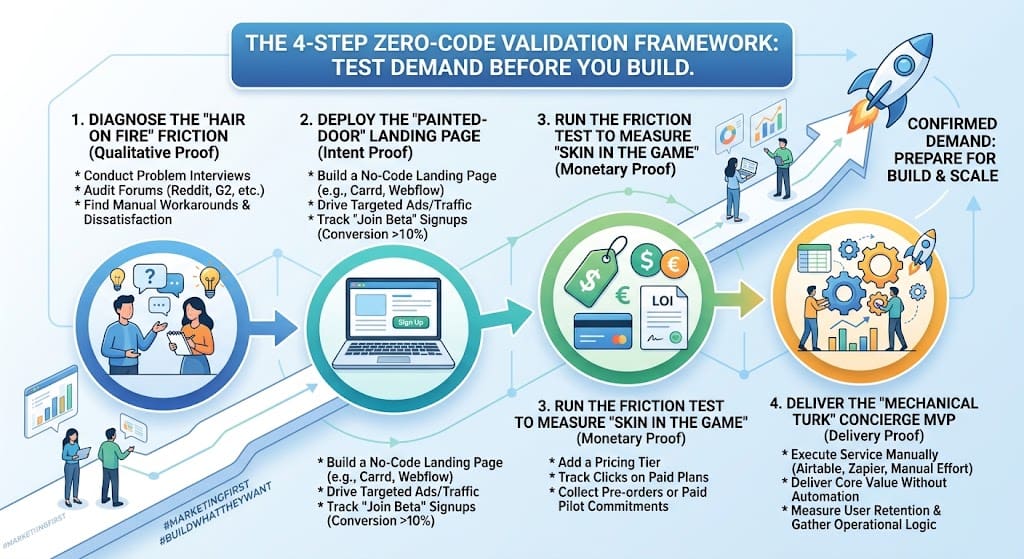
You don’t need to code or have any special engineering talent to develop successful innovations. Instead, you must employ this framework, which outlines an innovation process that dramatically increases your chances of innovation success. In fact, the hallmark of organizational advances such as agile is doing your marketing before writing the first line of code or outlining the first schematic of your product.
Step 1. Find the problem
Consumers buy solutions, not products. It’s easy in our digital world to find the problems that need a solution because consumers complain and post their unmet needs on every social platform, online forum, and product review. You’ll likely even find unmet needs by monitoring your own customer support. Other options include:

Your own customers are a great source for uncovering unmet needs. If a problem isn’t costing consumers time, money, stress, or frustration, it’s unlikely you’ll switch from whatever solution they’re currently using to your innovation.
Step 2. Set up a simple landing page
After uncovering unmet needs, your next step is to quantify potential demand for a possible solution. Something as simple as a landing page can help test your value proposition, positioning, and messaging with prospects. You don’t need anything fancy as long as it looks professional and is built on the feedback you received in step 1.
Obviously, you need to drive traffic to your test page using targeted digital advertising or sharing the page in niche communities like the ones where you found unmet needs. Monitor key metrics to determine the potential sales of your idea. Adding a low-friction call to action, such as “Get Early Access”, really helps you quantify intent.
Recognize that intent isn’t sales. We once did market research asking prospective buyers if they would visit a planned aquarium and how much they’d be willing to pay. The results encouraged the city to build one. Unfortunately, the anticipated revenue didn’t live up to what the city anticipated from the research for several years. That leads us to step 3.
Step 3. Add a pricing barrier
Since stating intent is free, try adding a low-risk pricing barrier to get a better gauge of intent. For instance, try adding a small charge to reserve your spot or offer a discount once the product is introduced for a small fee. Crowdfunding sites are a great place to do this.. Set up a crowdfunding page where small investors get the product once developed in exchange for their investment to gauge interest. This not only gives you the financial resources you need to actually develop the product, but also gives you keen insights into potential demand. Once introduced, the investments achieved on these crowdfunding platforms act as social proof to entice future buyers after the introduction of the product.
An alternative to this method is to add a “Buy Now” call to action on your landing page. Once visitors click on the link to make a purchase, show a courteous message saying the product isn’t quite ready yet, but that visitors will lock in special pricing once the product is ready to ship.
Direct marketing companies found this method particularly effective. They’d mail product offers or post them in other advertising venues along with a card to purchase the product. In fact, the only product that existed was the prototype shown in the ad. If a sufficient number of orders were placed, they manufactured the product. If they didn’t get sufficient orders, they simply returned the money sent by prospective buyers.
Step 4. Test the process
Building the product based on market research and feedback using the prior steps, your next step in innovation success is to test your ability to deliver on customer expectations. You can test your value proposition by manually building or otherwise delivering the product to early buyers. This works especially well when delivering services because you can perform tasks manually rather than using the automation that’s planned for after the rollout.
For instance, if you plan to deliver a software product to streamline analytical tasks, you might sell to a few testers, then use a manual process to deliver reports to buyers before building the software. You then monitor retention and engagement. I worked for a SaaS company once. We built a prototype of the user interface that worked exactly like the real product would, except the results were produced manually. Not only were we able to test market acceptance using this prototype, but we were also able to collect information to improve the interface while there was still time to make changes without wasting money and time on code that didn’t deliver consumer results.
When Jobs finally had the Mac ready to demo in one of his classic events, some features simply didn’t work as he set up for the event. Rather than cancel or not touting features that didn’t work, he set up a simulation where the computer appeared to perform the tasks rather than actually performing them on stage. Obviously, they worked out the bugs before shipping

Examples of innovation success
It’s great to talk through a framework for innovation success, but it’s more illuminating to demonstrate innovation success with actual examples of how firms achieved success. So, here are a few details to help you with your own innovative projects.
Dropbox
When cloud computing first appeared in the early 2000s, the founder wanted to develop a simple, easy-to-use cloud storage platform that anyone could use. Rather than build the complex infrastructure needed to make the product viable, he recorded a short screencast demonstrating how the product would work once it was built. Similar to our working prototype of our SaaS product, he then shared the video with early potential adopters. Overnight, a waiting list emerged as over 75,000 beta signups appeared, which demonstrated the market potential for the finished product.

Buffer
Buffer chose to create a two-page website instead of building a complex scheduling engine for social media posts. On the first page, he outlined the value proposition and a pricing table showing various plans he would make available. The second page stated that the produce wasn’t ready yet, but asked for email addresses to notify visitors about future availability of the product.
This approach went beyond the simple intent modeling used by Dropbox to evaluate willingness to pay by tracking the proportion of visitors who clicked on a paid plan from the pricing table. Only after judging sufficient demand did the company begin writing the code necessary to deliver on the promises made regarding features available at each tier.that there was
Pebble Smartwatch
The founder of this product used Kickstarter to get his idea off the ground, raising funds and gauging demand. He used product prototypes along with touting features and benefits to defend his value proposition over existing smartwatch brands. Hoping to raise $100,000 to fund an initial production run and tooling, the company ended up raising $10.2 million in 30 days. Thus, they were able to enter the market without any risk of failure because they already had orders to cover everything and the social proof necessary to fuel future growth of the brand.
Conclusion
Putting marketing first is the key to innovation success. It’s not your ability to create the next whiz-bang product, but your ability to identify unmet needs, determine the financial viability of your idea based on consumer validation, and deliver a product that provides benefits over and above those available through existing vendors.
Need marketing help to support business growth?
We welcome the opportunity to show you how we can make your marketing SIZZLE with our data-driven, results-oriented marketing strategies. Sign up for our FREE newsletter, get our FREE guide to creating an awesome website, or contact us for more information on hiring us.
Hausman and Associates, the publisher of MKT Maven, is a full-service marketing agency operating at the intersection of marketing and digital media. Check out our affordable coaching programs to help your business thrive into the future.
Discover more from MKT Maven
Subscribe to get the latest posts sent to your email.


