 logo

If you’ve never heard the term unique value proposition, you’ve likely missed out on an excellent opportunity to explode your business. A unique value proposition clarifies why your target market should choose your business over your competition. Having a unique value proposition (UVP) is especially powerful for small businesses because it helps them cut through the noise and highlight their distinct advantages. A UVP offers the why behind customer choice. In today’s post, we’ll help you identify your unique value proposition and even provide a UVP template you can easily complete so you, too, can explode your opportunity.

What does a unique value proposition look like?
If you think about it, if your business looks like every other business offering the same products, consumers have no reason to choose your business over any other company in the market. Thus, it becomes a matter of chance as to whether they choose your brand or a competitor’s. Don’t you want to do better than split the market with your competition? Don’t you want to attract as many of the potential buyers to your offerings? Well, a unique value proposition gives consumers a reason to choose you. That’s why you need to craft a great UVP that fits your target market and conforms to your offerings.
Before we get into the weeds on how to create a great UVP, I want to share some great examples from Wordstream.
- Uber – The Smartest Way to Get Around
- Apple iPhone – The Experience IS the Product
- Unbounce – A/B Testing Without Tech Headaches
- Slack – Be More Productive at Work with Less Effort
- Digit – Save Money Without Thinking About It
- LessAccounting – Bookkeeping, Without the Hassle
- CrazyEgg – Website Behavior Tracking at an Unbeatable Price
Looking at these examples, you should find some easy takeaways:
- They’re short, not a novel or even a full sentence. You want to use as few words as possible to get your USP across.
- They’re benefit-focused. They focus on how their product solves a customer problem, the benefit that addresses users’ hot buttons, and makes users feel like they made the right choice.
- USP’s should differentiate your business and its products from competitors in an easy-to-understand format.
- You should demonstrate your USP in every interaction. Never choose a UVP that doesn’t fit your capabilities, as this will quickly backfire and damage your reputation.
- Your unique selling proposition should match the needs and problems faced by your target market.
- A consistent UVP is essential for success.
Creating a unique value proposition
Now that we see some defining characteristics of a UVP, sometimes called a unique selling proposition or USP, we can move into a more concrete discussion of how you can craft one to help your business attract new customers and compete more effectively in the marketplace. Follow the steps below, using thorough research and thought and you’ll end up with a UVP that helps you stand out and draw more consumers to your brand.
Understand your target market
You need to build personas like the ones below for each segment of the market that forms your target market.
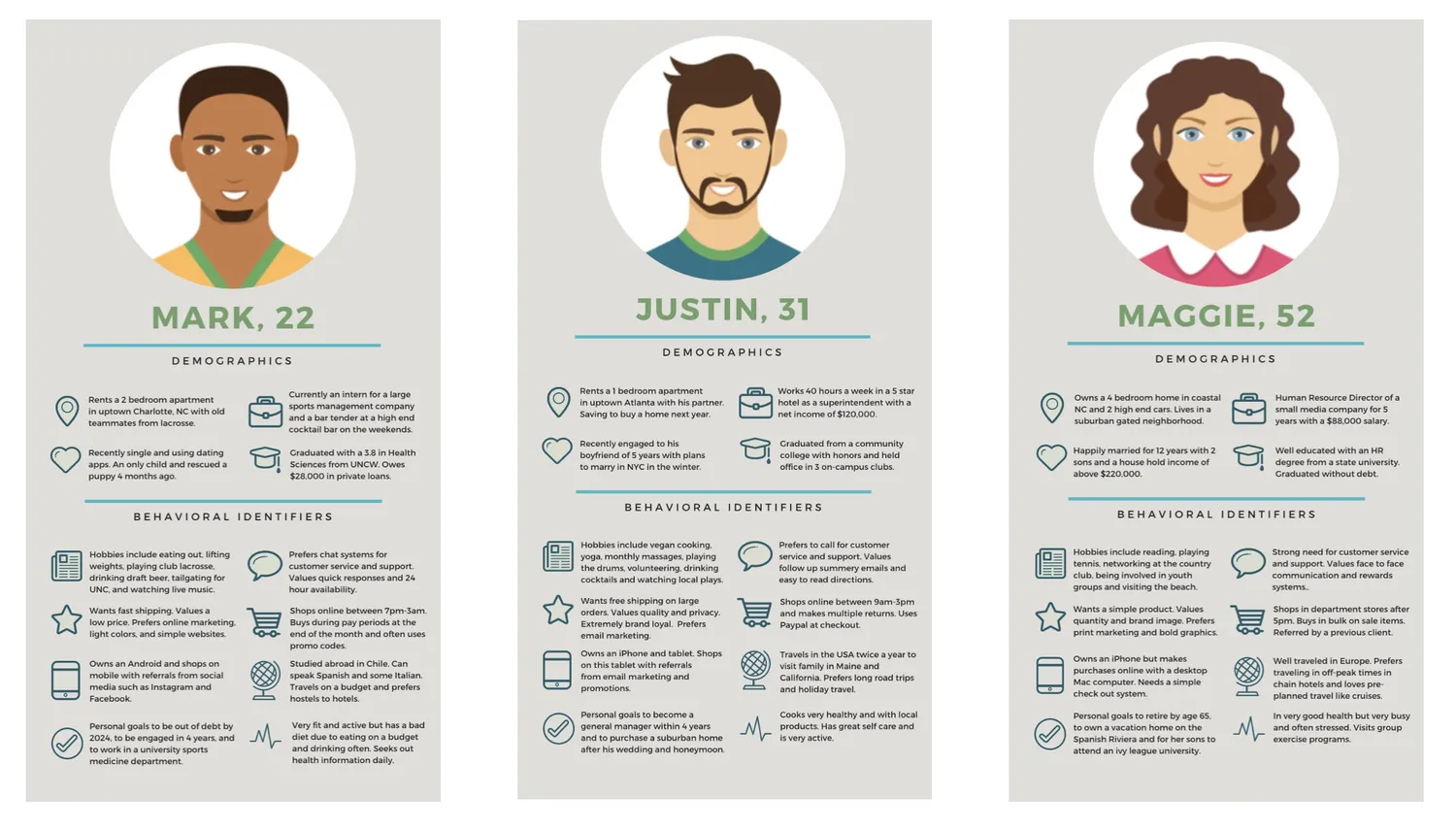
Don’t stop with identifying the demographics of each segment.
- Identify their pain points, desires, and buying behaviors, including which digital platforms they use regularly.
- What do they truly care about? You might think it’s price, but often price isn’t the overriding concern. It’s value. Hence, maybe the most salient characteristics consumers are looking for involve convenience, speed, the “coolness factor” (which explains the price advantage for Apple products over those charged by competitors), feeling good about their purchase (ie. Toms, which donates shoes to poor children for each purchase), status, or any one of a number of other potential decision valuables. In the age of digital media, you now have access to this type of information about your followers or any group you wish to target if you listen carefully.
For instance, farm-to-table (FTT) is gaining popularity. As a restaurant, you might use this as your UVP in competing with other restaurants without this advantage. Even if another restaurant advertises as FTT, you might highlight your brand by offering visits to the farm where you get your produce or by planting some herbs or small plants near the restaurant to demonstrate that FTT is more than talk.
One danger in choosing a unique value proposition that fits your target market is that tastes constantly change and new competitors attempt to capture your market with the same UVP. Hence, you must continuously scour social media and monitor competitors to determine when you might need to adjust your UVP to stay ahead of the competition or remain relevant to your target market.
Analyze your competition
Since “unique” is an integral part of a UVP, you need to analyze your competition to determine how they’ve positioned themselves. Use research, not assumptions, in building a map that positions your competition, along two or more factors that significantly influence customer choice. A map like the one below helps identify gaps in the marketplace that represent opportunities for your brand. In a complex world where consumers have more diverse needs, you aren’t restricted to mapping on two dimensions since computers can construct multi-dimensional maps.

Note that some areas of the map are empty for a reason. For instance, no consumer wants a low-quality/high-price product. But you can still find areas adjacent to another brand where you can stake a claim without competing directly against them. For instance, you might introduce a dark chocolate product and emphasize the health benefits over milk chocolate.
Define your differentiators
Whatever positioning you choose, remember that you must be able to deliver on the implicit promises made by that positioning. Hence, you must objectively evaluate your strengths that make you better, faster, or different from others in the marketplace. For instance,:
- Objectively superior product or service quality.
- Unique features or technology that allow you to make better, cheaper products
- A loyal market built on a history of delivering a better customer experience that gleans referrals, high ratings, and recommendations.
- Values that align with your target market. Consumers worldwide increasingly use shared values as a factor in making product decisions.
Translate benefits into value
Features have little appeal to consumers when choosing products. Instead, focus on the benefits that customers get when they buy your brand. For instance, rather than touting how fast your computer operates, quantify it by saying something like, “You can download a feature-length movie in less than 1 minute”. Try to be specific in the benefits you highlight and link them to a consumer problem you solve. For instance, your UVP might be: never take off without a movie in your pocket.
Craft a compelling UVP statement
Ensure your unique value proposition is simple and memorable, free from jargon. If possible, frame it in terms familiar to your target market using the vernacular common to that segment. Focus on your customer and their needs, not your business advantages. Don’t make vague promises that you can’t keep. Make sure they’re specific and that you can deliver on those promises every time.
As a small business, focus on developing an authentic story and emphasize a personal touch that is sensitive to local issues and temperature.
Test and refine
Creating a UVP that helps you explode your performance isn’t a one-time process. Instead, test out your initial statement with your target market to get feedback. Then, tweak it based on what they say about your statement. Also, recognize that no matter how great your UVP is today, consumers and competitors change over time, so you need to evaluate how well your UVP does over time.
Look at quantitative metrics, such as CTR (click-through rates), conversion, and other key metrics in evaluating the success of your UVP.
Examples of UVP

-
- Problem – Solution Style
👉 We help [target customer] who struggle with [pain point] by providing [your solution], so they can [key benefit/outcome].
Example:
We help busy professionals who struggle with eating healthy by providing fresh, chef-prepared meal kits, so they can save time and eat better.
-
- Benefit-Driven Style
👉 [Your business] delivers [main benefit] for [target customer] through [unique feature or approach].
Example:
EcoShine Cleaning delivers a spotless home for eco-conscious families through safe, plant-based products and meticulous care.
-
- Differentiator Style
👉 Unlike [main competitor or generic alternative], we [your unique differentiator] so that [customer benefit].
Example:
Unlike chain gyms that leave you on your own, FitLocal pairs every member with a personal coach so that you never feel lost in your fitness journey.
-
- Emotional Story Style
👉 We believe [core belief/mission]. That’s why we [your solution] for [target customer], so they can [emotional or aspirational outcome].
Example:
We believe your home should always feel like a sanctuary. That’s why we handcraft natural candles for mindful women, so they can relax and recharge after long days.
Conclusion
I hope you have a better understanding of why you need a unique value proposition and how to craft one. Good luck and let me know how this worked out for you in the comments below. If you have questions, feel free to enter them, as well, and I’ll get you an answer that helps your business succeed.
Need marketing help to support business growth?
We welcome the opportunity to show you how we can make your marketing SIZZLE with our data-driven, results-oriented marketing strategies. Sign up for our FREE newsletter, get our FREE guide to creating an awesome website, or contact us for more information on hiring us.
Hausman and Associates, the publisher of MKT Maven, is a full-service marketing agency operating at the intersection of marketing and digital media. Check out our full range of services.
Discover more from MKT Maven
Subscribe to get the latest posts sent to your email.


