 logo

Unless you’ve deluded yourself for the last decade, you realize the enormous potential offered by digital marketing. As more users worldwide turn to online platforms daily (over 5.5 billion as of July 2025), most consumers (76%) now consult the internet before making purchases. Given this data, you can easily see that your business success hinges on having a strong digital marketing program to support sales, both online and in physical stores. For example, Forrester Research predicts that nearly $4 trillion of in-store retail sales will be influenced by something online by 2027, while over $8 trillion of merchandise and services will be exchanged online by 2028. That said, let’s explore how you can become a digital marketing rockstar.

Becoming a digital marketing rockstar
You can’t simply use one channel or even a couple of them; you need to use multiple channels to have any hope of becoming a digital marketing rockstar. That’s due to several reasons, including:
- Different channels perform different functions, ie, awareness and conversion.
- You’ll find different consumers hang out on various channels and use them differently.
- You need analytics to make decisions informed by facts, not assumptions.
Moreover, you need a marketing plan that integrates your channels as a digital marketing rockstar. You need to coordinate publishing content across them, coordinate messaging, and build a cohesive brand, regardless of which channel you use.
Below, we list the seven channels you might consider adding to your marketing plan. Choose the ones that fit your market (see the image in the next section for social media demographics), goals, and bandwidth best, but don’t feel obligated to use every channel. So, buckle up and let’s move on to become a digital marketing rockstar.
1. Content marketing
Whether you’re publishing to a website, social media, ebooks, or case studies, you need content marketing to attract attention, demonstrate your expertise, and drive consumers toward conversion or other important business goals. You might consider creating a YouTube channel or a series of TikToks as tutorials or short reels to build your brand personality. You can repurpose content to meet the requirements for success across various platforms, thereby extending your reach.
Key elements to consider when creating content are:
- Consistency. You should plan to publish content at the optimal time and on days that generate the most notice. Each platform has it’s own optimal schedule (see below), which is easy to achieve by using marketing automation tools like Buffer and HubSpot that allow you to schedule lots of content quickly. While not listed, you’ll become a digital marketing rockstar more quickly by creating content on your website at least once a week. HubSpot demonstrates higher conversion rates for content posted three or more times a week. This is important for both attracting/ nurturing consumers and for SEO (see next channel).
To help you, I’ve created a content marketing calendar template, which helps by making you accountable for keeping your desired schedule and reducing stress by listing elements of each piece of content so you never face the dreaded blank screen again when facing a deadline.

- Maintain the proper voice across platforms to highlight your brand personality, although you may adjust this somewhat depending on the nature of the platform. Your brand personality (such as joker, sage, and caregiver), should align with your target market to increase the appeal of your products.
- Match your content style to the platform you’re using.
- Choose platforms that attract your target market and fit your marketing goals. Choose as many as you can, given your bandwidth limitations, but a website is not an option. You MUST use a website as a digital marketing tool if you hope to become a digital marketing rockstar.
- You need images and videos to add variety to your content, while some platforms, like Instagram and TikTok, require them. You can also use graphical elements to attract backlinks by creating ones that are entertaining or informative.
- Use the 80/20 rule (80% content valuable to your target market versus 20% promotional content) to guide content creation.
2. SEO or search engine optimization
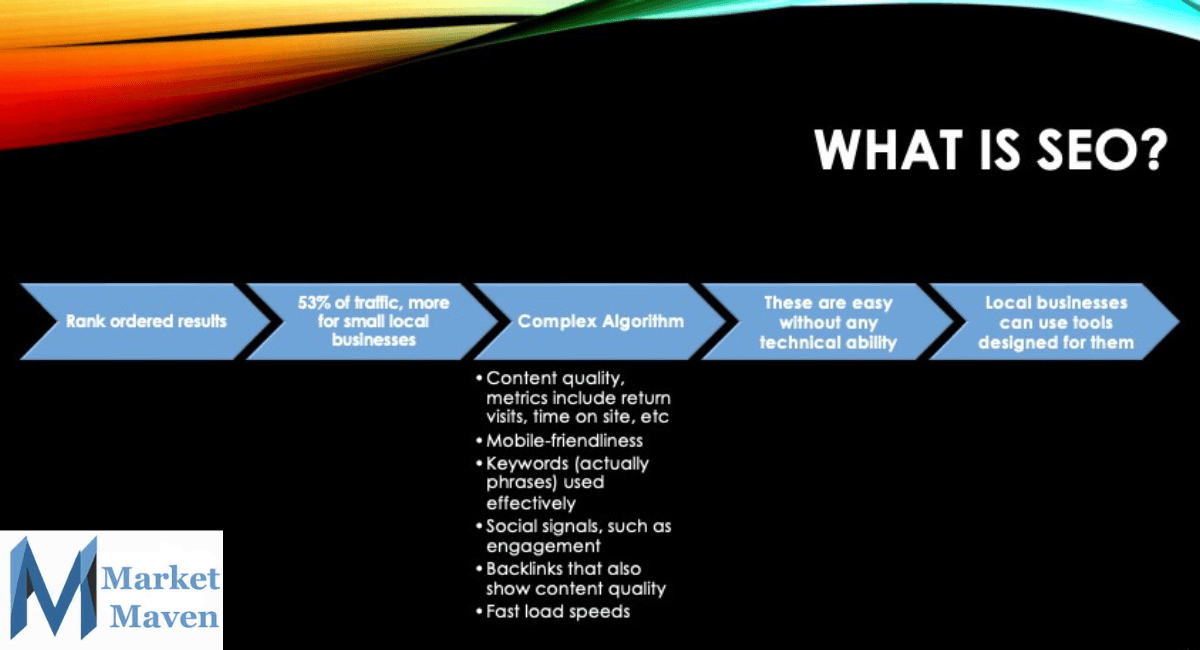
SEO involves creating content that ranks near the top when users search for businesses like yours or solutions to problems you can solve. As you know from your own browsing behavior, content ranking within the first few search results garners more clicks than links that rank lower because users assume high-ranking content is better. In fact, most clicks are to links within the top three positions. You can gain even more notice by using local SEO or creating shopping ads, which appear before other results on the page. Below you’ll find a definition of the various aspects of SEO that all feed into your rank:
- Local SEO involves targeting specific geographic markets with your marketing efforts. For instance, a local restaurant might highlight its location, rating, and menu (especially local dishes) by creating content related to an area.
- Technical SEO relates to the more technical aspects of your website. For instance, your domain age, speed, uptime stats, and schema markup. Submitting your sitemap to search engines is a basic process within technical SEO.
- Off-page SEO refers to actions taken outside your website, such as social media engagement, number and quality of your backlinks, customer ratings and reviews, influencer outreach, and podcasts.
- On-page SEO is achieved by using keywords (actually phrases) that represent a large number of searches and low competition that match your market. Using the keywords effectively as headlines, image alt titles, in meta descriptions, and embedded within your content makes you a digital marketing rockstar.
3. Social media marketing
Using social media to market your business is very different from using it as an individual to connect with family and friends. Hence, you should create a business page/ profile as distinguished from your individual one. A business page allows more flexibility in your social media efforts, such as including hyperlinks in YouTube descriptions and using Meta advertising. By creating your business page, you also protect your brand by eliminating the potential for another person to steal your traffic or damage your brand by creating their own.
Choose one or two social media channels to start with, based on your goals, market, and ability. Then, add new channels as the social media landscape changes and your bandwidth increases. Each channel requires you to craft content differently, with different requirements, users, and norms. Video content represents a special challenge with requirements for equipment and editing, but it reflects greater awareness than many other content forms.
4. Email marketing
Email marketing is the best way to become a digital marketing rockstar because this tactic generates an ROI of 3500%. Which means, for every dollar you spend, you get $35- $40 back. As you can see in the graphic below, that’s the highest ROI of any marketing channel.

Email marketing isn’t a fast or easy way to generate revenue, however. First, you must build a subscriber list because you can’t buy or rent them any longer due to privacy laws in the US and most of the industrialized nations. Penalties for violating these laws are steep, so you want to avoid breaking them.
Next, you must send out personalized messages at the right time to engage your subscribers and get them to click on your links. That requires images, buttons, and landing pages.
5. Paid advertising
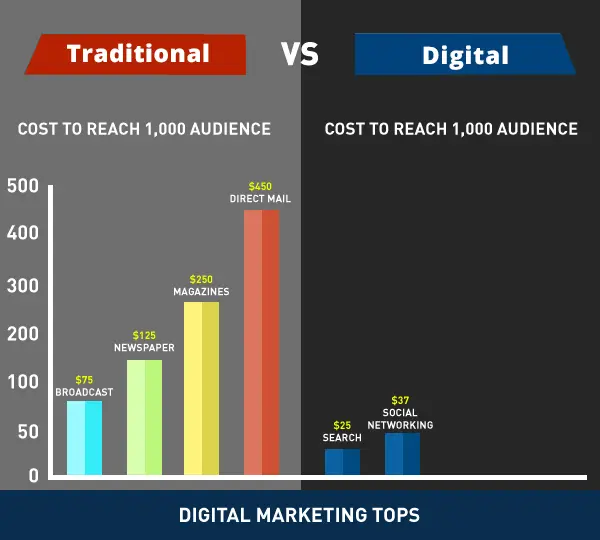
Using paid advertising, such as Google Ads and ads on social media platforms, can generate faster ROI than most other digital marketing strategies. However, unlike most other strategies, digital advertising relies on a budget. While other digital tactics necessitate spending money to hire staff and pay for tools, digital advertising is the only tactic that requires a dedicated budget to pay for transmission. The advantage of digital advertising is that costs are a pittance compared with the costs associated with other forms of advertising, as you can see below.
6. Influencer and user-generated content (UGC)
Consumers are much more likely to make a purchase based on input from other consumers because they see these recommendations as impartial (even though they might actually be motivated by a brand). This type of peer-to-peer influence works even when the recommendation involves a tacit endorsement (such as wearing a brand in a shared image) or when we have no relationship with the consumer. If you’re old enough to remember the old days when renting a movie involved a visit to Blockbuster, you may recall how casual comments made by other customers as you searched for something to rent on a Friday night impacted your choice. We call this social proof, and it also impacts purchase decisions when a peer posts a testimonial or review of a product.
Of course, you don’t have to leave it to chance that customers will leave a review or recommend your brand. Influencers are individuals with a highly engaged audience and are generally compensated (monetarily or with free stuff) for their efforts. UGC is often solicited from customers through emails requesting a review or a brief note contained in the customer’s shipment, which includes a QR code for easy feedback submission. You might host a contest to award a prize based on a drawing from all the users who post an image of your product on social media. You might also consider providing coupons for customers to share with their friends or offering free samples sent to those who provide their personal information in response to a customer’s solicitation.
7. Analytics and conversion optimization
Data-driven decision-making helps you to become a digital marketing rockstar. Use tools like Google’s GA4 (to monitor website, Google Ads, and your Play Store data), data provided by various digital platforms (social media), and the tools you use to manage your digital marketing (email marketing providers, marketing automation tools, and SEO platforms). Bring all this data into a single dashboard and display data as visualizations to make interpretation easier.

But don’t stop there. Explore your data with tools like heatmaps (which display sections of a page that attract more attention), UTM tags added to your URL for tracking clicks to distinguish between campaigns and channels, such as social media campaigns, ad campaigns, and email messages (Google provides a tool to help with this task), and A/B testing (it’s actually possible to use multivariate testing with modern tools).
Armed with this information, you can optimize your conversion to become a true digital marketing rockstar. You can use data to optimize:
- landing pages by testing different images, calls-to-action, button colors, offers, and headlines
- user flow through your website
- ad content, most platforms, like Meta and Google, enable automatic multivariate testing that quickly optimizes your ads or offers suggestions to make them better
- marketing spend by investing in only those tactics and campaigns resulting in the highest ROI
- your target market segments and your results across different target marketing groups to tweak your campaigns
- personalization
- SEO
You can also use insights to forecast demand and revenue and improve your understanding of customers and their journeys.
How to become a digital marketing rockstar in 60 days
Below, you can see an action plan to guide you along your journey to becoming a digital marketing rockstar. If you follow this plan, you’ll find your conversion rate and revenue growing.
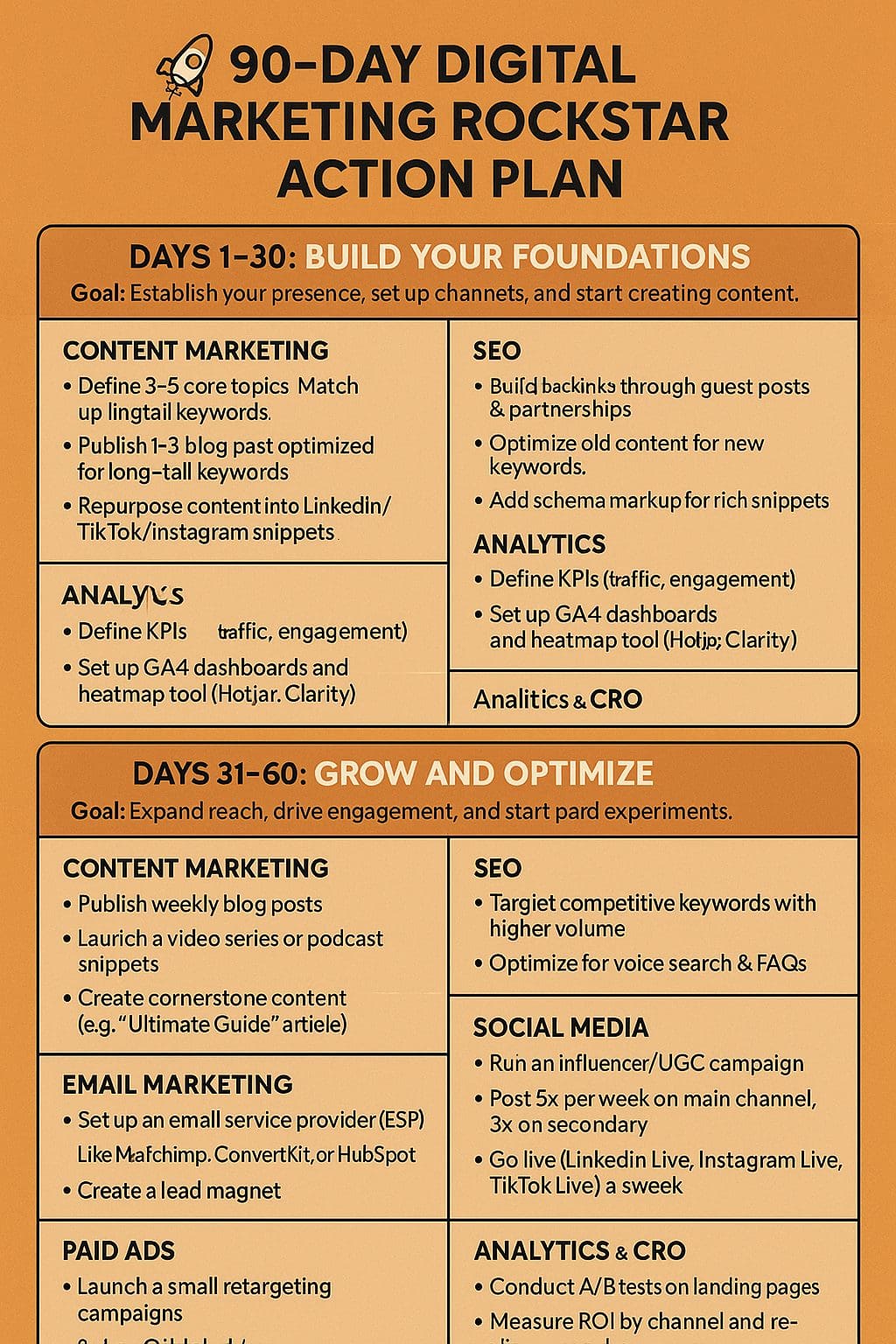
On days 61-90, here’s an outline of your strategy:
Goal: Amplify your best channels, build authority, and generate consistent leads.
- Content marketing
- Launch a content cluster strategy (interlinked articles around one theme).
- Repurpose your best blog post into an eBook or webinar.
- SEO
- Target competitive keywords with higher volume.
- Optimize for voice search & FAQs.
- Social media
- Run an influencer/UGC campaign.
- Post 5x per week on your main channel, 3x on secondary.
- Go live (LinkedIn Live, Instagram Live, TikTok Live) once a week.
- Email marketing
- Build an automated sales funnel (educational emails → case studies → CTA).
- Offer exclusive content or early access to increase retention.
- Paid ads
- Scale retargeting campaigns.
- Launch lookalike audiences on Facebook/Instagram.
- Expand Google Ads to 3–5 keywords.
- Analytics & CRO
- Conduct A/B tests on landing pages.
- Measure ROI by channel and reallocate budget.
- Build a simple monthly report to track progress.
Conclusion
Most digital marketing strategies take time to bear fruit. It takes time to build authority, generate a community, and create enough content to rank well. Plus, it takes time to learn new tools, get into a routine, and develop the right processes to become a digital marketing rockstar. Likely the first place you’ll see the results of your efforts is in your digital advertising and in achieving small goals, such as engagement. However, you should see a general improvement in your KPIs from week to week, month to month, as your plan starts to generate returns.
Give yourself the entire 90 days (and likely a little more) before you consider making a drastic change to your plan. During that time, use metrics and the insights they provide to make tweaks to improve your performance.
Need marketing help to support business growth?
We welcome the opportunity to show you how we can make your marketing SIZZLE with our data-driven, results-oriented marketing strategies. Sign up for our FREE newsletter, get our FREE guide to creating an awesome website, or contact us for more information on hiring us.
Hausman and Associates, the publisher of MKT Maven, is a full-service marketing agency operating at the intersection of marketing and digital media. Check out our full range of services.
Discover more from MKT Maven
Subscribe to get the latest posts sent to your email.


