 logo

Have you ever heard the term demand generation? Well, if you’re still relying on discounts to fill your coffers this holiday season, you’re not optimizing your revenue. Slashing prices this holiday season feels like the easiest way to compete with big-box giants—until you look at your January bank balance and realize you gave away all your margins for one-time shoppers who will never return. If you’re tired of running a discount race to the bottom, there is a smarter way to pack your storefront or fully book your calendar before Cyber Week even starts.
Read on to learn how demand generation can not only generate more revenue this holiday, but also all year long. In fact, implementing demand generation today will consistently improve performance over time. Be sure to read until the end of this post for your holiday demand generation checklist (downloadable with email signup – use the popup or scroll to the bottom to subscribe).
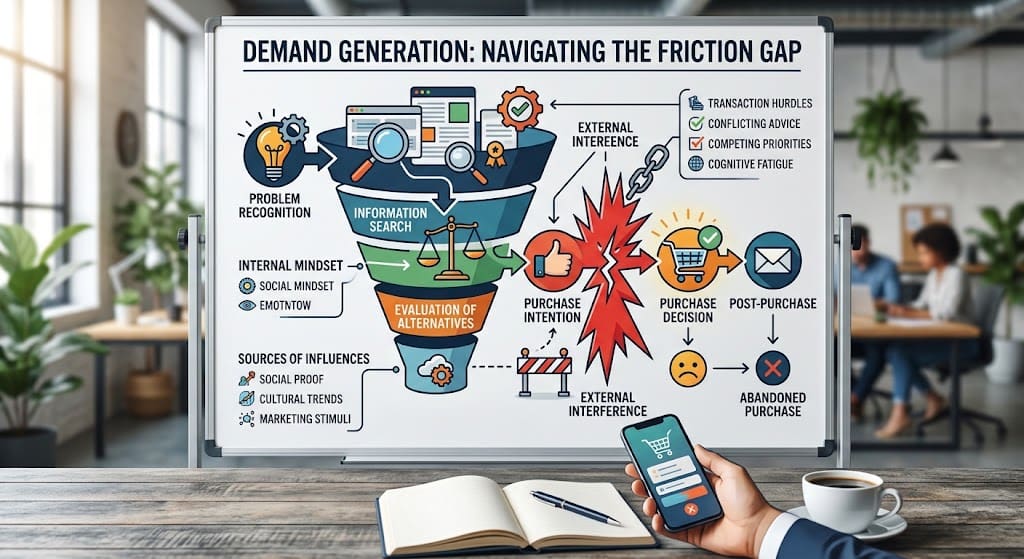
Table of Contents
What is demand generation?
About a month ago, I published a post entitled “The Marketing Mind,” where I outlined how brands can use their understanding of the consumer decision-making process to optimize market performance. You should read that post first to help you build on the concept of demand generation to optimize your revenue. This isn’t a new concept, although I prefer to picture demand generation in terms of the customer journey that consumers employ when searching for products, which goes into hyperdrive in just a few weeks with the approach of “Black Friday” and “Cyber Monday”, let alone the entire feeding frenzy that drives holiday shopping.
 If you rely on trying to outshout the big brands using promotions that read like this:
- 20% off, this week only
- Last-minute blowout
- Only 10 days until Christmas
you’re missing the boat. Every brand is filling users’ social feeds, SMS (short message service), inboxes, and airwaves with similar messaging. You need to do something to help you stand out against the millions of dollars spent by your competition to steal your sales with their incessant promotions. Trying to offer better discounts is a race to the bottom, which is nearly always won by the brand with the deepest pockets.
In contrast, demand generation:
builds brand awareness, educates potential customers, and ultimately motivates them to interact
with a brand
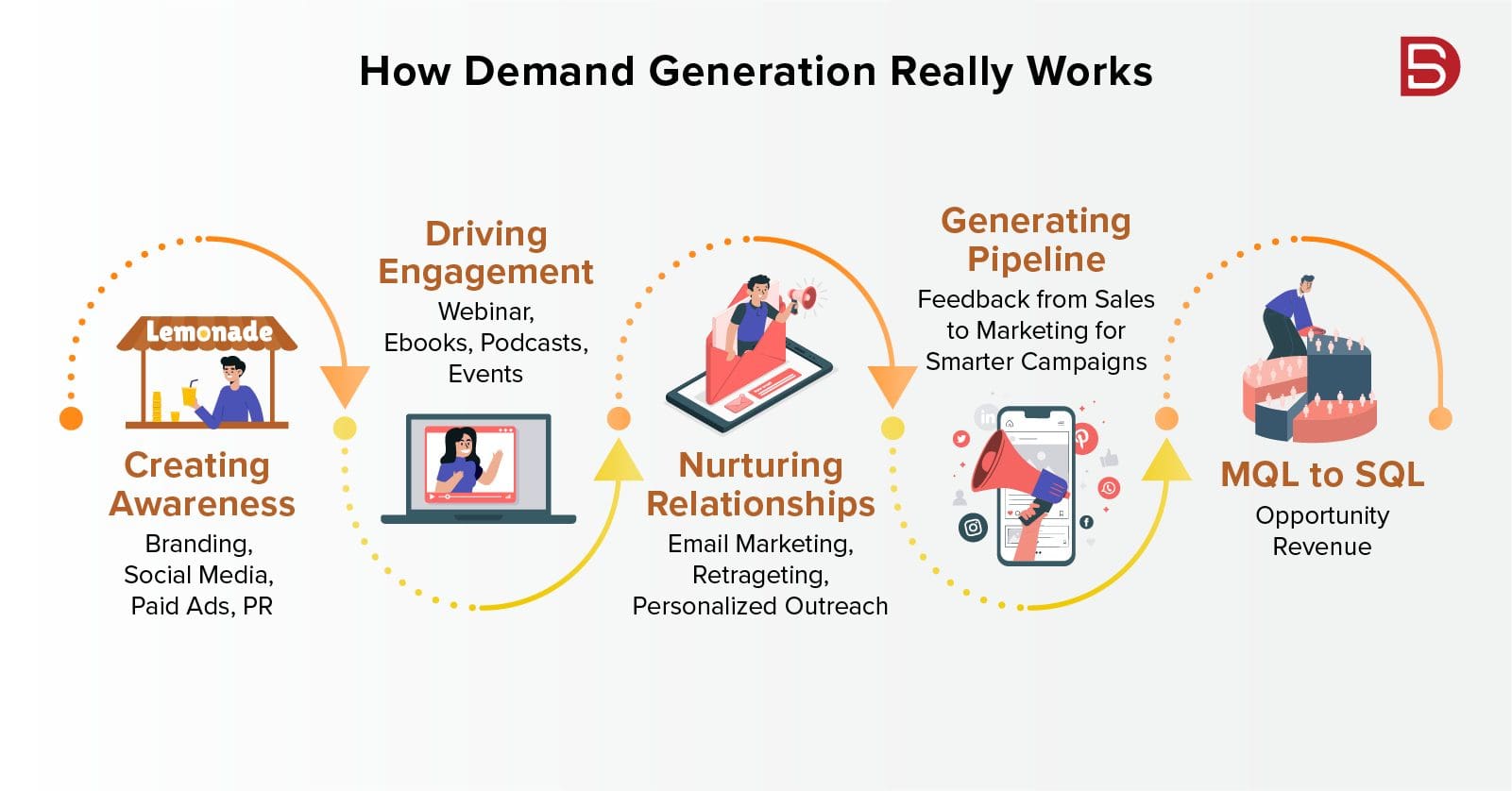
The demand generation process relies on five tactics to increase revenue:
- Brand awareness and education so that likely buyers know about your brand, its key benefits, and what makes it a highly suitable solution to their problems (consumers buy solutions, not products; ie., they don’t buy a hammer to own one, but to drive a nail into some suitable material). Becoming a trusted provider that cares about the consumer builds a brand that consumers want to buy from again and again.
- Lead generation that creates curiosity to encourage customers to learn more about your brand and its products
- Lead nurturing, which relies on tactics designed to enhance brand image and interest, such as email marketing, free trials, sampling, or fresh motivational content.
- Conversion is the last step in the process, resulting in revenue for your business and solutions for consumers.
- Analytics helps you improve performance over time by tracking the right metrics to help you improve performance.
By implementing demand generation strategies today, you’ll find a warm audience ahead of the holiday rush, resulting in holiday offers that deliver dramatically higher results come January.
4 demand generation tactics for this holiday season
Here are four strategies that will build demand ahead of the holiday season:
- Build solution-oriented holiday gift guides
- Build trust with social proof and content
- Focus on local partnerships with non-competing brands and build micro-communities
- Prime demand by offering teasers and “early access” to upcoming sales info
1. Solution-oriented gift guides
You already know the reality that consumers buy solutions, not products. Well, during the holidays, those solutions are for a loved one, a gift exchange, or to recognize a service provider, which makes the challenge especially hard. Deciding on the perfect gift for everyone on your shopping list, remembering the wrapping accessories, decorations, and getting them delivered in time for giving makes this season one of the most stressful times of the year. And it’s not just the gifts. It’s the new clothes, food, and travel required to truly enjoy the sparkle of the holiday.

Why not drive demand generation and make it easier for consumers at the same time by putting together a gift guide, especially a themed gift guide? Your gift guide might feature products related to the hobbies and interests of those folks on your list. For instance, a fishing guide stuffed with lots of rods, reels, hooks, and bait to stimulate demand generation, while interesting buyers with stories of “the one that got away” or “best fishing holes in Mississippi”. Or maybe a gift guide featuring products under $25, for those pesky gift exchanges at work made more challenging by knowing little about the outside interests of your coworkers.
Distribute the guides wherever folks will see them. Share on social media, in online newsletters, and on your website. Include hyperlinks and QR codes to make holiday shopping easier.
2. Build trust with social proof and content
The holidays involve a myriad of choices outside the consumer’s normal buying patterns. They might not know which brands are best or which features are most valued by users. Creating content to help them navigate these choices will help with demand generation, as well as encourage them to share your insights with other consumers. You can then build on this goodwill to engender the trust needed to break your buyer out of preconceived notions about which brands are suitable, so they’ll give you a try. The information might also help them decide which products are right for their friends and family. By demonstrating social proof with your valuable content, consumers trust you.
There are lots of ways your content can create value for your target market. Here are a few:
- Create a short video demonstrating how to use one of your products
- You might include ways to pair your clothing with the right accessories in your social posts
- Offer solutions to common problems, such as tired feet, stress, and meals in minutes to make the holidays a little easier
- Give customers ideas for wrapping presents
3. Focus on local partnerships and micro-communities
When it comes to demand generation, there’s no rule that you have to go it alone. In fact, building a community of influencers or collaborating with non-competing businesses is a great way to increase your reach and encourage buyers. For instance, you might collaborate with a few other businesses in your area to put together a shared deal, such as a dinner (at your restaurant) and a movie (at the local theater). Bundling these together in a gift card or a self-gift as a reward for all your hard work over the holidays works great for both businesses. Or a local grocery store and a liquor store might similarly collaborate for a nice, home-cooked meal.
Another option is putting together a local treasure hunt or a shopping trail where shoppers can go from store to store hunting for special deals. Or how about hosting a holiday event with local businesses, such as a snowball fight or a cookie swap.
The key to success for this type of demand generation is to heavily promote the event on multiple communication channels among participating businesses. And don’t forget to share photos after the event to show people how much fun it was and encourage them to attend the event next year.
4. Prime demand by offering teasers and “early access”
FOMO, or fear of missing out, is a strong motivator for consumer buying. Sharing photos of the event that consumers missed will encourage them to attend the next event, thereby amplifying your efforts from point 3.
You can also build anticipation with sneak peeks and teasers that whet a consumer’s appetite for an event. This is called demand priming and it’s an important part of demand generation. Don’t overuse the technique, however. Attempting to use it too much or being heavy-handed in the application can “kill the golden goose”.

For instance, if you’re old enough, you might remember the anticipation for Black Friday. Even folks who didn’t normally get the paper (when it was still physical) got all those ads delivered on Thanksgiving Day. The stores were all closed, and we would pore over the ads, developing the optimal strategy by ranking which stores were most important to visit early before the sales expired or the inventory was all sold out. No one does that anymore because stores kept pushing up their opening times, even offering items before Thanksgiving. The effort to capture the lion’s share of the consumers’ wallets destroyed the marketing advantage of the Black Friday/ Cyber Monday sales.
A timeline for implementing demand generation
| Phase | Window | Focus for Local Retail & Service | Primary Channels |
| Phase 1: Seed & Educate | Late Oct – Early Nov | Publish gift guides, styling/care tips, launch appointment pre-booking | Google Business Profile, Instagram Reels, In-store signage |
| Phase 2: Build Momentum | Mid-November | Host VIP preview nights, announce collaborative local bundles | Email list, Local community forums, Direct mail |
| Phase 3: Capture & Serve | Small Business Saturday – Mid-Dec | Emphasize grab-and-go gifts, physical gift card stations, express shopping hours | Curbside sandwich boards, Window merchandising, SMS alerts |
| Phase 4: January Retention | Late Dec – January | Bounce-back vouchers (e.g., “$15 toward January visits”), care tips for gifted items | Bag stuffers, Post-visit follow-up emails |
Your holiday demand generation checklist
For Local Retailers, Salons, Spas & Neighborhood Services
Phase 1: October 15 – November 7 | Foundation, Seeding & Pre-Booking
- [ ] Audit Local Search & Profile Assets
- Update Google Business Profile holiday hours, appointment links, and service menus.
- Upload fresh, high-res photos of storefront merchandising, gift stations, or treatment rooms.
- [ ] Map 3–4 “Solution-First” Themed Guides
- Retail: Assemble products into grab-and-go bundles (“Host Gifts Under $35,” “Locally Crafted Stocking Stuffers”).
- Services: Create packaged experiences (“Post-Holiday Reset,” “Express Event Styling Duo”).
- [ ] Launch the Service “Early Bird” Booking Window
- Email your client list announcing open calendar slots for Thanksgiving and December.
- Frame it around peace of mind: “Lock in your holiday appointments before prime weekend slots fill.”
- [ ] Finalize Cross-Promotions with Main Street Neighbors
- Partner with 2–3 non-competing storefronts (e.g., boutique + coffee shop + salon).
- Agree on shared terms: collaborative neighborhood gift basket, joint punch-card trail, or shared social tags.
Phase 2: November 8 – November 25 | Anticipation & Main Street Foot Traffic
- [ ] Distribute Ungated Educational Tips
- Publish 2–3 short video tips/posts answering holiday prep dilemmas (e.g., winter skincare, party outfit styling, table setting).
- Post updates directly to Google Updates and neighborhood Facebook/Nextdoor groups without email gates.
- [ ] Host an Exclusive VIP “Sip & Shop” or Preview Window
- Hold a 2-hour evening event for top customers with light refreshments and first access to holiday bundles.
- [ ] Merchandise Physical Gift Card Stations
- Set up a dedicated grab-and-go register station with pre-packaged gift cards, decorative sleeves, and tissue wrap.
- [ ] Prepare Storefront Visual Cues
- Deploy sidewalk A-frame boards highlighting your zero-stress solutions (“Turnkey Host Gifts Inside” / “Skip the Shipping Delays”).
Phase 3: November 26 – December 18 | Demand Capture & Express Buying
- [ ] Lead Small Business Saturday with Experience, Not Discounts
- Offer complimentary gift-wrapping, local cider, or a gift-with-purchase instead of margin-eroding price cuts.
- [ ] Publish Daily “Gift Dilemma of the Day” Spotlights
- Feature one specific recipient problem each day across social channels (“Day 3: What to get your neighbor”).
- [ ] Announce Safe Shipping & Local Pickup Deadlines
- Post clear cutoff dates for custom orders, phone hold requests, and curbside pickups.
- [ ] Insert Bounce-Back Retainers in Every Shopping Bag
- Place a physical voucher in every customer bag (e.g., “$15 credit toward any booking or purchase during January 10–31”).
Phase 4: December 19 – January 15 | Last-Minute Sprints & Retention
- [ ] Target Last-Minute Procrastinators (Dec 19–24)
- Promote digital, instantly printable gift certificates for service businesses.
- Highlight ready-to-hand-over boxed retail sets for zero-friction last-minute buying.
- [ ] Send Post-Gifting Care & Styling Notes (Dec 26–31)
- Email follow-up care instructions for seasonal products, materials, or newly gifted service packages.
- [ ] Activate the January Lull Campaign (Jan 1–15)
- Send targeted email and SMS reminders to redeem holiday bounce-back vouchers before month’s end.
Conclusion
Demand generation forces you to rethink your approach to the holiday season. Instead of engaging in your normal race to the bottom by cutting prices, consider ways to stimulate demand with tools like gift guides, generating valuable content that builds trust, offering viable solutions to gift occasions, and whetting consumer appetites with a sneak peek.
Need marketing help to support business growth?
We welcome the opportunity to show you how we can make your marketing SIZZLE with our data-driven, results-oriented marketing strategies. Sign up for our FREE newsletter, get our FREE guide to creating an awesome website, or contact us for more information on hiring us.
Hausman and Associates, the publisher of MKT Maven, is a full-service marketing agency operating at the intersection of marketing and digital media. Check out our affordable coaching programs to help your business thrive into the future.
Discover more from MKT Maven
Subscribe to get the latest posts sent to your email.


