 logo


Take a good look at the graphic above, courtesy of Adobe. In it, you see that data translates into value, such as improved ROI, but only when viewed through the lens of using better analytics to generate better insights that you translate into action. So, what are the keys to developing better analytics that produce ROI? Read on to find out.
Keys to better analytics
Key #1 to better analytics: building insights from unstructured data
The #1 key to better analytics is deriving insights from the data. But data is just a bunch of numbers, words, and images. And we produce tons of it every year. In fact, we produce 2.5 quintillion bytes of information per day, on average. To put that in perspective, 90% of the data in existence in the world today was produced in the last 2 years, according to IBM.
Most of that data is unstructured, meaning it is something other than numbers: it’s in the form of images, words, and video. With the rise of video marketing, both long-form on YouTube and short-form on Instagram Reels and TikTok, that proportion is shifting in favor of more unstructured data. Add to that the popularity of podcasts and image social media, like Pinterest, and the amount of hard-to-analyze unstructured data is exploding. The analysis of unstructured data is particularly difficult even in the age of artificial intelligence. Natural language processing is helping to corral some of this data to generate better analysis that can lead to actionable insights, but the challenge is still massive..
Turning massive amounts of data, Big Data, into insights requires a process involving organizing or reporting and better analytic tools to generate meaningful insights. Hence, data is useless unless you can accurately and validly transform that data into insights. Otherwise, data is a cost rather than a benefit: as it costs money to collect and store data.
Take a look at this graphic to see a deeper investigation into better analytics by improving the way data is processed to produce meaningful, actionable insights that translate into improved market performance.

Key #2 to better analytics: Combining data with concepts
But data shouldn’t be analyzed in a vacuum. You need to incorporate data with existing knowledge structures to both guide the analyst on what metrics are important and to formulate actions from the data. Without subject matter experts involved in the analysis process and controlling how analysis translates into actions, the firm won’t optimize performance despite better analytics. Better analytics MUST combine with experts who command the concepts to build actionable insights.
Let’s look at an example.
Say we have a ton of data from our e-commerce website. Here’s what an AdWords dashboard might look like viewed through Google’s Data Studio:
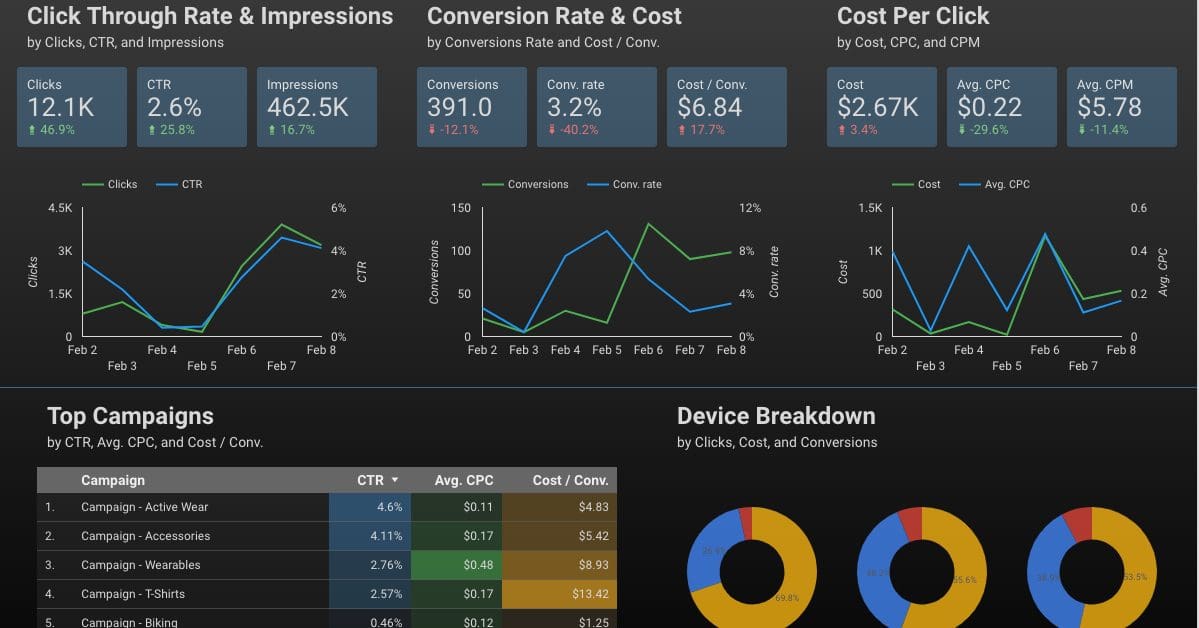
Data visualizations help us see more about what’s going on with our advertising campaign–something we’d never be able to do effectively by looking at columns of numbers.
We get valuable insights from this data, including the best days to run ads based on cost, conversion rate, and clicks, the best-performing ads, and devices used to view the ad. This is great information, but it’s not all that you’ll find if you combine this data with marketing concepts. Hidden within the short identifier of the ad for t-shirts is information about customer attitudes derived from marketing theory that can guide better ad creation. Knowing that a high-performing ad, for t-shirts, used humor, for instance, suggests that future ads might perform better if they use humor.
Keys #3 to better analytics: Using marketing concepts to create data gathering
You also need a good understanding of marketing concepts to construct tests that guide your data-gathering efforts. A good example is looking at user experience data. Without a clear understanding of how consumers move through the decision-making process or what factors impact this journey, it’s hard to know what data to investigate further or to build into your A/B testing.
For instance, understanding that purchases are guided by the theory of planned behavior (also called the theory of reasoned action), which seeks to understand why people buy products as a function of norms and other factors when used with data, helps in constructing advertising campaigns or developing other marketing strategies. Using the theory of planned behavior, a researcher might construct an A/B test involving previously identified social norms, then use data to see which drives purchases more strongly. Without knowing the theory, analysts wouldn’t even know to look at normative beliefs.
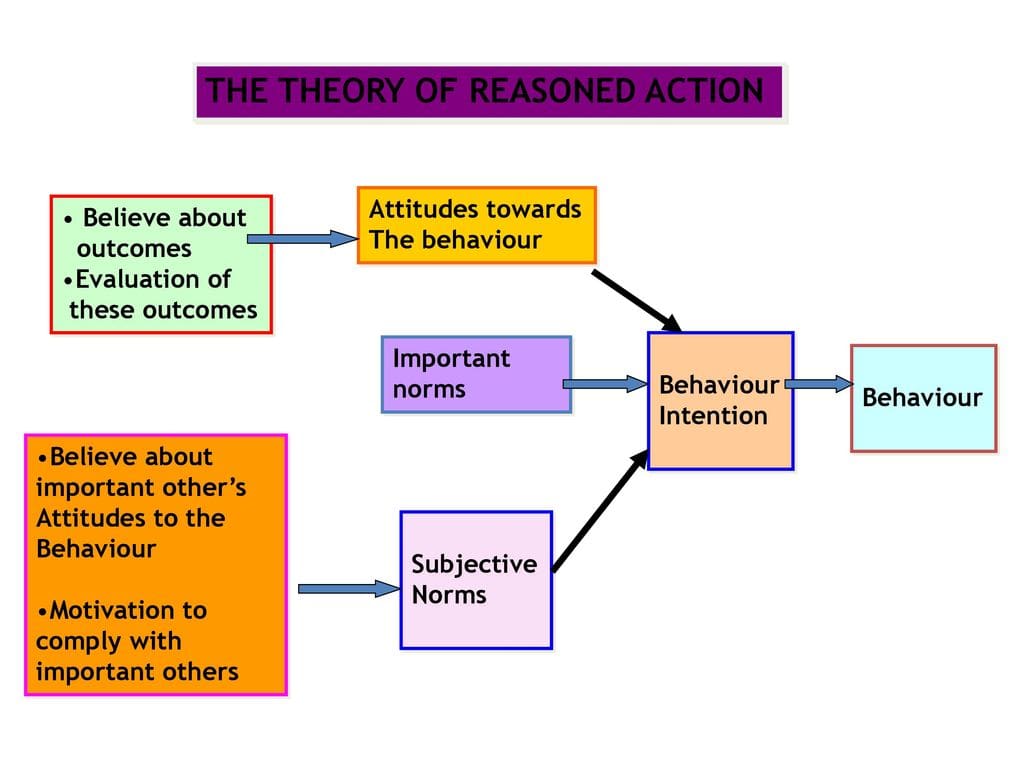
Constructing predictive algorithms also relies on an understanding of consumer theory. Without guidance from theory, you’re handing big data blindly, and you’ll likely run into a bunch of spurious correlations, which a new book from Harvard Business School highlights as both dangerous and ubiquitous.
Keys to analytics #4: Ignoring qualitative data
All those fancy charts and pictographs and pretty images are very cool, providing an assurance of reality that they might not possess. Play a few tricks with the scale and transform a few data points and you’ve got lies masquerading as truth. We see it all the time. That’s what’s behind the old saying that there are lies, damn lies, and statistics.
A bigger problem is that those columns of numbers ignore up to 80% of the problem, according to the data from IBM we presented earlier. By unstructured data, we mean all those words, images, and videos that can’t be categorized through statistical analysis. Transforming this data into insights is currently one of the biggest data analysis problems out there, according to the IBM article linked above.
Because they can’t analyze unstructured data, analysts tend to discount its value. Which is a huge mistake. Unstructured data gives us important information about how people think, feel, and interact with products in their environment, interact with friends and family, and how influencers influence their decisions. They also share their problems, challenges, and aspirations, providing insights into unmet needs that offer great opportunities for successful innovation opportunities.
I have a friend working at Microsoft who found enough insights by analyzing criticisms of their recently introduced Surface computer, he was able to provide engineers with valuable guidance on improving the product within the first week after product release. That enabled Microsoft to speed an improved product to market and led to its dominance in the new market of tablets/laptops.
Keys to better analytics #5: Constant monitoring
It isn’t enough to have a great analytics program in place. You have to monitor performance on a continual basis. For some businesses, that means gathering, structuring, and analyzing data in real-time.
Take a look at the dashboard below. Here, analysts monitor performance in real-time during a NASCAR race, so they can tweak messaging or craft social media posts based on the freshest data coming in. During the race, analysts monitor performance constantly, which allows them to send high-performing social media posts, as well as adjust the broadcast to keep fans engaged with the race at every moment. If they notice a change in sentiment about a particular driver or sponsor, the team can adjust the broadcast to show more or less footage of that car, for instance. That’s how better analytics translates into actionable insights that improve performance.

Translating better analytics into action
To summarize, better analytics translates into better insights; insights that are actionable. You must still implement changes based on these insights into actions if you want to improve ROI. Sometimes that isn’t as easy as it sounds. Here are some common problems you might encounter on your journey toward implementing insights:
Disconnect between insights and action
Often, analytics teams are isolated from the teams charged with creating business strategy, such as managers and copywriters. They might not speak the same language, making it hard to communicate what changes might improve performance. Moreover, each team might trivialize the importance of the other team’s contribution, seeing the business intelligence team as a bunch of geeks with no grounding in the reality of what it takes to run the day-to-day marketing operation.
Organizational silos
We all experience the impact of organizational silos that interfere with integrating across them, although some companies seem to have the secret sauce that makes the silos disappear. For instance, marketing may suggest a change based on insights, while engineers only see interference with their operation or feel marketing doesn’t respect how challenging the change will be.
I once consulted with a firm where the engineers developed a new product based on improved engineering. Marketing and sales argued that customers wouldn’t see the improvement as worth the added cost. I conducted market research with their existing customer base. Results showed that no one wanted the product, which they saw as over-engineered. Instead of going with the insights I generated, engineering won the argument and the company sold the product. It never reached break-even.
Governance and approval
 Often, companies are huge bureaucracies. Even small businesses might experience this with the owner(s) holding control so tightly that progress is slowed to a crawl as they work through operational imperatives without the time needed for major shifts in strategy. By the time an anomaly is identified and presented to decision makers, the window of opportunity is gone. Or the decision is tabled for later discussion with a request for more information.
Don’t forget that many changes required to implement insights from better analytics require resources of time, money, or both. These are always in short supply. In businesses where budgets are fixed by the quarter or by the year, it may prove impossible to reallocate these scarce resources toward implementing insights.
Cultural inertia
Organizations are somewhat like living organisms, where change takes time (although faster than organisms adapt). You still find folks in organizations who prefer to run the business by the seat of their pants, rather than listening to data, insights, or other folks.
Some firms are also pretty risk-averse, especially ones that penalize failure instead of recognizing that trying and failing is often better than a slavish commitment to the status quo.
Conclusion
In today’s post, we not only identified five keys to using better analytics to develop better insights. But factors that interfere with transforming those insights into changes that improve firm performance. The keys are:
- Recognizing that most data is unstructured
- You must combine data with subject matter theory in order to derive insights
- Marketing theories, like the Theory of Planned Behavior help to provide actionable insights
- Combining qualitative data enriches quantitative analytics to provide better insights
- Constant monitoring, in some cases real-time monitoring is essential to building actionable insights
We also discussed factors that interfere with transforming better analytics and insights into actions that actually improve performance. Without this last step, the effort, time, and money spent on analytics and insight-building is wasted. To actually see these benefits, you must:
- Develop actionable insights, then share these insights using communication strategies that work across areas of expertise to argue for how and why changes will improve performance.
- Reduce silos so there’s less friction across departments and no ownership challenges.
- Reduce bureaucracy to help decisions move forward seamlessly. In fact, a bureaucratic structure is cumbersome in many ways and organizations should strive to be more nimble in all decision-making situations.
- Learn to accept that risk is part of a functional business. Failure is the process of learning that generates better performance. Adopt a culture of learning and relying on insights rather than your gut to run your business.
Need marketing help to support business growth?
We welcome the opportunity to show you how we can make your marketing SIZZLE with our data-driven, results-oriented marketing strategies. Sign up for our FREE newsletter, get our FREE guide to creating an awesome website, or contact us for more information on hiring us.
Hausman and Associates, the publisher of MKT Maven, is a full-service marketing agency operating at the intersection of marketing and digital media. Check out our affordable coaching programs to help your business thrive into the future.
Discover more from MKT Maven
Subscribe to get the latest posts sent to your email.


