 logo

Did the title of this post catch you by surprise? In a world where we seem to consistently strive for more (more wealth, more power, more customers, more, more, more), it seems weird to consider that less is really better sometimes than more. But only when you consider context, not just of having less but doing more with those limitations. Here are seven analytics caveats that show the wisdom of the notion that less is better.
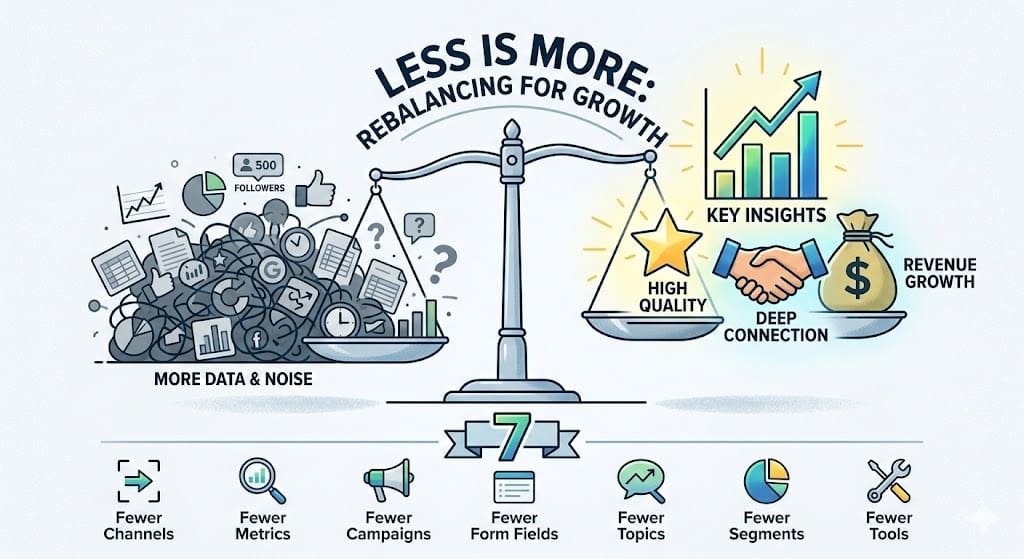
Analytics caveats
If you’re a modern marketing executive or run the marketing in your small business, you know you’re constantly bombarded with metrics and data. Attempting to make sense of the mountains of data that flow into your business every day from internal and external sources (see image below) is a full-time job for a virtual army of analysts. Hence, the notion that less is more and why we suggest seven analytics caveats to help you manage this river of data to develop meaningful insights that guide your decisions. In fact, Avinad Kashik, the evangelist from Google Analytics, recommends a maximum of 10 metrics to monitor your website.

Adding to the deluge of data available for analysis, not all data is meaningful. Some data is even false or misleading, at best. Buried under all this data, it’s easy to overlook danger signals until it’s too late.
In the long-run, it’s often better to focus on a few metrics as signals of your brand’s health, build insights based on these metrics, and make long-term decisions based on them, rather than become paralyzed in an effort to make sense out of data that comes at you fast, reflects various formats and sources, and may lack veracity. IBM talks about the 3 V’s of big data as velocity, volume, and variability that contribute to analysis problems. I’ve added the 4th V of veracity.
7 analytics caveats in digital marketing
Here are the 7 analytics caveats we’ll discuss in this post:
- Fewer metrics
- Fewer channels
- Fewer leads
- Fewer goals
- Fewer content topics
- Fewer target markets
- Fewer tools in your tech stack
Let’s discuss each of these analytics caveats to understand why less is often more.
1. Fewer metrics
Even if you’re practicing best practices by bringing data to an interactive dashboard and displaying metrics using the proper data visualizations, there’s no way to analyze 50 metrics on a daily basis. Splitting up the data analysis challenge among various analysts can make matters even worse, as it’s easy to overlook the big picture when each analyst only focuses on a small piece of the whole.

Creating interactive dashboards containing KPIs (key performance indicators) helps the situation somewhat, as it allows analysts to view the big picture, then partition the data in a way that digs down in a meaningful way. For instance, a product manager might want to view the performance of the products she manages, while a regional manager can view metrics for their region.
When you simplify your dashboards so they only contain the right metrics, displayed in the right way, you gain the insights necessary to guide decision-making that improves long-term and short-term performance.
2. Fewer channels
For some brands, success comes from being everywhere. For instance, Coke maintains its parity in the soft drink market by being in the most “points of thirst” with ubiquitous machines and availability in most physical locations where someone might get thirsty, such as gyms, sporting events, college buildings, etc. For most brands, especially those that gain appeal through their selective distribution, such as Rolex, you need a selective physical distribution strategy. If you want a refresher on how the availability of your products affects performance, I’ve written a post using product categories that shows how the distribution intensity should vary by product type.
The same thing goes when it comes to the marketing channels you use. You don’t need to be everywhere online or even in traditional marketing channels. You should be in the “right” channels based on the characteristics of your target market and the type of content you produce. It’s not simply a question of your bandwidth; it’s a reflection on your brand image. What is the image you want to portray of your product?
Below is an image that might help guide you when choosing the right digital channels for your native ads, paid advertising, and content marketing:
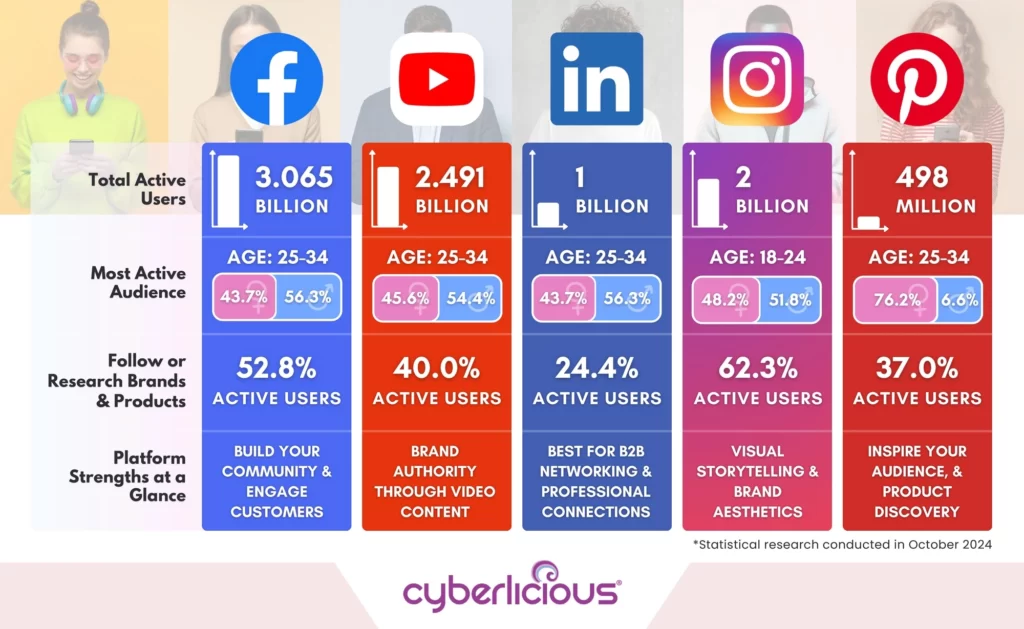
Analytics caveat #2 suggests you can build not only better insights by limiting the number of channels (physical and digital) you use, but also by being more thorough and strategic in building your strategy for creating and analyzing content.
3. Fewer leads
This probably sounds like bonkers advice. Obviously, you want as many leads as possible. Why would you want fewer leads?
For some of my clients, generating a lot of leads is their primary marketing goal. So, why am I arguing that fewer leads are better?
Because a lead is just a lead — nothing more, nothing less. What you really want are customers, right? Leads are only interesting in that they’re the first step down the conversion funnel to becoming customers. Increasing your conversion rate is preferable to generating more leads. The number of leads is a useless metric.
Moreover, if you generate too many leads, especially if they aren’t quality leads, you can’t effectively nurture those leads to help them become customers.
And, you really don’t care about customers, for that matter. What you care about is revenue. So fewer customers isn’t really a problem and shouldn’t be a goal. Your goal is to build higher revenue.
What you should be looking at is CLV (customer lifetime value) and doing yield management to maximize the CLV per customer. Here’s the formula for calculating CLV.

Adding high-CLV customers is much better than retaining existing low-CLV customers. Increasing customer CLV is preferable to adding new customers. You can track the CLV of customers through your website using GA4 (the newest Google Analytics platform). Then, determine the characteristics shared by these customers to build a pathway to attracting and converting more of them. You can also use strategies focused on high CLV customers to build incentive programs directed at them to reduce churn.
The entire sales process was turned on its ear by inbound marketing, which transfers power from the seller to the buyer. Buyers no longer have to reach out to you (becoming a lead) before they buy. If you’ve done it right, they have all the information they need right on your website or in your social feeds. They can go straight from strangers to customers with a single sales call without ever becoming a lead or generating incremental costs.
Isn’t that great!
4. Fewer goals
It’s important to have goals for your business. It’s even more important to have the right goals and to align them. Thus, our fourth analytics caveat is to keep your goals to those that help your business thrive in the long-run. Also, since KPIs are a function of your goals, having fewer goals means you can do a better job of monitoring, analyzing, and decision-making based on more focused metrics.
Having fewer goals also helps you stay focused on the things that truly matter for long-run growth. Having fewer goals means you waste less money on things that don’t contribute as much to your overall performance.
5. Fewer content topics
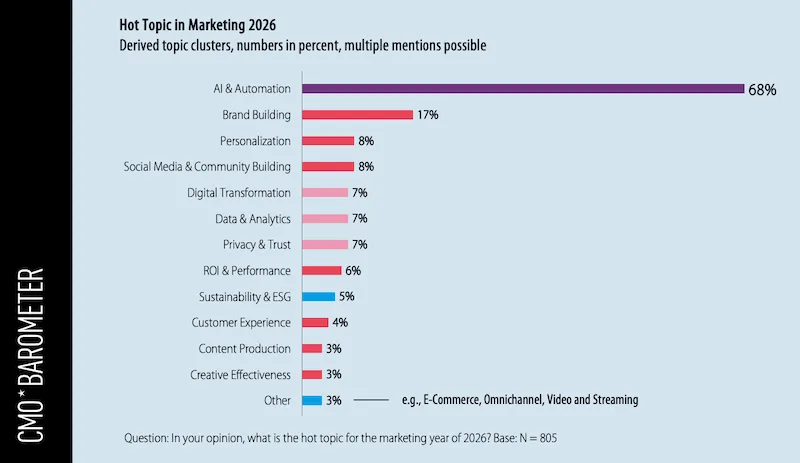
Your blog and social media posts are the lifeblood of your organic marketing strategy because it costs you nothing to transmit this content. That might lead you to believe that more content is better. Yet, that isn’t really the case, especially in a world dominated by AI search, either directly through an AI tool or by answer snippets that appear before organic search results. In this world, you must demonstrate expertise and authority to build trust, which is used by LLMs (large language models) to determine the content the model uses to build users’ answers. It’s hard to establish those characteristics when your content topics are all over the place.
Since I publish marketing articles, primarily focused on small business owners, I use something like the image above to determine my content topics. This image, built on recent surveys of CMOs (chief marketing officers), shows the top marketing topics they’re interested in. I create content on these topics to attract new customers to my coaching and digital marketing programs.
By focusing on fewer topics, you not only develop authority and trust, but you can also dig into the topic to produce content that’s high quality and provides value to your community. As an analytics caveat, fewer topics also allow you to dig into what types of content perform best with your target market.
6. Fewer target markets
This is the next in our discussion of analytics caveats. Almost no brand survives by trying to be everything to everyone. Instead, you should choose a target market or markets that match your products, brand image, and goals. Use data about your customers and data from outside sources, such as visitors and followers, to construct a market persona (such as those shown in the image below) to represent each group of consumers attracted to your product.

By constructing your primary and secondary personas, you’re now positioned to create personalized content and strategies that will appeal to them rather than waste resources and confuse your target market by including messages that might appeal to a broader market, such as those represented by anti-personas.
Personalization is the name of the game in marketing today. Consumers expect messages, products, and campaigns designed for who they are, where they are in the decision-making process, and what’s important to them. Nothing says I don’t care about you better than sending a message about a product you already bought from the company. But sending a message reminding a consumer about a product left in their shopping cart, along with an incentive to complete the order, makes a big difference.
The notion of personalization is never more salient than when it comes to products. Crafting products that offer something for everyone is often either too expensive, too complicated, or doesn’t fit the distinct needs of your target market well.
Since most brands can only effectively manage personalization well if they have a few personas, with individuals in each persona at different stages of the buying process, less is more.
Focusing on a few ideal customer types allows you to build products that are tailored for their needs, while controlling your marketing spend to generate a higher ROI.
7. Fewer tools
I’m really a fan of using as few tools as possible to get the job done — preferably 1 tool.
This is a great example of where less is really better. Too many tools result in a lack of coordination, duplication of efforts, and confusion. It also makes analytics a nightmare, hence this is one of our analytics caveats. Having one tool to manage SEO, another for email marketing, another for CRM (customer relationship management) and so on results in inefficiencies and silos that confound interpretation, let alone challenges in creating dashboards from data collected in different formats, different scales, and without a key to bring it all together.
I once consulted with a company that had the same product sold through 4 or 5 different companies. Each had its own website and social media. It was a nightmare just to keep everything straight. Instead, I recommended having a single website with different pages for different target markets rather than different companies and websites.
Conclusion
It’s common practice to assume that more is better. I don’t agree. Throwing money at a problem doesn’t always fix it and may make it worse. Instead, you should be throwing smarts at a problem — figure out what it takes to get where you REALLY want to be, the figuring out what it’ll take you to get there.
I know we didn’t cover all the analytics caveats, but we have limited space. If you think of one or found one in the opening image you found especially interesting, I’m happy to create another post on the topic of analytics caveats in the future. Simply enter your comments below.
In many cases, less is really better. If nothing else, it forces you to use resources wisely.
Need marketing help to support business growth?
We welcome the opportunity to show you how we can make your marketing SIZZLE with our data-driven, results-oriented marketing strategies. Sign up for our FREE newsletter, get our FREE guide to creating an awesome website, or contact us for more information on hiring us.
Hausman and Associates, the publisher of MKT Maven, is a full-service marketing agency operating at the intersection of marketing and digital media. Check out our affordable coaching programs to help your business thrive into the future.
Discover more from MKT Maven
Subscribe to get the latest posts sent to your email.


