 logo

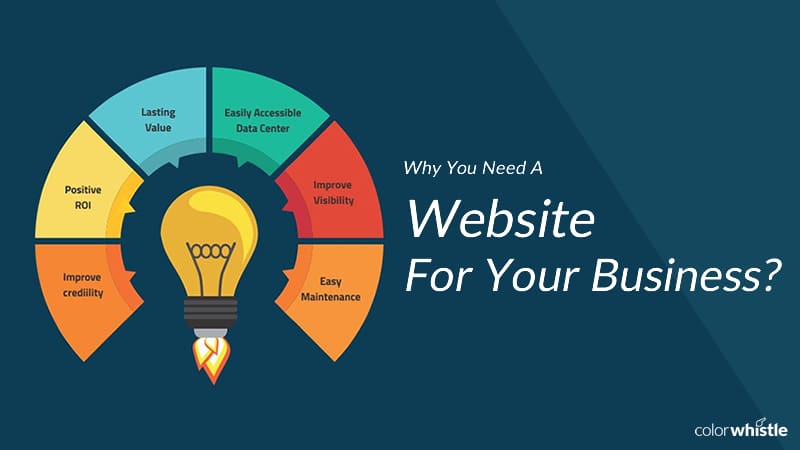
Are you making any of these common website mistakes? As a small business, you may be one of the nearly 30% that don’t even have a website in the first place, or one of the many websites that find the traffic visiting their website isn’t sufficient to meet revenue goals. Maybe you think building a website isn’t necessary in your industry, or you’re concerned about the cost of building and running a website, or maybe you think that social media platforms are enough to reach your revenue goals. Hopefully, this blog post will dissuade you from this negative attitude towards a website and help you create one that propels you towards success.

Did you know that, on average, 81% of consumers do online research before buying a product, with younger consumers most likely to start their purchase online. The image above shows the percentage of product searches that begin online by product category. Does this surprise you?
Moreover, about 77% of these searches are conducted on mobile devices. And a staggering 59% of shoppers use their mobile devices in-store to compare prices, research deals, or access coupons. Making any of these common website mistakes means you’re losing out on opportunities to convert these customers who start by searching online.
Table of Contents
Table of Contents
Shocking website mistakes
As these statistics indicate, a website is no longer just a nice extra. You need a website because it is often the first interaction you have with the potential customer. It acts as your digital storefront, working 24 hours a day, seven days a week, without taking a day off, to promote your brand to potential customers. Making any of these shocking website mistakes frustrates visitors who might have become customers, either online or in-store, and sends them straight to your competitors. The good news is that you can easily fix these website mistakes so you can capitalize on customers who explore online before making a purchase.
Here are seven shocking website mistakes that could be costing you customers right now, along with actionable steps on how to fix them.

1. Not having a website or having a poor website
If you’re one of the nearly 30% of small business owners without a website, your first step is to build a website. Luckily, by reading this post, you will avoid making website mistakes in the first place, resulting in an exceptional website that delivers profits for your business.
Building a website isn’t hard or expensive and you don’t even have to know how to code. The link in the paragraph above takes you to my how-to guide for building a website. It’s free and full of images that step you through the process, helping you create a new website quickly and inexpensively. However, avoid website builders such as Wix and Squarespace because they do not perform well in search results.
Because they have templates that are used by too many businesses, you end up with a website that looks just like everyone else. Another problem with these websites is that they don’t rank well in search results, so they don’t appear near the top. This means you have fewer prospective customers visiting your website, which translates into fewer opportunities to make a sale.
2. Offering a poor mobile experience
As mentioned earlier, 77% of product searches begin using a mobile device. With today’s connected consumers, you often see users watching TV, surfing the Internet on their mobile device, and texting with friends. If you don’t have a website that offers a great mobile experience, you’re missing out on most of the opportunity you have to sell products. It’s easy to build a website that offers a great mobile experience by choosing a responsive template (you’ll find most templates sold on sites like Themeforest are responsive). It also means that using images looks great on a mobile device.
Fixing this website mistake is easy. After choosing a responsive template to build your website, the next step is to test your design on real devices. Test using both Android and iOS devices, as well as tablets, to ensure that your website looks great and provides a great user experience.
3. The website loads slowly
Studies suggest that 40% of visitors will leave a website that takes more than three seconds to load, and that impatience for loading a page grows shorter every year. Are you making this website mistake?
Fixing this website mistake is a little more challenging and involves a little technical know-how. First, work towards optimizing your images, as large images take longer to load. Use a tool to compress and resize your images before uploading them to your website. Also, uploading images as PNGs will slow your website down. Instead, load images as JPEGs.
Next, consider upgrading your hosting company. Cheap coasting plans often mean using slow servers located offshore. This will slow your website down significantly. Before deciding on a hosting company, check them out to ensure they offer fast load times.
Minimize the number of plugins you have running on your site. Plugins are great for expanding your usability; however, they can bog your site down. If you check out my guide on building a website, you’ll find that I offer suggestions for a few plugins that you should add. Limit adding other plugins to your website. A website audit is a great way to analyze your website plugins and remove those that aren’t essential. In fact, some plugins will not work well with other plugins and actually damage the performance of your website beyond just slowing it down.
4. Ignoring SEO and GEO
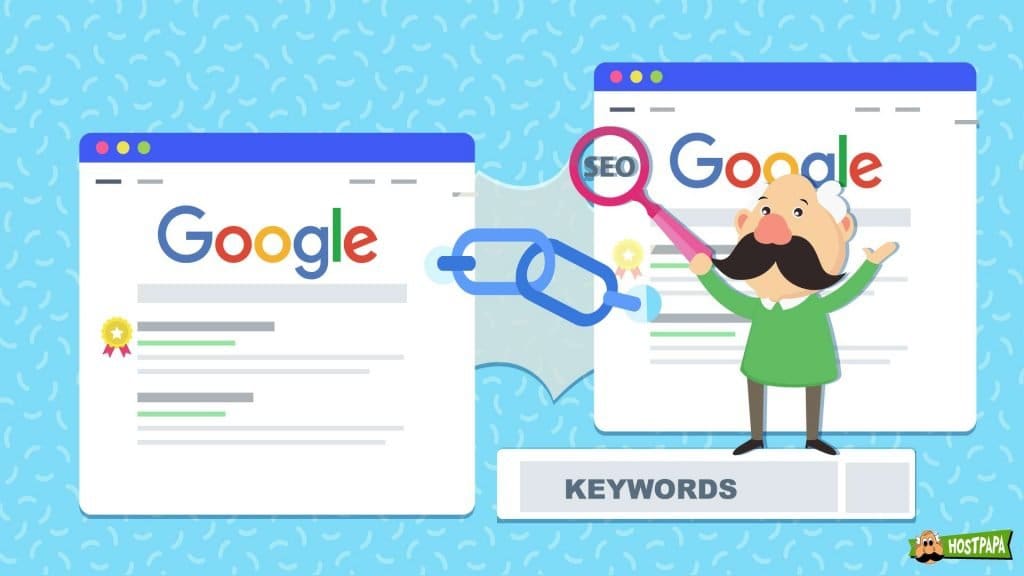
SEO, or search engine optimization, and GEO, or generative engine optimization, are key elements determining whether users find the beautiful website that you’ve built. Most of the traffic to your website comes from organic search (53%, compared with only 15% from social media ads). Showing up near the top of search results related to your business means you get most of this traffic (97% of the clicks in the search results go to the top ten in the list). Mastering SEO is your best shot at becoming one of these ten.
If you’ve done an Internet search recently, you know about answer snippets. These snippets appear before organic search results and offer answers to users’ questions that don’t require them to visit a website. This is Geo. Here, the goal is not to attract users to your website but to have your brand name mentioned in the answer snippet. This creates greater awareness for your brand and may drive users to then search out your website.
Fixing these website mistakes relies on performing tasks related to both SEO and Geo. For SEO, you’ll start by conducting keyword research to identify terms and phrases your target market likely uses when searching for businesses like yours. Next, you optimize on-page elements such as titles, meta descriptions, headings, and image alt text to match your keywords.
Create valuable content by writing informative answers to questions your target market might pose in order to show up in the answer snippets, as well as gain engagement and backlinks that improve your SEO. Using a schema, such as how-tos and tables of contents, will enhance your chances of appearing in these answer snippets.
5. Poor user experience
One of the biggest website mistakes you can make is providing a poor user experience. Rather than a monolith, poor user experience has many pieces to it. For instance, a slow load speed is one element that contributes to poor user experience. Another element of poor user experience is poor navigation on the website. It should be clear when a visitor enters your website exactly where they need to go to get the information they desire. That means using elements like menus and breadcrumbs to help them find anything they want on your website.
Since many users visit your website using a mobile device, think about the information that is most critical for them at that moment. Often, users on mobile devices are looking for information as they travel. That means offering an address and phone number that’s easy to find on the website is critical. Linking this information to a map or to a click-to-call will improve the user experience.
Cluttered pages filled with random fonts and colors are an outdated way to design a website. Today’s users want a user experience facilitated by a clean website design that isn’t weighed down by mountains of text. Employing a clear call-to-action, implemented via a colored button (buttons outperform links in your call-to-action), not only provides a good user experience, but also increases your conversion rate.
6. A cumbersome conversion process
Once you’ve convinced a visitor to make a purchase, one of the biggest website mistakes you can make is delivering them to a cumbersome conversion process. For instance, a buyer might want to make a purchase without creating an account. You should allow for guest purchases, recognizing that without signing in, the user will lose access to updates about this purchase. That should be the visitor’s decision.
Another mistake in the conversion process is to request too much information. Only ask for information that is necessary to complete the order and make the delivery. If you would like to convert that visitor in the future by collecting additional information, a follow-up e-mail is the best way to do so.
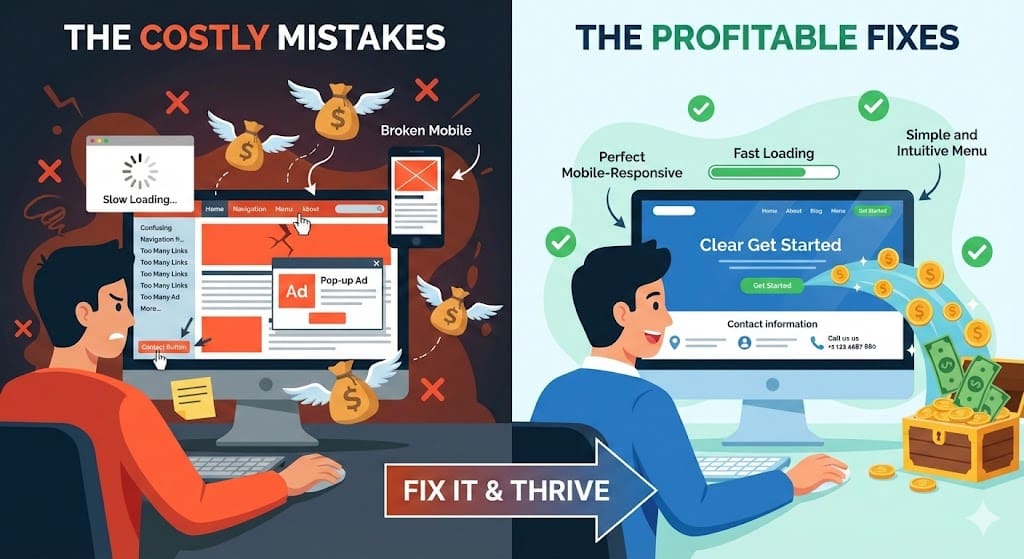
Pop-ups and ads are another thing that interferes with a good user experience. Use these sparingly or not at all. If you want to improve performance, an exit-intent pop-up that appears only when a user’s mouse indicates they’re leaving the page is the best tool. Also, you need a privacy notice to comply with rules in the EU and other parts of the world. Ensure pop-ups and ads are easy to dismiss on both a desktop and a mobile device.
7. Lack of trust signals
In an online world filled with scams, visitors are naturally skeptical. If your website doesn’t provide any evidence that you are a legitimate and credible business, they won’t feel comfortable giving you their money or personal information.
Fixing this website mistake requires you to collect testimonials, reviews, and share case studies from satisfied customers. If you can share anonymous results you achieved for other customers, you’ll go a long way towards helping visitors trust you.
You can also display trust badges, such as industry certificates and awards. For instance, I highlight my certification in Google Analytics as a way to build trust with my visitors that I can handle their business. Websites that employ an HTTPS protocol ensure that the data shared on the website, including financial information, is encrypted and secured.
Finally, you can humanize your brand by showing images and resumes or other accomplishments for yourself and your team to help visitors build a personal, trusting relationship with you.
Conclusion
Your website isn’t a “set it and forget it” project; it’s an ongoing investment in your business’s growth. By identifying and fixing these common website mistakes, you can transform your site from a leaky bucket that loses customers into a powerful, user-friendly conversion machine. Take the time to audit your website today—your bottom line will thank you.
Need marketing help to support business growth?
We welcome the opportunity to show you how we can make your marketing SIZZLE with our data-driven, results-oriented marketing strategies. Sign up for our FREE newsletter, get our FREE guide to creating an awesome website, or contact us for more information on hiring us.
Hausman and Associates, the publisher of MKT Maven, is a full-service marketing agency operating at the intersection of marketing and digital media. Check out our affordable coaching programs to help your business thrive into the future.
Discover more from MKT Maven
Subscribe to get the latest posts sent to your email.


