 logo

Academics teach the concept of segmentation based on consumer personality traits, lifestyles, and motivations. Yet, while many businesses use demographic variables to segment their marketing campaigns, they are less likely to use so-called psychographics to create target markets (or consumer personas) in a meaningful way. In the crowded marketplace where digital marketing drives hyper-competition, treating all consumers as a monolith is a recipe for mediocrity, leading to poor market outcomes.
While demographics like age and gender offer a basic sketch of your audience, they miss the vibrant color and detail of who your customers truly are. The key to unlocking deeper connections and superior market performance (15% increase in sales, 50% decrease in acquisition costs, and 30% higher ROI) lies in understanding consumer personality segmentation.

In today’s discussion, we’ll talk about:
- How marketers segment markets based on consumer personality, including lifestyles, motivations, and values
- How marketers discover distinct consumer personality traits
- How marketers use consumer personality to construct brand messages
Why consumer personality matters in marketing
Integrating consumer personality into your marketing strategy is not just an academic exercise; it yields real-world results:
- Higher engagement rates
- Higher conversion rates
- Increased brand loyalty
- More efficient allocation of resources
Segmentation based on consumer personality
Key personality traits
Personality is an enduring and stable pattern of behavior, attitudes, and emotions that varies between individuals. Brands have personalities, too, but today we’ll confine our conversation to consumer personality.
As you can see from the image opening this post, there are five key components of consumer personality (the Big 5). However, competing conceptualizations exist, such as the following [source]:
- Openness: Creative, curious, and open to new experiences.
- Conscientiousness: Organized, dependable, and goal-oriented.
- Extraversion: Outgoing, sociable, and energetic.
- Agreeableness: Compassionate, cooperative, and trusting.
- Neuroticism: Sensitive to stress and prone to negative emotions.
Another well-accepted construction of consumer personality comes from VALS, which stands for values, attitudes, and lifestyles. A final way to think about personality creates a dozen archetypes using four main traits: thought, emotions, energy, and substance.
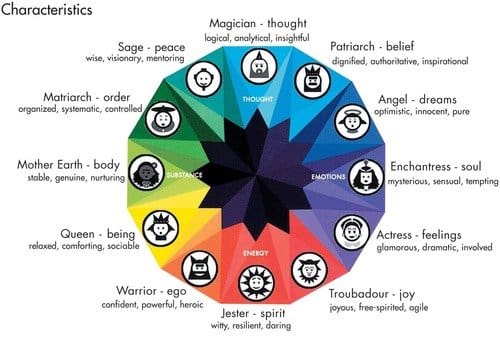
Rather than argue the merits of Freudian versus other constructions of personality, like the ones above, I’ll talk about the implications of personality on marketing.
Why don’t marketers use consumer personality
The concept of consumer personality comes from psychology, which might explain some of the reluctance to use it for marketing purposes. Yet, the potential for using consumer personality to laser focus marketing appeals to particular groups is vast. So, why, you ask, don’t marketers use personality as a segmentation variable?
Part of the reason, maybe most of the explanation, is that marketers are unaware of academic research on consumer personality. In teaching marketing, we spend so much time trying to teach the concepts and definition, we fail to show the impact of personality on marketing performance.
Likely, a bigger part of the explanation lies in the inability of marketers to access personality traits. Until the advent of social media and other means of two-way conversations between consumers that were accessible to companies, they did not have access to personality traits, and collecting this information using surveys or other tools that were available was much more expensive.
When we look at these key drivers of consumer personality, we’re in a much better position to tailor our marketing campaigns to each personality, thus achieving higher returns.
How to determine a consumer’s personality
In the past, discovering personality required long surveys that were both time-consuming and expensive. Today, with the plethora of social media posts, consumers reveal their personality unintentionally in every post they write, like, or share.
So, how do you learn more about the personalities of consumers in your target market?
- Surveys are still a great source of information about consumer personality. Online surveys reduced the cost and time necessary to collect data on attitudes, values, and lifestyles of your target markets.
- Listening on social media allows you to analyze the language topics and sentiments that are important to your consumers. Many social media platforms allow you to collect data through their advertising platforms, where users are defined based on their interests and lifestyles. You can experiment by placing ads on these platforms and A/B testing with different messaging to different user segments.
- Website analytics are a valuable tool to provide rich insights into the users who visit your website and how they choose to explore that website.
- Conduct qualitative interviews to uncover the deeper “why” behind their decisions.
The image below shows the personality of a particular Facebook user who participated in a study. Information about this user’s personality allow you to craft messages that resonate with the user. This image shows how that user’s personality rates across the so-called “Big 5” elements of personality discussed earlier. You’ll likely get similar reports using Google Analytics in the near future as social networks strive to maintain their value to advertisers.

In the meantime, new AI (artificial intelligence) products promise to scrub your social networks to collect data, then use text analytics to determine the personality (or any other trait) of users.
Here’s a great article I wrote about determining user personality on Facebook.
In addition to using text analytics to determine consumer personality, posts reflect surrogates to personality, such as types of movies or media they enjoy. For instance, “Outlaws” are likely fans of Scarface or similar genres, while “Regular Guys/ Gals” are more likely to watch movies where the little guy excels.
Using personality information in marketing
While some argue that personality has little impact on purchase behavior, others disagree, and I’m one of them. I think the failure to find the link is due to errors in measuring or implementing. Thus, I strongly encourage marketers to consider personality in crafting marketing campaigns.
Keep in mind that personality research generates a probability about how consumers respond. Other factors, such as mood, aging, and external factors, including the ability to buy, moderate the relationship so you can never predict with complete accuracy how a particular person will respond, but predictions of how a group is likely to respond are valuable for improving your campaigns.
Let’s take on the archetypes above, for example, say the “Outlaw” archetype, because it’s very common on social networks.
The “Outlaw” is motivated to destroy what isn’t working and they like to disrupt and shock others. Products that are edgy, maybe a little dangerous, and seem a little outside accepted norms appeal to them. Contrast that with the “Regular Guy/Gal,” and you see a distinctly different marketing strategy relying on safety, conformity, and doing what everyone else is doing.
Beyond these archetypes, we can look at other personality traits, such as self-control, where there’s a difference between whether consumers prefer portion-controlled packaging (low self-control) versus larger, less expensive mass packaging.
The key to marketing to personality types is to create a fit between the personality and the brand — including not only messaging, but brand attributes and packaging.
How to leverage consumer personality for success

You can use these insights, combines with information about you target market, to create a sustainable competitive advantage for your brand.
Build more nuanced buyer personas
If the concept of buyer personas is new to you, it’s a way of segmenting your target market into groups based on the characteristics shared by people within those groups. These are much richer than the old target market concept we taught in your marketing classes years ago because they contain a host of information beyond demographics and geographics. They contain information on personalities, lifestyles, hot buttons, and the types of media consumed that is important in learning how to market more effectively to that group.
Tailor messaging
One-size-fits-all messaging is rarely effective. Adapt your tone, language, and content to match different personality types. For instance, you want to market very differently to someone with an expressive personality (exciting visuals and bold claims) versus someone with an analytical one (data and logic).
Optimize the customer journey
Identify potential friction points for different personalities at each stage of the buying cycle. A deeply researched white paper might be the perfect top-of-funnel content for an analytical buyer, while a quick, visually appealing video ad might better capture the attention of an impulsive, extraverted shopper. Ensure your checkout process is efficient for goal-oriented types and reassuring for cautious ones.
Build a brand personality that fits

Brands also have personalities. The key to building your brand personality is to match the brand personality with your target markets. If your target market values conscientiousness, then your brand should convey reliability and trustworthiness, for instance. If your target market is more interested in fun and fantasy, then those are the traits that you should emphasize in building your brand personality.
Concusion
Situations impact how we evaluate ourselves and modify our personality somewhat. When we’re confident, we tend to be more extroverted; when we’re at work, we tend to view ourselves as more conscientious. Thus, your marketing should fit the situation. If your advertising message appears on a business site, such as on the subway or on a business site like LinkedIn, you should focus on the more salient aspects of conscientiousness and focus on archetypes such as Matriarch, Warrior, or Sage that are more likely activated by the situation. Conversely, if your advertising message appears on a social site like Instagram or in the entertainment district, you might favor extraversion and archetypes such as Jester, Magician, and Troubadour.
Need marketing help to support business growth?
We welcome the opportunity to show you how we can make your marketing SIZZLE with our data-driven, results-oriented marketing strategies. Sign up for our FREE newsletter, get our FREE guide to creating an awesome website, or contact us for more information on hiring us.
Hausman and Associates, the publisher of MKT Maven, is a full-service marketing agency operating at the intersection of marketing and digital media. Check out our affordable coaching programs to help your business thrive into the future.
Discover more from MKT Maven
Subscribe to get the latest posts sent to your email.


Hey Angela
Though most of the businesses today realize the potential segmentation has yet they still struggle to segment their customer base to get maximum results. With customer being the king, businesses must pamper them as per their need but without segmentation, predicting the customers need would be a near impossible task.
Bonny Jones