 logo

Ever wondered how your content does over time? How long does a post work to drive traffic and engagement? What does the lifecycle of content marketing look like? Well, today, we’ll look at this important aspect of content marketing since the longer your content delivers value to your brand, the better your return on investment.

Well, the reality isn’t very promising, as you can see based on the data shown in the image above. According to data from StumbleUpon and companies like Nielsen and Fast Company, the half-life of the average post isn’t very long but favors blogging, where content delivers results for two years and beyond.
A deep dive into the lifecycle of content
A large number of factors impact the lifecycle of your content, including:
- the quality of your content, as high-quality content that provides value to users lasts much longer than content that you threw together
- timing as sharing content at the right time garners more engagement, which helps spread your content to new users
- platform, as you can see in the image shared earlier, there’s a distinct advantage in half-life for some platforms over others
- keywords have a huge impact on the lifespan of your content as some keywords represent trending topics while others reflect topics with broad appeal over time
- how engaged your community is with your brand as engaged users spread your message to their contacts, as you can see in the image below. This image assumes the brand starts with two million users. Each user has an average of 130 friends/followers, and about 20% of those engage with the content. After just three iterations, you’ve reached 1.2 billion users.


Let’s start by investigating the lifecycle of three general types of content: social media posts, blog posts, and email messages.
The lifecycle of a piece of content varies significantly depending on the platform. Here’s an overview of how content typically behaves on social media platforms, the web, and in email:
Social media platforms
The lifecycle starts when brands create content. Creating the right content for each platform means more than simply structuring a post to conform with standards, such as using hashtags on X but not on Facebook. It requires a brand to understand where their target market hangs out online and how to reach them based on their values, slang, and interests. You can’t hope to do a good job of creating engagement on social media if you overextend your resources. Instead, choose a few likely platforms and focus on sharing content on those platforms on a regular basis. Share the content when your target market is most likely to engage on that platform.
The content receives immediate attention from followers or friends. Engagement metrics like likes, comments, shares, and retweets start accumulating and spreading your message far and wide, although the platform algorithm determines how widely the content is distributed.
Content reaches its peak visibility and interaction, typically within the first few hours to days, depending on the platform. Reach is influenced by the platform’s algorithm, user engagement, and the number of followers.
After the peak, engagement declines as the platform’s algorithm prioritizes newer content. User behavior also influences how rapidly content declines. For instance, users might scroll down through Facebook content in a feed for minutes or hours to fill empty hours, while users on TikTok might go down the rabbit hole from one video to the next rather than continue to view new content.
Content becomes less visible in feeds unless it continues to receive interactions. The content can still receive sporadic engagement from new users or through shares. It may resurface occasionally by the platform’s algorithm or through user interactions. Content remains accessible on the user’s profile or page but rarely receives new interactions after this period, although it may still be found through searches or by scrolling through older posts.
Website
Brands create content for their websites, commonly using a blog. In contrast to landing pages that are static across a campaign, blog pages are updated on a consistent basis. For SEO purposes, you want to create long-form content (between 1500 and 2500 words with the sweet spot closer to the max), contain 2-3 images, optimize for keywords (long-tail keywords or phrases of 2-3 words), and links (both internal and external links to high-quality website content). Of course, over time, these criteria for scoring near the top in search results are getting more stringent.
You should also post at least once per week. As this image shows, your ROI increases with increasing post frequency.
 Image courtesy of Hubspot
Traffic is driven by direct visits, social media shares, email newsletters, or search engines. To improve the performance of your blog content, share it ubiquitously across these channels and optimize SEO. Search engines index the content, making it discoverable through search queries, so share your sitemap with Google and other search engines. Periodically check your Google Search Consol to ensure pages are indexed properly and manually submit any that weren’t picked up automatically.
Traffic peaks as the content is actively promoted and shared. To increase awareness of new content, solicit comments from readers. Include custom images and other elements that generate secondary traffic when another website backlinks to your content or when readers share your content on their own social platforms. Include sharing buttons to make this easier.
Over time, search engine traffic becomes the primary source of visitors. The content may continue to attract visitors for months or years, especially if it is evergreen. Hence, mix up daily posts with content that will last over time. For instance, repackage several individual posts into a more comprehensive post.
Over time, older posts become irrelevant or fail to attract much traffic. It’s time to consider updating or deleting these posts so your blog stays relevant. For instance, this post was originally written in 2015. Obviously, many aspects of the post are no longer relevant and it fails to capture a good rank with current search algorithms. Hence, this post was heavily rewritten to reflect these changes and attract more attention. Hopefully, by submitting the content for reindexing, the revision will begin to bring in more traffic.
Email marketing is a two-pronged strategy. The first part involves collecting subscribers, as most countries no longer allow brands to buy, share, or rent email lists due to privacy regulations. Next, the brand sends messages to subscribers. Many brands send some form of welcome message and then periodically send messages to all or some segment of that list.
Recipients open the email and interact with the content (clicking links, replying, etc.). Most engagement happens within the first 24-48 hours. Some recipients may open the email later, especially if something in the email appeals to them, leading to additional interactions. Many brands encourage subscribers to forward the message to their contacts who might find the content interesting.
Since subscribers like to clear their inboxes regularly, you must offer some rationale for them to keep them for future reference. Over time, emails become buried in the inbox, and engagement stops.
While the lifecycle of content shared through email is short, email offers the highest ROI of any digital marketing effort, so don’t let the short lifespan discourage you from using this channel.

Dealing with the lifecycle of content
Different folks recommend different strategies and tactics to deal with the relatively short lifecycle of content marketing.
Buffer, among others, recommends re-sharing your content to encourage more engagement over time. Here’s the schedule recommended by Kissmetrics:
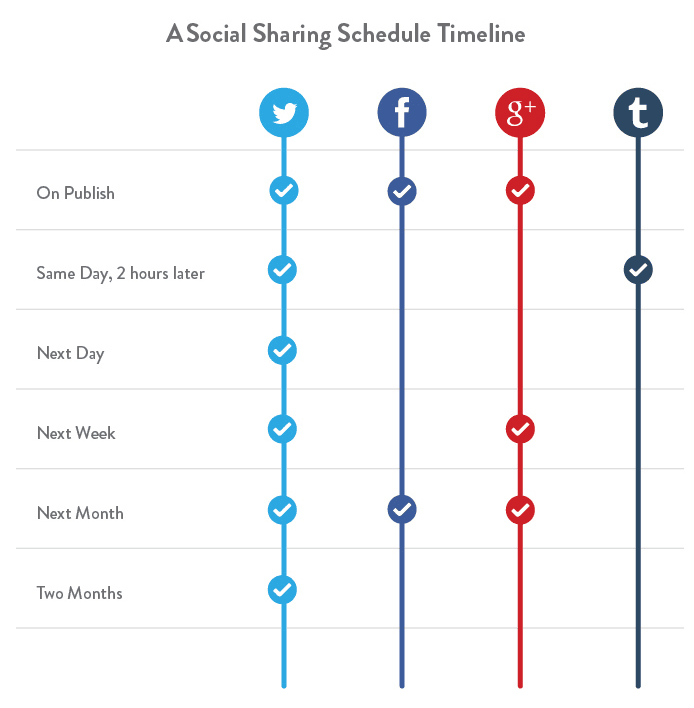
Obviously, this data is a little old, but it gives you some idea of how your content can do double or triple duty. You should tweak your post with each share to avoid penalties assessed by some platforms for sharing duplicate content.
Resharing content multiple times extends the content marketing lifecycle as each share starts a new lifecycle. Oversharing can turn off your target marketing, so I don’t recommend sharing more frequently than this infographic suggests. I also recommend sharing content created by others (curating content) to supplement sharing your own content. A good content marketing strategy involves an 80/20 split, with 80% of shared content comprised of content created by others and 20% your own content. I also stretch things out a bit by sharing after 2 weeks, not 1, as shown in the graphic.
Obviously, reaching out to influencers to share your content not only increases your reach, but starts the lifecycle of content marketing over again, so that’s an excellent strategy. A couple of caveats in reaching out to influencers. Influencers are busy people and their job isn’t to make your life easier. Before asking an influencer to share your content:
- Do your homework. Make sure the influencer commonly shares content in your content area. It’s amazing how many times someone reaches out with their infographic or press release without carefully researching my content marketing efforts. They either send me something so far out of my content marketing area or something that contradicts my other content.
- Getting influencers to share content is a two-way street. Don’t just pop into an influencer’s inbox out of the blue. Develop a relationship with the influencer first or prepare some inducement to get them to share your content. A nice tit-for-tat is to share their content first or offer to share your content if they share yours.
- Be sure to recognize influencers who share your content. A simple thank you is usually sufficient.
Social bookmarking
Unlike traditional social networks, social bookmarking involves submitting content to a site where users search for interesting articles. But, social bookmarking shares some value with social networks when it comes to SEO because users-generated bookmarks help Google categorize your content, as well as showing the value users find in your content. Some social bookmarking sites even provide backlinks, which can also help your SEO.
Based on my experience and several other bloggers I respect, Reddit is the most powerful social bookmarking site. Reddit, which identifies itself as the front page of the internet, contains links and text about various topics (subreddits) and encourages users to vote up or down content. It is a community-driven social bookmarking site.
Here are a few things to know if you plan to use Reddit:
- Choose an appropriate subreddit. Each subreddit has its own rules (for instance, business doesn’t allow you to submit content that’s your own, and marketing doesn’t allow linked content, only texts). Respect the community by following the rules — or face the consequences of banishment.
- Each subreddit has folks who follow it. Obviously, you’d like to share your content in the subreddit (don’t duplicate shares on several subreddits) with the largest number of followers.
- Play nice by sharing content submitted by others.
- Make it easy for visitors to share your content by adding a Reddit button to your website.
StumbleUpon
StumbleUpon is another popular bookmarking site. The infographic shows just how enormous StumbleUpon is—with 51 pages added every minute. To make StumbleUpon an effective part of your content marketing, be sure to use tags and leave comments when you submit your content because finding it among all the other content is like finding a needle in a haystack.
Not only is StumbleUpon a great place to share your content, but it’s also a great place to find content for sharing or just to learn something new — called Stumbling. I find it a great research tool for preparing new content.
Other social bookmarking sites
There are tons of other social bookmarking sites: Digg, Newsvine, Squidoo, and Yahoo Bookmarks are among them. Check some out and see if they work for you.
Need marketing help to support business growth?
We welcome the opportunity to show you how we can make your marketing SIZZLE with our data-driven, results-oriented marketing strategies. Sign up for our FREE newsletter, get our FREE guide to creating an awesome website, or contact us for more information on hiring us.
Hausman and Associates, the publisher of MKT Maven, is a full-service marketing agency operating at the intersection of marketing and digital media. Check out our full range of services.
Discover more from MKT Maven
Subscribe to get the latest posts sent to your email.


