 logo

Finding just the right words to describe your brand, entice your target market to make a purchase, and speak for your company isn’t always easy. Neither is doing so consistently. But the truth is that great copywriting has never been more important – especially for online stores. Your landing pages and product pages are your eternal sales pitch and your chance to connect with your visitors.
Right up there with critical elements like design and usability, strong writing is one of the most effective tools in building a brand that people want to associate with. So, how to get better at it? You need to learn from the best. Here are eight examples of successful brands that have mastered the sound of their own voice to consistently produce superior copywriting that helps their brands succeed over the longrun.
The secret to great copywriting
The secret to great copywriting is learning to gain attention in an increasingly noisy environment. Then, you must do so consistently. Marketers must go beyond describing the product, show how it solves the consumers’ problems, and draw attention. It must tell a story that engages the emotions, because emotions are strong drivers of consumer decision-making. Great copywriting is challenging for even the best marketers. It’s one part marketing, one part whimsy, and two parts fun. Here are some examples.
1. Patagonia
Consumers don’t just want to choose the right products that solve their problems; they want to feel good about the products they buy. Studies consistently demonstrate the power of shared values in driving consumer decisions (see an example below). We had our choice of companies that emulate shared values that help support their brand (others are Ben & Jerry’s, Starbucks, and Lego) through living their values through corporate social responsibility commitments, while also creating a great place to work, and caring for customers. We chose Patagonia because they demonstrate their conscience with every campaign they develop. Customers increasingly vote with their dollars to support companies that live their shared values.

An example of a campaign that demonstrates the company’s commitment to the environment was one that ran on Black Friday, urging customers to reuse or repair their old jackets, rather than buy a new one. The campaign worked because it was shocking, running alongside ads from other brands, urging consumers toward greater levels of consumerism. Instead, Patagonia attracted attention to its core mission of protecting the environment by producing clothing that lasts, rather than ending up in landfills or being exported to developing nations, creating an environmental disaster like the one below in Chile.

Small business owners can learn from this lesson by embracing an authentic commitment to values shared by their target market, whether they’re popular or not. For instance, while not a small business, Anthropic recently told the US government it wouldn’t remove the guardrails protecting citizens from overreach with its AI tool, Claude. In response, the government canceled millions of dollars in contracts with the company, and the app surged to the top in the Apple App Store.
2. Newcastle Brown Ale
Newcastle Brown Ale proves that marketing isn’t always about serious topics. Instead, its advertising campaigns are full of clever, tongue-in-cheek writing that resonates with its target demographic: namely, British and American ale drinkers. Its videos poke fun at both cultures in turn, as seen in its hilarious ‘Independence Eve’ and ‘If We Won’ campaigns.
Making fun of both the US and Great Britain, Stephen Merchant argues:
Do you really have to celebrate your emancipation from us? That’s like your girlfriend breaking up with you, and then celebrating with fireworks
And of course, on the table next to him is a nice, chilled bottle of ‘no bollocks’ Newcastle Brown Ale, which is the only mention of the brand until the closing images. But the video is so funny, you’ll want to see it through to the end, and you’ll remember it, which is 90% of the job of a marketing campaign.
The lesson for small business owners from this brand is simple: don’t take yourself too seriously. It’s ok to have fun with your brand.
3. Oatly
Maybe you’ve never heard of this Swedish oat milk company, but they do a great copywriting job by making a mundane product fun while poking fun at the debate as to whether milk can only be milk if it comes from a cow (or maybe a goat). It also absurdly jumps into the health debate over whether humans are meant to drink milk from an animal.
The essence of their copywriting is the slogan: “It’s like milk, but made for humans.” In marketing campaigns, they go into great detail about challenges and internal processes that go counter to general marketing concepts that copy should be short and to the point. They even produced a billboard that said:
You actually read this poster? We had no idea this would work. To be honest, we were just testing things.
For small businesses, the takeaway is that the brand feels human, which makes them seem honest and accessible. I have a colleague who works for the California Tortilla company who uses the same tactic across her social media posts, where she shares everything from the contents of her purse to a health challenge she’s facing. Here she is getting feedback from customers about a proposed new logo.

Great copywriting is honest, owning up to mistakes, and is willing to make fun of itself. Even brands with serious products, such as insurance and banking, can do with a little of this type of copywriting.
4. Dove
No mention of great copywriting would be complete without a mention of Dove brands. Dave has spent years celebrating the many versions of female beauty to counteract the prevailing notion that there’s only one form of beauty that’s unattainable for most women. Not only do media portrayals of what a woman should look like damage the self-esteem of the average woman, but they can also lead to deadly consequences for women and young girls who think they must look like the models and actors.
BTW, I once spent a summer working with a major NY advertising agency. I spent a day with a graphic designer who was in the middle of a multiday project to retouch the image of a model for a print ad. I was so impressed with what he was doing and how none of these models looked as perfect as they appeared in the final image, that I went back the next day to show my 15-year-old daughter the before and after to help her feel better about herself.
The Dove “campaign for real women” attempts to do this on a massive scale. The ads show women in all their shapes and colors to support women, whatever they look like. The goal of the campaign is to make girls and women feel good about themselves by telling them, “You’re more beautiful than you think”. Dove now focuses on selling confidence and helping women accept themselves rather than selling soap and lotions.
5. Apple
While I recognize that not everyone is a fan of this brand and I’d be the last person to agree with their politics, environmental impact, and manufacturing decisions, you have to respect a brand that generates such a loyal, dedicated following among such a wide swath of consumers. The great copywriting that generates this commitment benefits from two decisions that form the foundation of the company. First, they seek to solve consumer problems, whatever that might mean for pushing the technology frontier. Second, they make technology accessible to the most technophobic among us by ensuring the products are intuitive to use.
Rather than toute the gigabytes or clock speed, its copywriting focuses on what the product does for you. For instance, the iPod was introduced with the slogan, “1000 songs in your pocket,” and the Mac with the now-famous ad based on Alex Haley’s book, 1984 (see below).
Meanwhile, competitors forced consumers to master technological terms to use their products (which were often superior, such as Microsoft’s Zune) and perform arcane actions to get the products to work. Marketers have taught this for years, advising companies to talk about benefits, rather than features, for great copywriting.
6. Mailchimp
Popular email marketing service, MailChimp, is another great example of a brand that succeeded at injecting its content with personality. You can even see who’s behind the content on their ‘about’ page.
With MailChimp, it’s all about getting to the point – no waffle. Of course, as an email service, they understand how important this is.
MailChimp understands that, for many of its users, this might be the first time they’ve sent out an email newsletter. So they explain themselves in a simple and supportive way. “Connect your store, sell more stuff”. That’s a pretty simple concept to grasp, right?
“Hundreds of integrations with apps you already use”. Oh, good, this sounds familiar and comfortable. The site is also full of guides and resources for both novice and experienced users. Great copywriting, MailChimp.
7. Old Spice
Maybe when you think about Old Spice, you think about your dad, or, in my case, a favorite uncle. This makes you think of the brand as old-fashioned and unappealing. One of the hardest jobs in marketing is rebranding a product. It’s almost a case of falling victim to great copywriting that no longer resonates with your market. That’s Old Spice.
To rebrand the product, the company went for the absurd. It used hyper-masculinity to the point of parody with surreal and absurd monologues, such as “I’m on a horse,” that quickly became memes. The ads were so confident, memorable, and weird that they worked. They made fun of the brand and its image.
The lesson is that you shouldn’t be constrained by what you were, but by what you need to be for modern consumers. Don’t be forgettable. Do the unexpected.
8. Hubspot
HubSpot didn’t so much rely on great copywriting as it did on the message it sent through the brand’s commitment to creating value for users, whether they were paid users or simply read the content produced on the website and in daily email messages sent to subscribers. Rather than hide great content, such as the State of Inbound report, behind a paywall, they made it freely available to anyone who cared to read it. I share many of the brand’s insights and images as a tool to help my small business readers, such as the one below.

In the age when AI is often the first source for information many users turn to, showing up in this content requires E-E-A-T, expertise, experience, authoritativeness, and trust. HubSpot built this in spades with the content posted on the website, in social media, and email messages that didn’t sell the viewer, but educated them. The message was that the brand cared about your success, using the philosophy that “a rising tide raises all boats”.
Small business owners should try to emulate this lesson by focusing on providing value, not making sales. Not only does this resonate with your target market, but it also helps new prospective customers find you when searching using a search engine, an AI platform, or even viewing posts in their newsfeed.
Conclusion
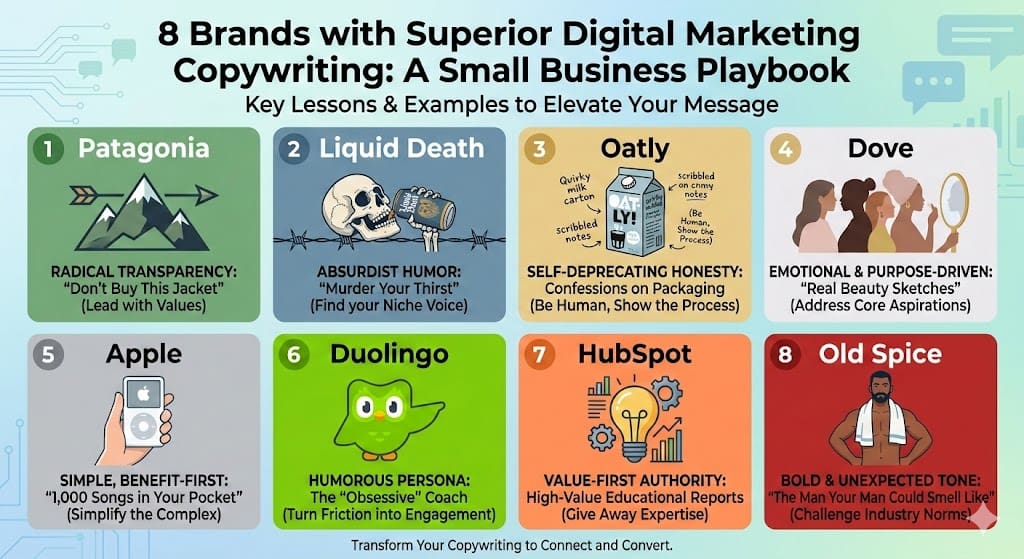
I realize we haven’t mentioned every brand shown in the top image, as I added some that I found worthy. If you’re interested, here’s a summary of the brands mentioned above, along with the key takeaways from each for small business owners.
| Brand | Superior Quality | Key Small Business Takeaway |
| Patagonia | Radical Transparency | Lead with your values, not just your product. Authenticity builds loyalty. |
| Liquid Death | Absurdist & Niche Voice | Be bold. Pick a lane and lean into your unique voice. Don’t fade into the middle. |
| Oatly | Self-Deprecating Honesty | Be human. Show the person behind the brand. Own your imperfections. |
| Dove | Emotional & Purpose-Driven | Sell the outcome, not the item. Address the core emotional need your customer has. |
| Apple | Simple, Benefit-First | Translate features into clear, desirable user benefits. Explain “what’s in it for me.” |
| Duolingo | Humorous & Engaging Persona | Turn customer pain points into a shared story. Use character to bridge gaps. |
| HubSpot | Informative & Value-First | Build trust by giving away extreme value. Become the “helpful expert.” |
| Old Spice | Bold & Unexpected Tone | The biggest risk is being forgettable. Challenge industry conventions. |
As always, I’d love your feedback. Please leave a message in the comments below to let me know how this post on great copywriting helps you. If you’d like to see more content, feel free to suggest your ideas or ask your questions.
Need marketing help to support business growth?
We welcome the opportunity to show you how we can make your marketing SIZZLE with our data-driven, results-oriented marketing strategies. Sign up for our FREE newsletter, get our FREE guide to creating an awesome website, or contact us for more information on hiring us.
Hausman and Associates, the publisher of MKT Maven, is a full-service marketing agency operating at the intersection of marketing and digital media. Check out our affordable coaching programs to help your business thrive into the future.
Discover more from MKT Maven
Subscribe to get the latest posts sent to your email.


