 logo

Imagine building a brand that commands respect and is recognized and trusted by your target market, regardless of geography. Building this strong brand ensures success at home, which might tempt you to adapt your brand strategy for your products, allowing them to expand your potential overseas. Just as you witnessed your profits soar at home as your brand strategy increasingly resonated with your target market, the thought of taking your brand international isn’t just a dream—it’s a powerful opportunity waiting to be seized. Embrace this moment and expand your reach to new markets, where your brand’s reputation can flourish even further to grow your business.

But wait! Elevating your brand from a local hero to an international sensation won’t work if you simply copy and paste your U.S. strategy onto the global stage. Consider Walmart’s initial struggles in Germany: Their unique approach, including door greeters, failed to resonate with the marketplace’s cultural expectations. And, this is just one of the many examples of international expansion that initially failed because the firm didn’t adapt its brand strategy to the cultural expectations of the consumers in that country. These failures serve as a potent reminder that understanding and adapting your brand strategy to local cultures is the key to worldwide success.
Building a global brand is not merely about maintaining the same identity across all markets; instead, it is about ensuring that the brand is recognized universally while also resonating with local cultures and preferences. For instance, Coke markets its brands in nearly every country in the world. Yet, despite maintaining the same branding through imaging and packaging, the contents inside the bottles and cans are adapted for local tastes. For instance, some versions are less sweet, while others are less carbonated. Some versions add fruit flavors while others are branded as Coke Light, rather than Diet Coke, due to local sensitivities to the word diet. Even the marketing of Coke varies by country in more ways than language, so the product appears authentic to the local consumers. Thus, you must adapt your brand strategy to attract consumers in all the countries where you market your brand.
This strategy, known as glocalization, emphasizes the importance of thinking globally to establish a worldwide presence while simultaneously acting locally to adapt to the specific needs and values of different communities. By blending global standards with local insights, brands can enhance their relevance and connection with diverse audiences.

In this post, we’ll share a few strategies to help you manage this balancing act and build a brand people genuinely connect with worldwide by adapting your brand strategy.
Adapt your brand strategy
#1: Balance uniformity with localized strategies
You want your target market to recognize your brand wherever it appears, right? But you also don’t want to come off as tone-deaf in a new market. This is why it’s essential to strike the right balance between global consistency and local adaptation. Pinpoint the brand’s non-negotiables—the elements that absolutely must remain consistent worldwide, such as the color palette and other design elements. This includes core values, the primary brand message, and the fundamental identity that defines the brand. Sometimes, even these elements must change, however, to conform to local expectations. For instance, Ford’s NOVA car didn’t do well in Latin America, where NOVA translates as No Go, which isn’t the image you want for your brand.
On the other side of the coin, add local magic to adapt your brand strategy to local tastes and sensibilities. Beyond simple language translation, adaptation involves thoughtfully changing products, services, and visuals to align with local tastes and preferences. For instance, in some developing nations, selling pre-packaged products, such as bags of flour, doesn’t fit the needs of the local market. In these countries, consumers purchase small quantities from large bins to meet their immediate needs and conserve limited funds.
Many successful global brands demonstrate this balancing act in action. McDonald’s is a classic example. It maintains its globally recognized golden arches and core menu items like the Big Mac. However, its menu varies significantly worldwide. It offers the McSpicy burger in Singapore, the vegetarian McAloo Tikki burger in India, and kosher options like Big Macs without cheese in Israel.

#2: Adapt colors and narratives to fit local tastes
The most common yet easily avoidable pitfall in global branding is assuming that colors, images, and narratives carry universal meanings. They don’t. What feels like trust or joy in one culture might signal mourning or offense in another. Red, for instance, often means love or excitement in the West, but in South Africa, it’s linked to mourning. White suggests purity in the U.S., yet in parts of Asia, it’s a funeral color. Colors also imply different values in various countries. For instance, wearing a cap the color of the opposition party by a US president nearly caused an international incident. These might seem like minor details, but they can make or break how your brand is perceived. So, before you hit go on that campaign, do your homework on local color psychology.
Brand storytelling is a powerful way to connect emotionally, but narratives also require cultural adaptation. You’ll need to adjust characters, tone, setting, and even the message so they’re authentic.
Great marketing case studies show this in action. Vestas and Steelhead Americas, for example, faced rural skepticism about wind energy in the U.S. Midwest. So, instead of going big-picture with climate change, they kept it local. According to Mambo Media, the brands used clear visuals showcasing the benefits, such as job creation, tax revenue for schools, and the shift from carbon sources.
#3: Build a flexible brand identity
Rigid branding dies quickly in international markets. If your brand identity is a straitjacket, you’re going to struggle. Don’t mistake flexibility for chaos, inconsistency, or a complete disregard of your guidelines. Rather, it refers to a well-defined system or toolkit designed to adapt your brand strategy as needed.
Think of it like a set of building blocks. Your brand identity should have key building blocks that are always there, like your tone, your logo, and your values. There should also be complementary variations and supporting assets, like secondary marks, icons, patterns, illustrations, and alternative logo lockups. You can combine these elements in fresh, context-appropriate ways while still clearly communicating the brand’s identity. Responsive logos and design are key components of this flexibility. Main logos are often too detailed for small digital formats, so responsive design simplifies them by removing elements or details.
Google, perhaps, is the most famous example. Its core logo is instantly recognizable, yet it frequently adapts into creative “Doodles” for special occasions. This shows how flexible it can be without you ever forgetting it’s Google.

#4: Research cultural nuances, local slang, and humor
Perhaps the quickest route to global marketing failure? It’s assuming that people everywhere share the same communication styles, cultural references, or sense of humor. Humor often doesn’t transcend cultures. Cultural nuances, though subtle, powerfully impact perception. Ignoring them can be detrimental to your brand’s reputation and market entry. There are many stories in global marketing history about things that went wrong. Pepsi’s slogan, “Come Alive with Pepsi,” was notoriously translated in China as “Pepsi brings your ancestors back from the grave.”
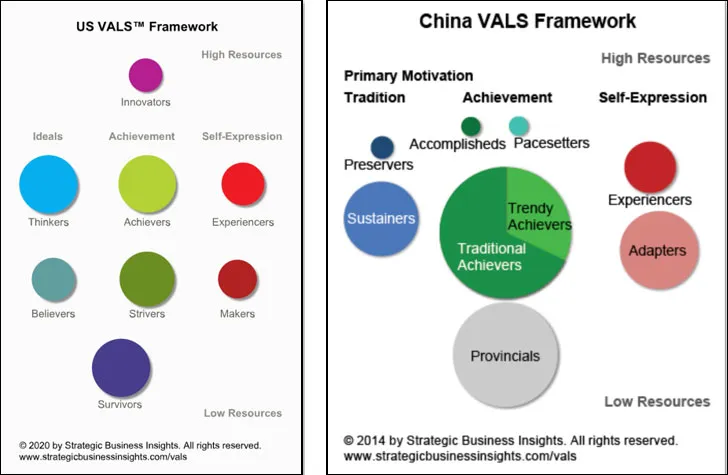
Therefore, you must understand the local way of life—the customs, values, traditions, and social norms of your target market. This is important because three in four native speakers would choose a brand that better understands their culture. Understanding the target culture’s values, communication norms, linguistic nuances, taboos, and legal/regulatory frameworks is the key to avoiding such blunders. Below, you see the differences between the US and China when it comes to the values they cherish and the size of the consumer group in each of the VALS groupings.
Adapt your brand strategy with the help of local consultants and marketing agencies. Also, prioritize transcreation. That is, focus on adapting the intended meaning, tone, and impact of the message, rather than just converting words.
Go forth and glocalize
When you go global, you don’t have to reinvent your brand for every market. The key to success is knowing what parts of your identity are sacred and what parts can and should adapt. When you strike that balance, people not only recognize your brand but also remember and trust it.
Marketing tips to help support business growth?
We welcome the opportunity to show you how we can make your marketing SIZZLE with our data-driven, results-oriented marketing strategies. Sign up for our FREE newsletter, get our FREE guide to creating an awesome website, or contact us for more information on hiring us.
Hausman and Associates, the publisher of MKT Maven, is a full-service marketing agency operating at the intersection of marketing and digital media. Check out our full range of services.
Discover more from MKT Maven
Subscribe to get the latest posts sent to your email.


