 logo

Have you ever waded through mountains of reports only to wonder if your business is actually making progress? That’s like trying to measure your fitness by staring at a treadmill. It’s time to flex the power of automation to revamp the way businesses track their wellness metrics. Trust me, this isn’t just another buzzword-packed suggestion – automation can genuinely turn your business wellness metrics from muddled to meaningful. Here’s how businesses can use automation to flex their data muscles and measure business wellness in real time.

What are business wellness metrics?
Business wellness refers to the overall health and sustainability of a business, encompassing financial, operational, and cultural aspects. Unfortunately, the key metrics for assessing business wellness are spread over various reporting platforms and may be the preview of different functional areas within the organization, making it hard to understand whether the company is doing well overall or not. Here are some of the metrics to consider when evaluating the health of your organization.
Financial health
These metrics are available from commonly used financial statements such as the income statement, which is a snapshot of the profits (or losses) incurred for a defined period (such as a quarter or year), a cash flow statement, which details how much liquid cash the business has on hand at a particular point in time, and a balance sheet, which shows the assets and liabilities held by the company.
In addition, financial projections for the coming period demonstrate the financial health of the organization. Included in this category are budget statements, forecasts, and financial goals for the coming period.
Operational efficiency
Unlike financial statements that are widely disseminated to stakeholders, these metrics might be harder to find and, in some organizations, buried across various databases rather than as useable metrics. These include:
- Productivity, which reflects the efficient use of resources like labor, materials, and time
- Technology and the time-savings offered through implementing technology solutions
- Quality of products as shown by percentage defects, returns, complaints, or a formal quality assessment of services
- Process optimization: continuous improvement in processes to reduce waste and increase efficiency.
Employee health
Employees are likely your greatest resource. Retaining them, training them, keeping them happy, and reducing lost time are critical for productivity. Hence, you must assess metrics often held within the HR department, such as:
- How engaged and motivated employees are in their work
- Success in providing safe working conditions and employee health programs as measured by days without injury and sick days used
- Are you providing a good work-life balance, including such things as flex time, work from home, and providing on-site childcare
- Do you offer professional development, such as training classes, reimbursement for classes, mentoring, and promotion from within
Customer satisfaction
The marketing and sales departments commonly retain customer satisfaction metrics, but you might have to monitor customer service for complaints, as well. First, look for customer satisfaction from surveys, retention or repeat customer metrics, and complaints across a variety of communication channels (including social media) to assess how satisfied your customers are with your products. Do they meet customer expectations, and if not, where do they fall short? What is your reputation like?
In addition to assessing these factors, it’s essential to track how your company is doing over time. Are you improving or getting worse?
Market position
A company that’s doing a good job shows that its market share continues to grow or, at a minimum, remains stable from year to year. If your products appeal to different target markets, you should assess your market share across each market group. These metrics help you determine whether your products continue to meet or exceed the needs of ever-changing markets. They also help you decide whether or not you should expand to new market groups or innovate by introducing new products as needs change.
Does your target market evaluate your products as offering a clear competitive advantage and a unique value proposition of the changing competitive landscape?
Leadership and governance
- Does your company offer a clear vision statement, and does your strategy fit this vision and goals established by leadership?
- Do you live up to your vision by embracing ethical values that align with your target market as well as supporting social responsibility?
- Are leadership decisions transmitted to other stakeholders, and is it transparent how decisions were reached?
Risk management
- Are you ready to face the varied challenges facing a modern corporation, such as financial, operational, or reputational crises?
- Do you adhere to various laws and regulations that are imposed on your industry?
- Are you protected against cyber and other types of risk that might face your company?
Innovation
The one reality all businesses face is a changing world. Competition changes as new competitors enter the market and older companies are forced out. The five-forces model shown below demonstrates how these competitive pressures influence any company in that industry.
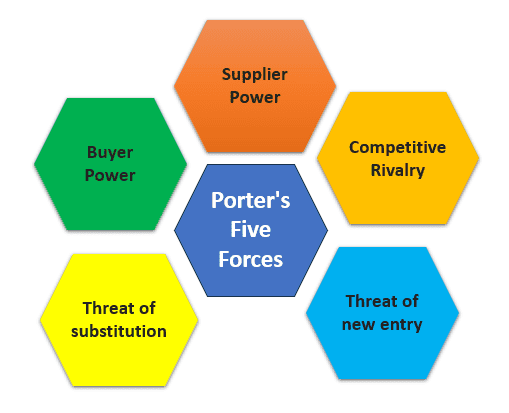 To meet these competitive challenges, a firm must invest in research to develop new products. Hence, metrics related to research and development spending, successful introduction of new products, and assessments of the changing needs of your target market are essential.
Does your company have a learning culture that keeps an eye on the environment surrounding your business to prepare for any changes that challenge your current business operations?
Corporate culture
- Do your values align across functional areas and with employees? Do they align with your target market?
- Are there plans in class to ensure diversity and inclusion in your workplace? Not only are these a direct demonstration of value alignment, but a diverse and inclusive workforce offers a diversity of insights that can help your business grow.
- Channels of communication should be open at all levels within the business
Addressing these factors holistically ensures a business is resilient, competitive, and prepared to thrive in dynamic environments.
How automation is reshaping business wellness metrics
Wellness metrics are like the pulse check for your business. They tell you whether your company is thriving or barely crawling to Friday.
Traditionally, tracking these metrics required manual labor – cue hours spent number crunching, head-scratching, and chaotic sticky-note mountains. Begging various departments to hand over data or collect it in the first place is challenging in any business. Drawing insights from this data requires establishing sets of relational databases you can query as a unit rather than each one individually. Messy, huh?
Enter automation, which is the equivalent of ordering takeout instead of slaving over the stove. It’s faster, smarter, and, frankly, less messy. Automation tools are changing how businesses monitor, manage, and act on wellness data – and in ways that feel borderline magical.
Automation takes the grunt work out of monitoring and managing wellness metrics. Intrigued? Here’s how automation reshapes wellness metrics across key areas:
Compliance monitoring – staying ahead without breaking a sweat
Ensuring compliance is like juggling flaming torches – nerve-wracking and risky. One misstep and your business could face penalties or damage its reputation.
Automation tools like the Ziflow compliance software are designed to simplify compliance management for businesses, ensuring your team follows regulations effortlessly.
Picture tools that track reviews, approvals, and version management for creative assets – all while keeping your workflow smooth. Such tools not only ensure compliance but also maintain a detailed audit trail, so you’re always prepared – no last-minute fire drills.
Data insights with a snap of a finger
Remember the agony of sifting through mountains of data to spot trends? Thank automation for turning that nightmare into a coffee break. Automated dashboards and AI-powered tools analyze real-time data, flagging potential issues or trends you might otherwise miss.
Think of it as having a virtual assistant who not only does the heavy lifting but also whispers proactive solutions. Suddenly, identifying inefficiencies – or a hidden pocket of success – becomes laughably easy.
Employee productivity tracking – without micromanaging
Manual productivity tracking feels a bit like babysitting. And nobody likes being “that guy.” Automation tools keep tabs on project timelines, task completion rates, and employee workloads for you.
You get a bird’s-eye view of what’s going on while avoiding the awkward micromanagement dance. It’s smarter oversight without the overbearing vibes.
Customer experience – made effortless
Metrics like response time, resolution time, and customer feedback are vital for ensuring your business truly serves its audience.
Automation tools track these metrics in real time, delivering insights that allow you to tweak your processes for a better experience. Chatbots, for example, ensure customers receive immediate responses while recording key data points like satisfaction scores.
Bringing it all together
Integrating automation into your business isn’t just streamlining – it’s revolutionizing. Your wellness metrics, once a cumbersome process riddled with errors, become a precise art supported by robust tools and systems.
Tools like Ziflow for compliance offer clear examples of how specific automation platforms optimize crucial aspects of business management. There’s no need to break a sweat when technology is designed to take on the heavy lifting.
Need marketing help to support business growth?
We welcome the opportunity to show you how we can make your marketing SIZZLE with our data-driven, results-oriented marketing strategies. Sign up for our FREE newsletter, get our FREE guide to creating an awesome website, or contact us for more information on hiring us.
Hausman and Associates, the publisher of MKT Maven, is a full-service marketing agency operating at the intersection of marketing and digital media. Check out our full range of services.
Discover more from MKT Maven
Subscribe to get the latest posts sent to your email.


