 logo

The art of persuasion is [according to Psychology Today]:
How do you get people to think and behave a little differently? Persuasion is an art—If you push too hard, you will risk being aggressive. If you nudge too lightly, you may turn into a pest. A thoughtful, persuasive argument can lead you to getting what you want.
In many ways, influence and persuasion are different heads of the same coin and often work best when they work together. According to some research I’ve done, influence is the ability to get people to work towards a goal, while persuasion is a communication tool that presents information in a way that leads them to certain behaviors. But most of the sites I visited seemed to treat them as virtually the same thing.
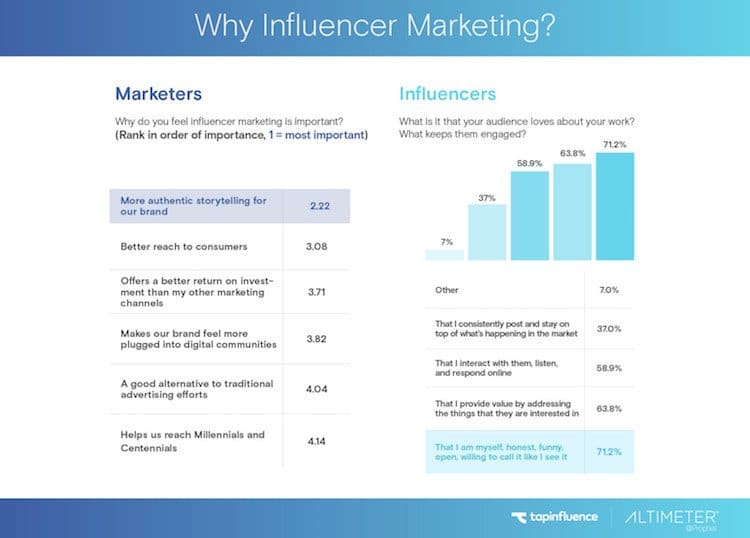
 Image courtesy of TapInfluence
The art of persuasion
Persuasion requires a brand make arguments framed in a manner that generates change — whether that change is buying a product, a social good, such as using seat belts, or changing your attitudes toward a brand.
Here’s a good example of the art of persuasion:[source]
The wind and the sun decided to have a competition to decide once and for all who was stronger. They agreed that the winner would be the one who could persuade a man to take off his coat. The wind blew and blew, but the man only held on more tightly to his coat. Then the sun shone gently down, and within minutes, the man took off his coat.
The moral here is that you can’t force someone to do what they don’t want; instead, the art of persuasion is to get them to want what you want.
A recent study by TapInfluence, shown below, reports that the ROI of influence comes from building authentic relationships with potential customers and the ability of influencers to amplify the brand’s messages across bigger and wider audiences. And, in the following graphic, we learn how influencers manage this, mainly through what Ciadini calls Liking, with a little Authority thrown in for good measure.
Tools to harness the art of persuasion
Many influencers have an innate ability to drive change.
For instance, celebrities (including micro celebrities) have huge followings and people love them. That gives them tremendous power to influence behavior. If they tweet about a new clothing brand or take a Selfie at a trending new restaurant, it can mean instant success for the company (or destroy the company in cases like the hotel where Kim Kardashian was robbed).
As mentioned earlier, this relies on “Liking” the celeb.
This tool of influence was used successfully in the era of traditional media by hiring celebrities for your commercials.
But what do brands that can’t afford to hire big-name celebrities do?
Well, there are a host of other tools of influence out there to help persuade potential customers to give your brand a try. So, let’s talk about some of them.
Cialdini’s weapons of influence
Cialdini introduced his 6 tools of influence (he’s recently added a 7th in his new book, Pre-suasion, unity) over 30 years ago, drawing on research in social psychology, in which he holds a PhD.
Marketing is much more than just putting pretty pictures and words on paper — it’s knowing which words and pictures will motivate your target audience to action. For this, marketers have all these influence tools available, but often fail to use them — personally, I’m convinced part of the problem is that too many brands hire folks to do marketing from outside marketing, but that’s a discussion for another day.
Briefly, here are the 7 tools of influence:
- Reciprocity
- Commitment and consistency
- Social Proof
- Authority
- Liking
- Scarcity
- Unity
Let’s discuss how your small business can use these tools of influence to improve market performance.
But, there’s more to generating persuasive materials than simply using the tools of influence. First, and foremost, you need to have a deep understanding of your customer — who are they, what are they like, what are their biggest pain points …
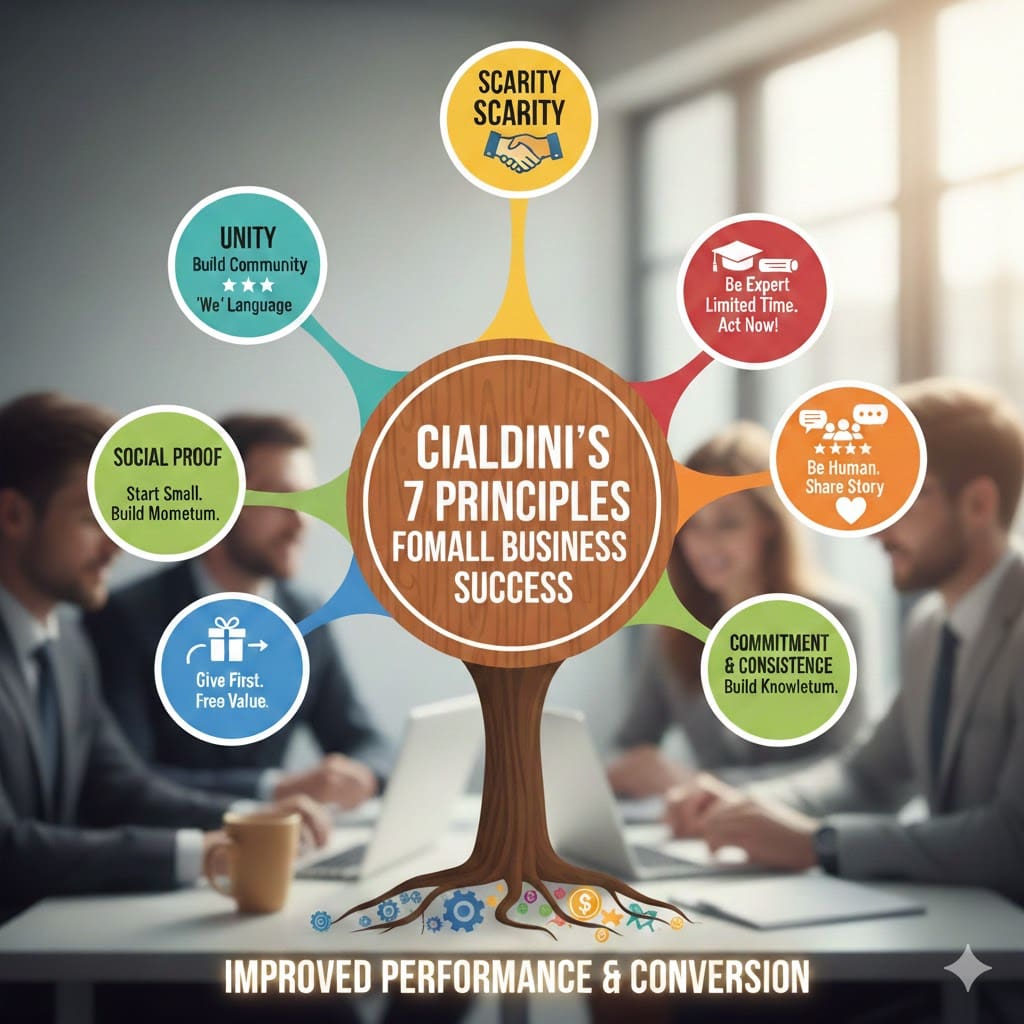
In this section, we’ll explore each of these seven tools for persuasion to show how you can use them alone or in combination to improve performance.
1. Reciprocity
It’s a natural human emotion to give back when someone gives you something of value. Generalized reciprocity is what motivates many types of charitable giving. This likely explains why people who have limited assets donate a higher percentage of their resources (those with incomes less than $50,000 donate, on average, 3%)than those with much greater assets (around 1%-2%), according to NPR.
A business might prompt greater repeat purchase intention, more willingness to recommend, and higher value purchases by including a small gift as a surprise with the order, or even offering extras available when visitors make a certain dollar purchase, or to prompt quick action (which involves another form of influence).
2. Commitment and consistency
There’s a principle in marketing referred to as an escalation to commitment. Basically, there’s a tendency for people to make future commitments after making a small, initial commitment. The psychology behind this is that people like to see themselves and have others see them as consistent.
Your business might use the art of persuasion to ask for a small commitment, such as subscribing to an email list or joining a community, to make it easier and more effective when you ask for them to buy something.
3. Social proof
Social proof is a powerful tool in the art of persuasion. Because consumers are often confused when making a decision among the plethora of options, they look to the behavior of others (even perfect strangers) to help them decide. This is why recommendations, ratings, and social media posts containing brand information have such a strong impact on your market performance.
User-generated content is much more effective in building social proof when it’s seen by users as authentic. That’s why influencer marketing can sometimes backfire. Your business can use this tool of influence by posting user-generated content, case studies, and ratings on your website.
4. Authority
People will follow the lead when they perceive the information comes from someone knowledgeable, respected, and credible. That’s why using backlinks to authoritative voices on your website and embedding them in other types of communication makes folks more comfortable buying from you. That’s especially true for intangible products, like financial services and consulting.
In addition, adding a resume of key personnel, sharing behind-the-scenes knowledge, and speaking at events builds your authority and encourages your market to trust you, increasing their chances of buying from you.
5. Liking
We prefer to deal with people we like. Hence, humanizing your brand goes a long way toward encouraging your market to make a purchase. Of course, you also have to train your staff to ensure that every point of contact appears human, friendly, and helpful.
You might improve your chances in a virtual world by including an “About Us” page, showing images of key team members, training chatbots to sound as human as possible, and offering human alternatives for complex issues to ensure questions are answered professionally and by knowledgeable staff.
6. Scarcity
Procrastination is part of the human experience, with some people experiencing more of this than others. As a marketer, procrastination can lead to shopping cart abandonment or visitors who leave without making a purchase, despite having good intentions to buy something. Once they leave your store, either a virtual or physical one, you must overcome inertia to get them to return to convert. Meanwhile, other brands are busy trying to convince them of the superiority of their product. You need a strategy to overcome these behaviors.
People have an innate fear of missing out (FOMO), which you can use to counter the effects of these realities. By offering limited -time offers or limited-edition products, you can harness this art of persuasion to increase revenue. Displaying a countdown clock or posting limitations of available stock works wonders when it comes to convincing consumers to buy now.
7. Unity
Consumers like to feel that they mean more to a brand than simply a nameless, faceless body willing to plunk down their hard-earned money. They want to feel like they matter to the brand and that they’re building a community together.
In a world where everyone is on social media constantly, building a community means shared, two-way conversations, answering questions thoroughly and promptly, asking for input on company decisions that might impact them, such as new menu items or changing the logo. Use “we” language to make people feel like you’re in this together and move from transactions to partnerships, not just in your language, but in your own commitment to your customers.
Other tools to use in the art of persuasion
- Norms — we tend to behave in ways that fit our normative values. If you align your pitch with these values, you’ll have more success. For instance, norms of sustainability help influence consumers to buy your brand when you suggest it creates less waste or is compostable.
- Attention — you’ll never get a chance to persuade potential consumers unless you get their attention. Using humor or fear appeals works particularly well in grabbing attention, especially when the images reinforce this.
- Repetition pays off, but over-repetition fails. Finding the perfect balance between repeating your message enough (usually something on the order of 5 times) and repeating your message so much you annoy your market (we call this advertising burnout) is challenging.
- Urgency — often, we’re successful in our efforts to persuade a consumer to buy our brand, but there’s no sense of urgency. Without this, they may forget their intention to buy (in fact, there’s only about a 30% correlation between intentions and actual purchase behavior).
- Avoid conflict — few are persuaded when you engage in conflict. Hence, if consumers reflect negatively on your brand, lashing out is the worst solution. Instead, thank them for their feedback and show how you will use the feedback to improve your brand. Deleting negative comments can backfire.
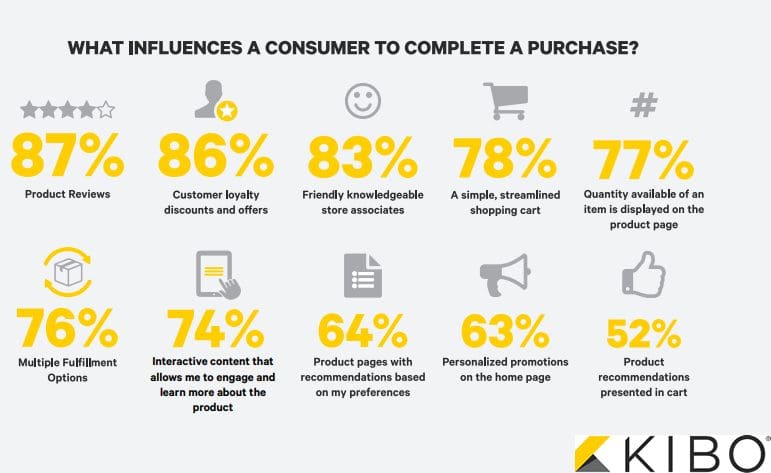
Putting it all together
Obviously, employing the art of persuasion requires an understanding of the tools, as well as an ability to bring them together in various types of communication — both mass communication (online and traditional advertising) and in one-on-one communication, which is becoming more common in digital marketing settings.
Using persuasive tactics requires you to understand your target market, not just their demographics, but psychographics such as norms, values, lifestyle, self-identity, and much more.
This is where influencers become important because they often have a ready-made audience that shares many of these psychographic characteristics — often because they’ve self-selected to become part of a group. Thus, a consumer who follows a blog or Twitter for a reality TV personality often shares some commonality with that personality — something that fits Cialdini’s last tool of influence — unity. Meanwhile, consumers who follow a celebrity who performs opera or Shakespeare are likely very different from those who follow the reality TV personality.
Misty Copeland, the first African-American dancer to become a principal with a major company, attracts a particular audience, for instance. Hence, recent advertising using her to tout yogurt helps sell to a particular audience that identifies with her.
Also, recognize that consumers often have multiple identities, not in a psychotic sense; it’s just that we may be slightly different people in different contexts — for instance, you’re likely a little different at work than out with your friends. For persuasion to work effectively, you need to activate the appropriate self-identity by manipulating the context of the ad and maybe other elements to ensure the consumer views the ad with the right identity.
Need marketing help to support business growth?
We welcome the opportunity to show you how we can make your marketing SIZZLE with our data-driven, results-oriented marketing strategies. Sign up for our FREE newsletter, get our FREE guide to creating an awesome website, or contact us for more information on hiring us.
Hausman and Associates, the publisher of MKT Maven, is a full-service marketing agency operating at the intersection of marketing and digital media. Check out our affordable coaching programs to help your business thrive into the future.
Discover more from MKT Maven
Subscribe to get the latest posts sent to your email.


