 logo

Digital marketing strategy is challenging for small business owners, while even large enterprise organizations struggle because what works changes frequently. Google algorithm updates threaten your rank in search results (especially in a world where search is dominated by AI), email filters that hide messages in folders that users rarely check, declining social media engagement as platforms bow to revenue pressures, shifts in demographics across digital networks, and new phones with ad blockers are just a few of the many recent changes that impact the success of your marketing efforts. But, as you add these to your list of strategies to work on, be sure to include integrated digital marketing channels in the list of strategic imperatives.
The role of digital marketing in modern business
Digital marketing is now a requirement for most small businesses. Not only does digital marketing offer affordable tools to reach your target market, but these tactics don’t require an art department to handle image creation, video, and content. In fact, because digital marketing is accessible to marketers without requiring training in design or the time-consuming process required to edit marketing collateral, these tactics improve performance by taking advantage of sound marketing concepts, including personality and authenticity, embedded in the messaging rather than artsy, inauthentic generic messages.
Before discussing how to use channel integration to improve performance, let’s look at what AJ Agrawal has to say about digital marketing channels (be sure to check out the hyperlinks in this quote as they’re golden):
The digital age has altered how businesses market their products. It has completely altered the playing field so companies have to tailor their strategies to reach their customers. It’s led to a rise in new companies, but in many ways it’s made it more difficult to succeed.
A huge marketing budget is no longer enough to take advantage of these marketing channels.
Changes wrought by digital marketing
According to Forbes, digital marketing wrought 5 strategic changes you can no longer ignore even if you only use traditional marketing tactics, which begs the question: WHY are you still using traditional marketing tactics alone?
The 5 changes are:
- Ads can’t be ads
- Customer service is always on
- Traditional advertising, especially when used alone, is D-E-A-D
- Because marketing costs are substantially lower in digital, the playing field is more level
- Emerging pay-to-play models mean digital advertising is no longer free
The Forbes list echoes my post on 16 differences between digital marketing and traditional marketing. You can find that post here.
I’d love to spend more time on this, but I need to get to the main topic for today, which is using integrated digital marketing channels. If you’d like to know more about what digital marketing has done to the old paradigm of traditional marketing, please ask questions in the comments.
FAQs about integrated digital marketing channels
We know there are a number of digital marketing channels. Some channels perform better than others, but your top-performing channel depends on your market. Each channel also helps reach a specific goal. Matching your target market and your goals to the optional channels available to you will optimize your performance. Below are the types of digital marketing channels, along with the specific goals likely met by the channel:
|
Channel Type |
Primary Goal |
Best For |
|
Search/AEO |
Discovery |
High-intent buyers looking for answers. |
|
Short-Form Video |
Awareness |
Building a hook and emotional connection. |
|
Email/SMS |
Conversion |
Nurturing leads and driving repeat sales. |
|
Communities |
Trust |
Long-term advocacy and brand loyalty. |
By using integrated digital marketing channels, using each channel for its intended goal, you build a solid revenue stream that supports success and growth.
This infographic (using the London Tube system) shows the major relationships among the channels and digital marketing strategies.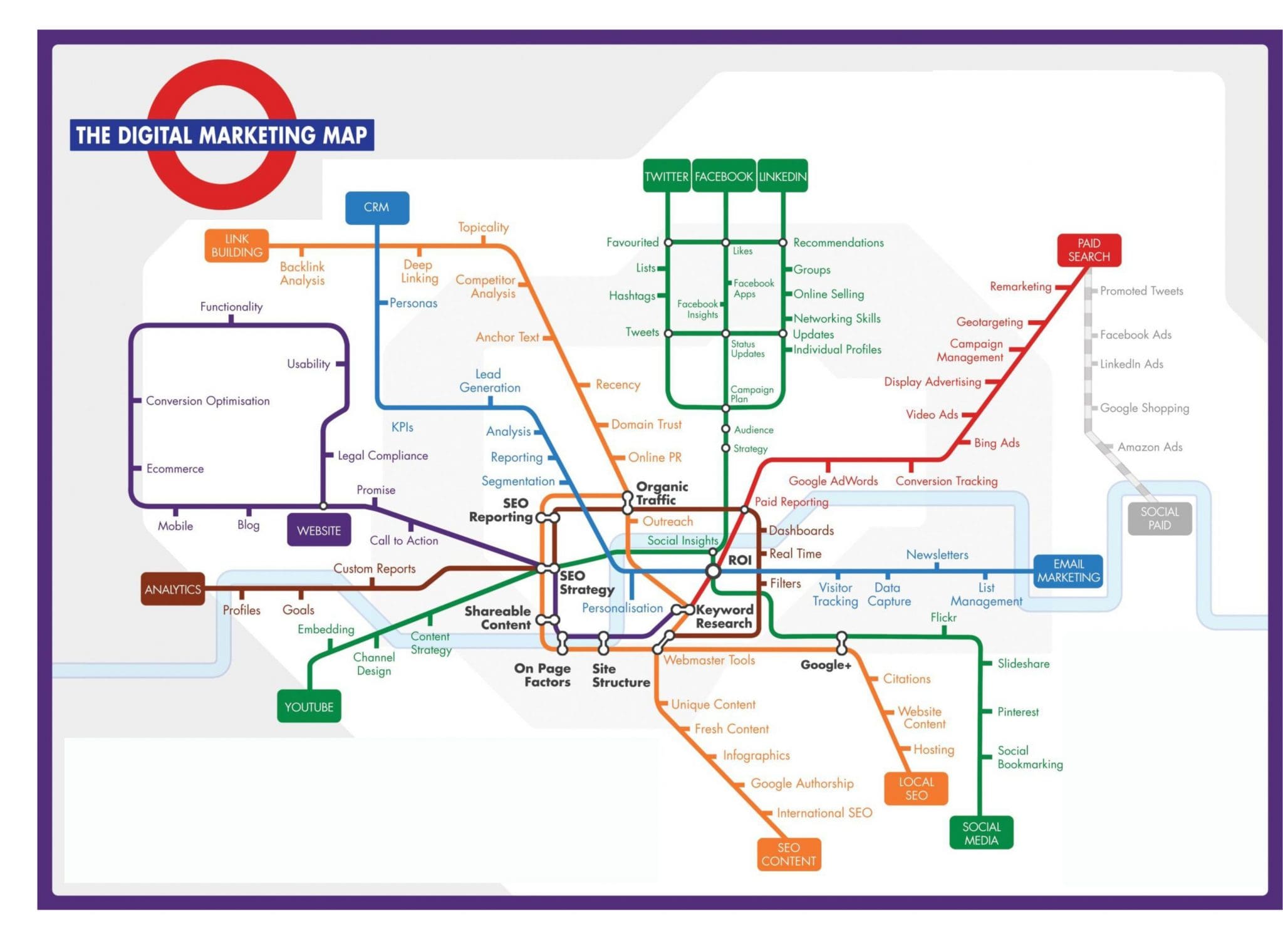
The answer is simple. Choose those channels where you find your target market. However, based on your budget and bandwidth, you likely can’t choose all the channels you think might work. Choosing at least one channel from each of those listed in the table above is your best bet because you then reach your target market with the right combination of channels to create awareness, then motivate users down the conversion funnel until you’ve not only made a sale, but built a trusting community.
In an age when businesses find that personalization is critical for success, you must also integrate information across channels to ensure a unified message regardless of which channels a user views. That means your social media messaging should tout the same discounts offered on your website and in email messages sent to subscribers. Using a centralized data platform or integrated CRM helps to ensure your customer data flows into offers and other types of messaging seamlessly.
Choosing multiple channels means you have a variety of tools you can use to attract and influence your target market, including images, videos of various lengths, links, hashtags, and keywords. Since consumers need to view a consistent message multiple times (seven is one of the most cited minimums) before making a positive purchase decision, spreading your message across multiple channels allows you to reach the minimum with less chance of message burnout because you can use different creative implementations.
The starting point for any integrated digital marketing strategy is content and, for organic search, it commonly means content on your company website. Sure, you can just use social media content shared on Facebook, Twitter (now X), TikTok, and others, and with e-commerce options on these platforms, you can monetize your social content without a website or send customers to a brick-and-mortar, again eliminating the need for a website. However, this strategy costs you the most valuable marketing channel: search. Despite the fact that Google does index several social media platforms, you’re more likely to attract prospective buyers with a website link or by sending them to a website from a social media platform.
Next, let’s introduce how to use each of the major channel types to most effectively meet your marketing goals.
GEO or generative engine optimization and SEO (search engine optimization) are tools to help users discover your digital resources, such as your website, your online store, or even social media communities. These should be part of your integrated digital marketing selections because they’re uniquely qualified for meeting your discovery goals.
Both discovery strategies rely on creating valuable content that addresses users’ queries. SEO requires long-form content published consistently on your website, plus content posted on a regular basis to your social media channels, as these are used to choose which content ranks near the top when users enter a query into a search engine. Using keywords that reflect user intent, plus constructing your content to match factors that make up the search algorithm, lands your content near the top, resulting in more visits from search engines.
Choose a dozen or more keywords that likely reflect user intent. These may come through the Google Keyword Planner (which is part of the Google Ads platform) or by searching trending topics on a variety of sources. Choose keywords that have a good bit of traffic and less competition, then construct long-tail keywords (phrases containing the keyword) to create content. Use a plugin like Yoast SEO to help with the heavy lifting involved in on-page SEO and use a well-written theme, such as Genesis, to handle the coding necessary to optimize SEO
GEO is critical as users move from selecting a link from a search engine results page to using the AI-generated answer snippet that precedes these results or asking questions within an AI platform like ChatGPT. Showing up in these AI answers relies on creating content that is trustworthy, organized to ease the burden associated with interpreting the content (often using specialized schema), and focuses on brand mentions rather than direct website visits.
Email marketing is the primary tool for lead nurturing. You must first collect a list of subscribers composed of your target market. Then, you must send personalized messages at the right frequency and containing the right content based on specific interests gleaned from subscriber behavior and their stage in the buying process.
Choosing the right combination of social media platforms to include in your integrated digital marketing strategy requires an understanding of the characteristics common among the users of individual social media platforms and the preferred formats required for each platform. Below is a graphic showing the distribution of users among the popular social media platforms.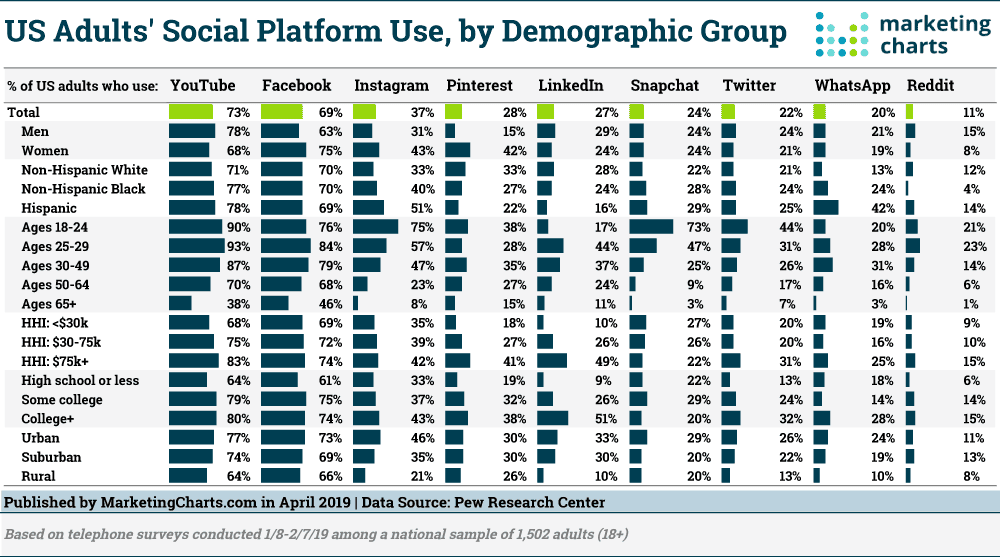
You should create a consistent posting schedule using a content marketing calendar. An automation tool, such as Buffer, can ease the burden of publishing at the optimal time, since you can prepare a number of posts to publish on your preferred schedule. Never miss a post.
Choose a couple of these platforms and, as your expertise, budget, and bandwidth allow, add more. Here’s a breakdown of the demographics found on popular social media platforms.
SMS and other mobile messaging platforms offer an immediacy you don’t find with any other communication channel. It’s great for time-sensitive offers, as a gentle reminder of a holiday or birthday to stimulate gift purchases, a way to stay in touch with your target market, and helps ensure customers know what’s going on around them. It’s also a great way to reduce no-shows at events and appointments.
Since SMS has an open rate close to 100%, it’s hard to ignore this communication channel when putting together your marketing plan.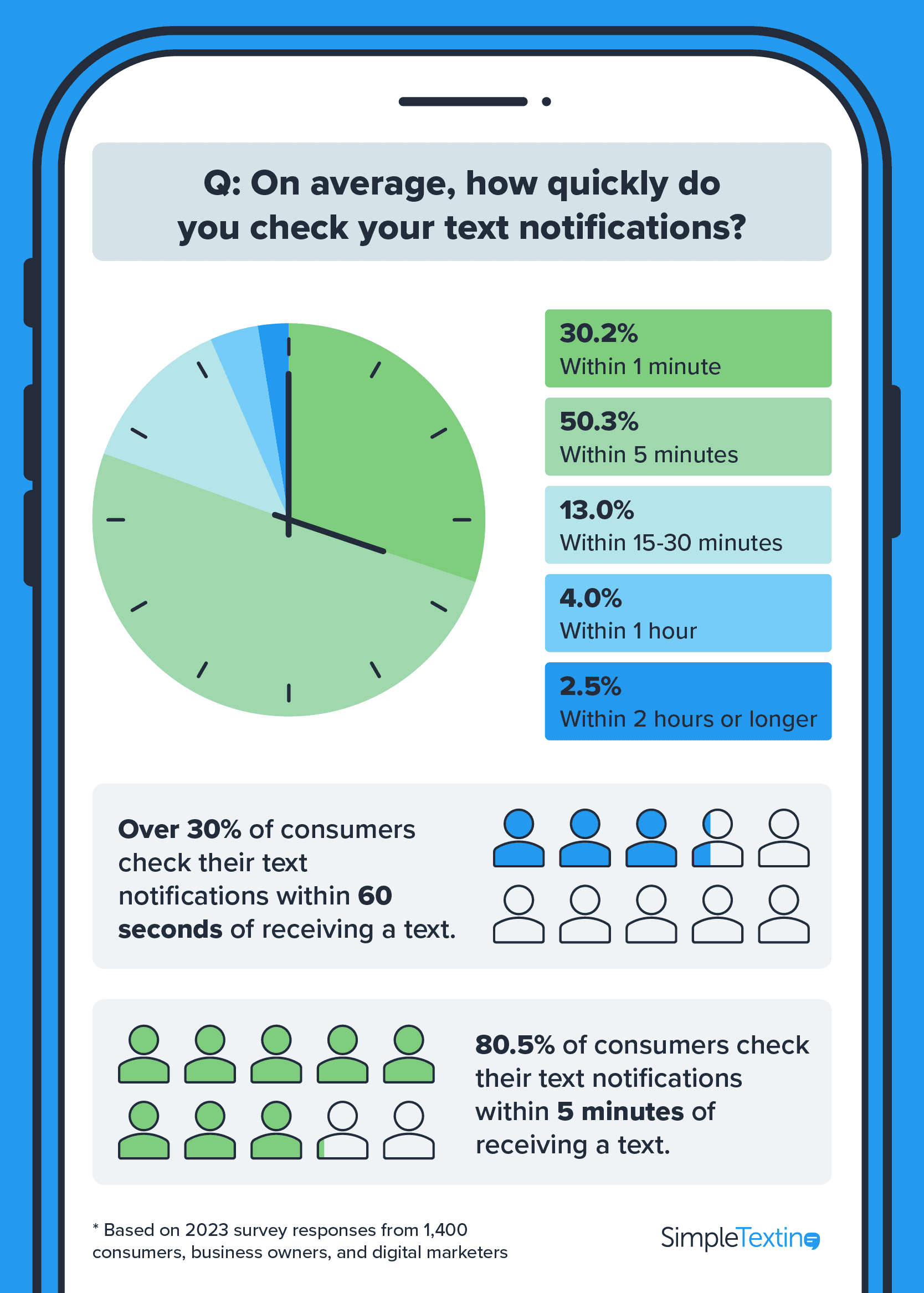
The channel delivering the highest ROI is email marketing. Because you must first build a subscriber list, the effort required to do a good job of email marketing is relatively high. However, once constructed, the long-term value of email marketing is high, especially if done well and you maintain consistency. Often, you find the returns from repeated messaging to this list grow over time.
| Channel | ROI Speed | Effort Level | Long-Term Value |
| Fast (once the list is built) | Medium | High | |
| SEO | Slow | High | Very High |
| PPC | Immediate | Low/Medium | Low |
| SMS | Immediate | Low | Medium |
SEO and GEO deliver on sales over time. That’s because you must create a lot of content before you’ll find that content ranking well. The rewards from SEO and GEO last forever, although there is a slight decline in the performance of older content. Plus, as users change the way they search, such as using voice search, and the content of their queries, you must change the way you construct content and the keywords you choose. Because search users are frequently seeking an immediate solution, such as finding a local plumber because they have a leaky pipe, the visitors coming to your website through organic search are high value.
Content marketing, including both short and long-form video, as well as social media posts, is essential for building awareness. While the immediate return on content marketing is small, the ability of good content to build awareness and shape attitudes that build purchase intentions results in long-term value from content marketing. Also, great content is essential for SEO/ GEO.
Paid advertising delivers a high ROI because it puts your content in front of users expressing intent that matches your chosen keywords. Since you only pay for the ad when someone clicks on the link, this type of advertising is very affordable. Paid ads on social media platforms are quickly replacing organic social media visits as more platforms seek to optimize revenue. The benefit of these ads is the laser focus you can use in targeting your ads to just the right users. Thus, both forms of paid digital advertising offer a high return.
Conclusion
In 2026, digital marketing isn’t so much about being everywhere as it is about connecting with your target market. By using an integrated digital marketing strategy across the channels where you’re likely to find them, you can move them through the conversion process more effectively.
By creating a channel ecosystem (like the one shown in the graphic at the end of this post), rather than a multi-channel strategy, you drive higher revenue and support growth.
Need marketing help to support business growth
We welcome the opportunity to show you how we can make your marketing SIZZLE with our data-driven, results-oriented marketing strategies. Sign up for our FREE newsletter, get our FREE guide to creating an awesome website, or contact us for more information on hiring us.
Hausman and Associates, the publisher of MKT Maven, is a full-service marketing agency operating at the intersection of marketing and digital media. Check out our affordable coaching programs to help your business thrive into the future.

Discover more from MKT Maven
Subscribe to get the latest posts sent to your email.


