 logo

Walk into any store. How do you feel? Engergized? Bored? That’s retail atmospherics, which greatly impact your shoppers and staff to drive behavior. Retail atmospherics include everything from lighting to inventory to parking to sensory input, such as scent. These atmospherics evoke memories and emotions that determine how long you’ll stay, whether you’ll buy something, and how employees feel about their jobs. Here are some retail atmospherics you can use to drive success.
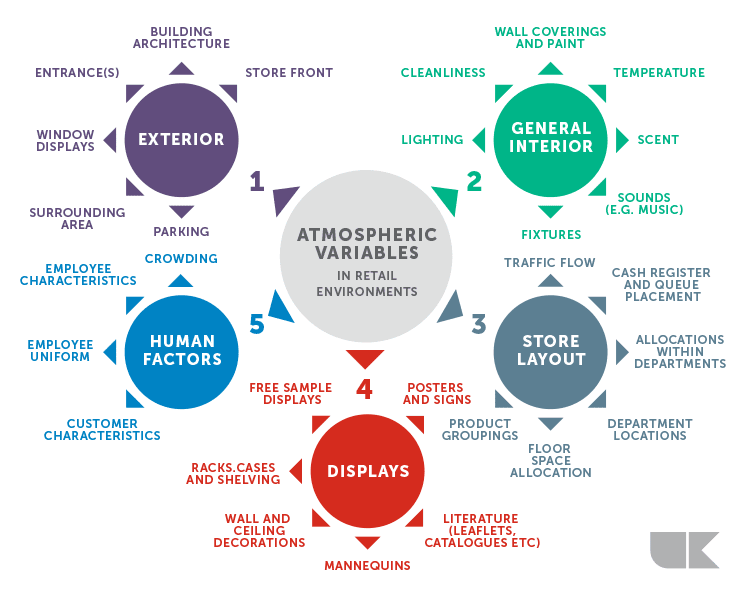
Retail atmospherics also tell shoppers whether they should walk into a store, whether it represents something for them or not. For instance, outside a trendy store, you might hear popular music playing and see samples of the store’s inventory. Even the way the window displays inventory tells you something about its target market. Is this “for you” or for someone else?
Extending the notion of retail atmospherics beyond a store, we can easily identify some of the same factors that impact your business. For instance, whether you run a beauty salon, a medical clinic, or a consulting business, you see some of these factors apply, such as parking, lighting, cleanliness, etc. Of course, some aspects of the retail atmosphere don’t apply in other contexts, for instance, mannequins, samples, uniforms, and queuing strategies.
We can also add digital elements such as shopping carts and checkout procedures, images and descriptions, virtual applications such as testing, and customer service in online retail atmospherics. In an online retail environment, purchase intentions are mediated by atmospherics and website satisfaction, including load speed and search/ filter operations.
How retail atmospherics impacts success
Atmospherics affect who you attract to your business, how long they stay, and how much they spend. Your physical space also impacts their intentions to recommend your business to others. Studies show that 79% of shoppers will stay longer in a business with appealing retail atmospherics. Now, staying longer might not be what you want if it doesn’t drive higher sales. Think broadly about this, however. Enter any Starbucks and you’ll see lots of folks parked at a table with their laptop and a single drink that they nurse for hours. You might prefer them to buy something and move along, but, over time, establishing this atmosphere drives more business.
Think about it; I’m sure you have a kitschy little boutique you love to shop at or a store you really hate because you can never find a parking space or it’s hard to get into the parking lot because of all the traffic. Or, a business with dirty bathrooms or a cluttered store. Studies show that one in five shoppers won’t return to it again.
Here are some ways atmospherics impact your business:
1. Retail atmospherics that impact success

Sights
How does your establishment look? Atmospherics also set the mood in your business. Bright lights, cluttered layouts, and lots of color work to attract younger customers, while a more muted palette, subdued lighting, and a wide open layout tend to attract wealthy customers. Colors impact purchases, as well. For instance, blue denotes trust (making it perfect for a doctor’s office or bank) while red shows energy (which is great for younger consumers). Warm colors stimulate appetite, so they’re great for a restaurant.
Lighting does more than make it easy to see. A dim restaurant might have just the right retail atmospherics for a date, but it doesn’t work if your guests can’t read the menu. If you see diners bringing out their cell phone flashlights to see the menu, it might be time to add a few watts to your lighting. You want to create a feeling of intimacy and relaxation, not discourage customers from entering your store.
How you display your inventory also impacts shoppers. A crowded showroom connotes bargains, so your pricing should fit with the notion evoked by your layout. Wide open layouts encourage shoppers to browse at their leisure.
Sounds
A cacophony of sound may work to jack up the vibe in a bar, but it doesn’t work for a restaurant or salon, where your customers want a sense of peace and stillness.
Slow music encourages shoppers to slow down and spend more money, whereas a faster tempo encourages a quick turnover.
Genre is also important as it tells shoppers what type of store or other establishment you run. Classical music implies sophistication and wealth, while popular music creates energy and attracts a younger shopper.
Smells
Scent is tied most closely to memory, which evokes emotion. The scent of cinnamon and chocolate evoke childhood memories of cookies baking in the oven to evoke positive memories. Developing a distinct scent for your brand, like Cinnabon or Auntie Anne’s, makes shoppers feel comforted.
A simple scent like vanilla makes a space feel relaxing, so it works well in a medical office where patients are often stressed. A citrus scent feels clean. Obviously, you want to avoid negative scents that are chemical or too strong.
Scent is so important for driving shopper behavior that some establishments actively pump the scent throughout the establishment or even into public areas, such as hallways in malls or sidewalks.
The takeaway from this discussion is that you want to use retail atmospherics to draw in your target market and encourage behaviors that lead to positive outcomes for your brand.
2. How retail atmospherics impact your staff

The same is true when it comes to the way retail atmospherics impact your employees who spend 40 or more hours a week in your establishment. Your goal should be to create a positive work environment for them; one that makes doing their job easier, not harder. Employees not only experience the mood of your operation from retail atmospherics, but their productivity is a function of those same elements.
For instance, lighting is important for working well, as struggling to find merchandise or prices leads to poor productivity, can cause headaches, and increases stress. A cramped layout not only annoys customers who have trouble finding what they want, it makes it hard on employees who must maintain some order in the chaos that results when shoppers rummage through the inventory looking for what they need.
Loud music might attract younger shoppers, but it strains the concentration and makes it hard to communicate for your staff. Moreover, listening to the same songs over and over every day lowers morale and causes irritation that makes it hard to concentrate on the job.
A strong scent, even a pleasant one, gets annoying when you’re exposed to it for eight hours every day. A room that’s too hot or too cold causes discomfort that might increase turnover.
Hence, when you create retail atmospherics, consider both staff and shoppers before settling on what works best.
3. Combining retail atmospherics of shoppers and staff
It’s undeniable that your employees directly impact the customer experience of shoppers. If you design a retail atmosphere that’s perfect for shoppers, but leaves your staff feeling stressed, tired, or annoyed by repetitive music played too loud, poor lighting, and a too-hot room that sends those shoppers to your competition.
Maintain your retail atmosphere
The issue of maintenance
One of the biggest challenges of working from a commercial property is the cost that comes with it. The mortgage or rent is usually one of the largest expenses for supporting activities, but you also have to worry about paying for utilities and any maintenance fees or repair costs.
Maintenance costs time and money and can even shut down your office for a short time, making it impossible to deal with customers. This can make it tempting to leave the maintenance to the last minute, only doing repair work when you absolutely need to. However, this is a mistake.
Putting off needed maintenance commonly results in higher costs when a machine breaks because you didn’t take the time to do regular maintenance. Software programs now help manage your maintenance to ensure you do regular maintenance. The use of AI and external monitoring, such as beacons, helps monitor your machines to ensure you take care of repairs before they break, requiring replacement or higher costs. Also, shutdowns represent opportunity costs, as you lose revenue when customers can’t buy from you.

Improving your image
The first reason to keep on top of your building maintenance is how it looks. Simply put, a worn-down and shabby building that’s been neglected doesn’t look good. It can represent a danger to your employees or visitors (customers) or simply create an unpleasant environment that makes it hard to recruit employees and customers.
Employees won’t enjoy working in a dangerous or unsightly place, which may also affect their morale. If the property is dangerous, then it could be illegal to expect them to work in such an environment, resulting in fines, lawsuits, or even criminal liability.
However, your employees are the least of your problems. Your customers and clients are sure to notice your property’s state, which can put create a bad impression. They could easily reason that a company that doesn’t care about its office or storefront doesn’t care about its product or service either. This can make customers lose trust. Customers may be driven away by a poorly maintained property at a storefront or restaurant location.
For example, if your parking lot is looking worse for wear, it can irritate visitors. However, making sure that the asphalt is properly sealed can prolong its life and slow down any damage. You can learn more about how this can improve how your business comes across to your employees and customers.
Reducing costs
As well as making your business look unsightly, neglecting your maintenance can also cost more money. It’s usually far easier and cheaper to repair a minor issue than to have to deal with a major one, which sometimes results in a complete replacement.
Regular maintenance also potentially reduces utility costs as your business will waste less energy and water. This is better for your wallet and for the environment.
Conclusion
Retail atmospherics is more than creating a pretty storefront or an excuse to hire a decorator. It’s a strategic investment in your customers and staff. Think about the feeling and emotions you want to create with your atmosphere, then moderate, taking into account ways the atmosphere might impact your staff.
Need marketing help to support business growth?
We welcome the opportunity to show you how we can make your marketing SIZZLE with our data-driven, results-oriented marketing strategies. Sign up for our FREE newsletter, get our FREE guide to creating an awesome website, or contact us for more information on hiring us.
Hausman and Associates, the publisher of MKT Maven, is a full-service marketing agency operating at the intersection of marketing and digital media. Check out our full range of services.
Discover more from MKT Maven
Subscribe to get the latest posts sent to your email.


