 logo

Ready, set, pump it up! When it comes to advertising your business, you need to ensure you allocate your resources well to maximize your gains and reach your goals! There are several factors you need to keep in mind when deciding your advertising budget and today’s post discusses the five most important considerations in setting your ad budget. In this example, we focus on setting an ad budget for a gym, since every industry offers its own unique set of challenges and opportunities.
 So, if you are wondering how much you should spend advertising your gym, make sure to read on!
Setting an ad budget
Before we jump into some specifics, let’s talk about setting an ad budget in general. There are four ways to set your budget:
- Percentage of sales method – which takes your sales forecast and dedicates a percentage of those sales (say 10%) to advertising
- Competitive parity method – which attempts to match your competitors’ ad budget. Finding this information isn’t easy but you can look to publically traded companies for this information since it’s a standard part of their required reporting to the SEC (security and exchange commission). Hoovers might also offer this information for some set of the companies for which they collect information. A final source comes from industry reports from private companies.
- All you can afford – which sets a dollar figure that represents what fits with the rest of your budget
- Object-task – which uses your goals and determines the ad budget necessary to reach these goals based on past performance.
I won’t go into specifics of each method in this post but you can find a detailed post on setting an ad budget using each of these methods in an earlier post. It’s a few years old, but not much has changed when it comes to budgeting methods.
Determining your ad budget for a gym
Marketing a gym is a little different from marketing in general. First, gyms are commonly marketed as a membership, although some newer models involve selling individual sessions or a package of session tokens. When selling memberships, you ask members to pay a subscription fee, thus spreading the purchase over time. This makes the price tag more palatable.
Another feature of gym marketing is its seasonality. Gyms sell more memberships during the New Year push for keeping resolutions and prior to summer when consumers focus on getting in shape for swimwear and more revealing clothing than the bulk worn during the colder months. Thus, gyms often flight their advertising, which translates into periods when you increase your ad budget corresponding to the times when consumers are more interested in joining and letting your campaigns go during other months or at least cutting back on ad spend. This makes budgeting a more complex task, as you spend much more during some periods than others. It can also strain your budget for other elements to accommodate higher ad spending levels.
Five considerations in ad budgeting
Reach
The first thing you should think about is your reach. How many people do you hope to reach with your gym advertising? In general, a wider reach costs more money than focusing on reaching a smaller group of consumers. By clearly defining your target market (those most likely to sign up for membership), you can selectively reach more of that market at a lower cost.
Defining your reach helps you define clear objectives for your advertising campaign. This is a great help in setting your budget.
Time and frequency
Advertising frequency is also an important factor to consider when developing a gym ad budget. The budget is determined by how frequently you want to advertise and when you run your advertising campaigns. More frequent advertising allows you to reach more people but also costs more money. You must strike a balance that is the middle ground between your requirements and your budget.
As you can see in the image below, if your target market doesn’t see your ad enough, you don’t see enough results (in this case clicks as reflected by click-through rate or CTR). The more you advertise, the higher the cost (cost per click or CPC). The goal is to choose wisely so you optimize your results without a large CPC.
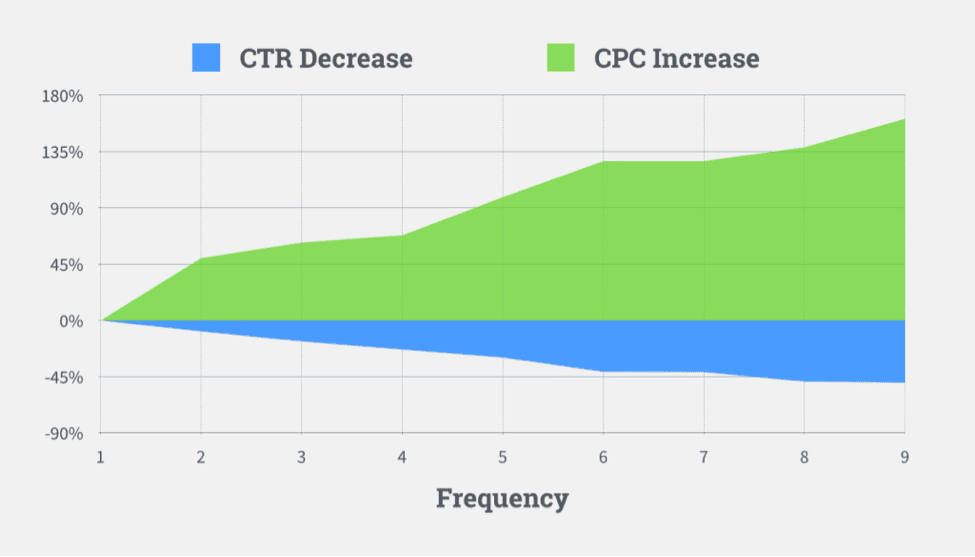
Also, consider how frequently your target market sees your advertising. In general, studies, such as those from Nielsen, found that consumers must see an ad 5-9 times to improve product performance metrics. Even more concerning, if your target market sees your ad too frequently, you can see ad burnout resulting in higher costs and lower returns.
Audience targeting
The most crucial task in creating an efficient gym ad budget is identifying your target market, as mentioned earlier. Ask yourself what your target market looks like. You need to make sure you are advertising to the people who are most likely to use your gym. This has a big impact on your gym advertising budget.
Building market personas (like the one below) to represent typical members of each target market helps you craft messaging that’s likely to drive results. Targeting different demographics, such as age, gender, location, interests, and so on, will incur different costs but will likely deliver higher returns. Thus, the more precise you are, the lower your overall costs and higher your returns.

Media channels
The media you choose for your gym marketing campaigns directly impacts your budget. Some media channels work on a local level, while others have a much broader audience. Local reach is unquestionably preferred for gym advertising unless you have a large national brand, such as Planet Fitness. Choose a media channel that reflects your target market.
Media channels differ in costs, as well. For example, online media is less expensive than broadcast TV. Cable TV and streaming advertising are middle-of-the-road options, in most markets. Online media, such as social advertising, offer different options in terms of cost and targeting. Choosing the right media can significantly increase your reach and frequency in order to increase awareness, interest, and interaction among those who matter the most at a favorable cost.
You must know the costs associated with each type of advertising channel to determine what works best for your budget. Check out this gym advertising article for more in-depth information about how frequently you should advertise and through which medium.
Creativity
When it comes to your gym ad budget, creativity and messaging greatly affect your results. In social media, these factors also help determine reach by gaining engagement that shares your messages with other users.
You need unique visuals or clever taglines that will grab people’s attention and make them want to visit your gym. After all, you want the advertisements to instantly catch your audience’s attention, but you will also need to budget for that. Outside-the-box ideas and creative ways to get your message across do not come cheap. So, the level of creativity you want will also outline the budget.
The Bottom Line
When advertising your gym, there are many factors you need to consider carefully to allocate your resources efficiently. If you keep these factors in mind, you will be able to create a successful advertising campaign that will help you reach your business goals!
Need marketing help to support business growth?
We welcome the opportunity to show you how we can make your marketing SIZZLE with our data-driven, results-oriented marketing strategies. Sign up for our FREE newsletter, get our FREE guide to creating an awesome website, or contact us for more information on hiring us.
Hausman and Associates, the publisher of MKT Maven, is a full-service marketing agency operating at the intersection of marketing and digital media. Check out our full range of services.
Discover more from MKT Maven
Subscribe to get the latest posts sent to your email.


