 logo

As a small business owner, you might not consider the impact of digital marketing on your business’s success, which means you need the core digital marketing skills to implement digital marketing effectively. According to Forbes, “The internet has become an indispensable tool for almost any consumer making a decision.” But even as far back as 2020, a survey of small business owners found that 60% recognized that a pivot to creating a strong digital presence was essential to succeed, according to Dun and Bradstreet. That’s because the internet is the first place most users go when looking for a solution, whether it’s finding a local plumber or buying a new dress for a niece’s wedding. In the graphic below, you see data supporting this claim.
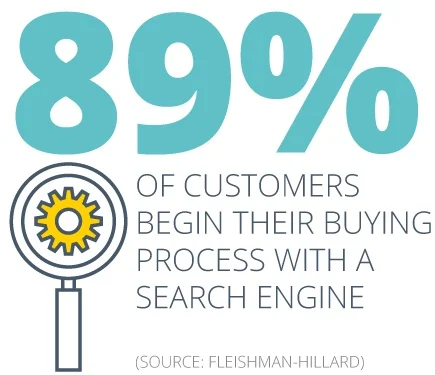
Hence, whether you’re selling products online or simply want an online presence so customers can find your business, digital marketing is a critical factor in your success. Among the powerful benefits small businesses gain from using effective digital marketing strategies, according to Salesforce, are:
- The ability to reach a broader target market
- Digital marketing is a very cost-effective marketing tool that allows small businesses to compete with much larger ones. For instance, by employing effective digital marketing, King Arthur ( a small flour company) increases year-over-year sales by 2000%.
- Targeting is essential for small businesses because most have a relatively small customer base. Especially for local businesses like physicians, hairdressers, and electricians, it’s wasteful to pay to reach customers in far-flung areas when your target market lives close to your business. Digital marketing allows you to reach a higher percentage of the folks who are likely to become customers while wasting fewer resources on those without this potential.
- With traditional marketing, you often couldn’t evaluate the performance of your marketing efforts. Using digital marketing, you can now drill down on your results to make data-driven decisions about how to allocate your resources to get the most bang for your buck.
- Using digital marketing, you’re able to present your business as a person rather than a nebulous entity, which helps you build long-term relationships that translate into reaching more prospective customers, bringing existing customers back over and over, and offering the potential to offer products at a premium price. You also gain access to new opportunities by engaging in two-way conversations with your target market.
What are the digital marketing skills you need for success
Succeeding in digital marketing is much more than putting some fancy words with some pretty pictures on an Instagram post. You need to understand the infrastructure of the digital marketing world, what words and images motivate your target market to buy your products rather than those offered by a competitor, and the ability to move at the speed of electrons, since you can’t wait when you need to respond to a comment or criticism of your brand. Today, we’ll discuss the skills you need.
Please don’t trust your digital marketing to your niece or some intern, thinking that young folks know all they need to know to generate digital marketing success. In today’s world, the number of skills needed for digital marketing success is growing and becoming more technical. Sure, they may have 10K following their TikTok channel where they tape themselves doing crazy stunts, or a bunch of folks following their Instagram displaying drunken parties at State U, but does that make them a digital marketing genius?
NO. You need staff with 21st-century digital marketing skills, combining traditional marketing concepts with newer technologies, to achieve success in the digital age.

It also doesn’t make much sense to hire someone with a degree in journalism, finance, engineering (the last two representing the newest trends I’m learning about), or another degree.
It takes skills to be a digital marketing success and create ROI for your business. And marketing majors have some of those skills, but most marketing programs at universities around the country do a pretty poor job of preparing students for the digital demands. The same is true for those online schools that offer a shortcut to digital marketing training because most lack any relationship to traditional marketing concepts such as segmentation and positioning, new product development, promotional strategies, and pricing.
10 digital marketing skills you need
At its heart, digital marketing IS marketing. That’s why my list of the top digital marketing skills starts with core marketing concepts.
Sure, you can learn what a target market is or develop personas by reading a few blog posts, but understanding more complex marketing concepts and tools takes more than an hour or 2. Does your digital marketing employee know about all these tools?
Core marketing concepts you’ll need to master
- Cialdini’s 6 tools of influence
- Perceptual mapping
- Pricing, including yield management and demand pricing
- Market research (we don’t mean some feeble attempt, but true market research)
- Group influences
- Service audits
- Marketing planning, strategy, and analytics, including developing a marketing plan
- The concept of customer lifetime value and how to craft strategies for optimization
- Understand the customer journey and craft strategies for unique stages in the customer journey

- and much, much more

And that’s just the traditional marketing stuff. Now, add digital marketing.
17 Skills needed for digital marketing success
There’s no definitive list of the skills you need to succeed in digital marketing, but here goes my take on this topic, in no particular order. It’s also worth mentioning that most, if not all, of these skills face a demand that far exceeds supply, leading to higher salaries and tough challenges in hiring.
- Analytical skills
- SEO/ SEM
- Digital advertising
- Email marketing
- Website design, including rudimentary knowledge of HTML and CSS, because no theme works without a little customization
- Knowledge of the tools necessary in the digital age to manage data-driven decision-making and strategic thinking
- Social listening and the tools used to monitor what folks are saying about your brand and products
- Community building on social media
- Lead generation and conversion, or CRM (customer relationship management)
- Content creation, writing and editing, and research
- Image and video design software like Photoshop and Premiere Pro, Canva, and others
- Social media marketing, engagement, and content
- Automation tools
- Branding and brand development
- AI (artificial intelligence)
- Chatbots and other customer management tactics
- Project management to keep everything running on schedule
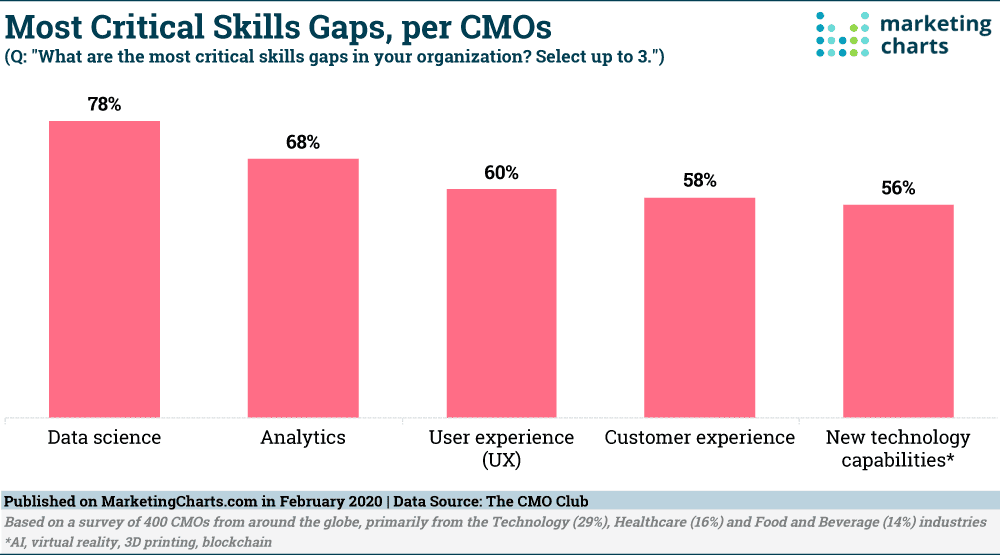
Analytics
Marketing in the future will be all about metrics, analysis, and proving performance (ROI). That’s the excuse given for hiring finance folks — they understand attribution, which involves understanding how your tactics contribute to performance. The marketers of the future need to surpass their financial brethren when it comes to analyzing market performance, so they can make data-driven decisions and calculate the ROI of each action to justify expenditures to upper management.
And, marketers have a leg up because they know WHAT to measure to understand how to improve market performance, not just attribution. While Google Analytics is a great tool, especially with funnel metrics, cohort analysis, and interest metrics, it’s not enough.
Also, marketers know that conversion requires a process of bringing in potential customers, driving them down the funnel, and nurturing them to retain customers, which is 5 times less expensive than bringing in new customers, as you can see in the image of the customer journey shared earlier. Simply focusing on conversion reduces market performance compared to focusing on the entire customer journey.
Design
Gone are the days of spending months using specially trained folks to design your ad or brochure. Now, content is crafted in the moment and in massive volume. Instead of going through layers of scrutiny, content creation requires great writing and editing skills, a little design sense, and the ability to manipulate images and text using some basic HTML/CSS. You need to research if you’re going to develop content that attracts backlinks and creates value for your readers. You need to create images and videos that supplement those content efforts.
Strategy
Maybe because marketing material is crafted using nearly JIT (just in time) methods, everyone on your digital marketing team needs to understand strategic direction, determine the fit between content and firm goals, and build in performance metrics when creating content for web pages, newsletters, and social media posts.
Google has some great tools to help with understanding how different strategies and tactics contribute to market performance, including event tracking and campaign performance tools. Aside from Google, several tools help monitor performance to guide decision-making. Among these are:
- Marketo – customer engagement metrics
- Google – UTM building, as well as other metrics that allow you to tag content, so you can parse responses to individual content
- Buffer – content curation
- Kissmetrics – analytics
SEO
It used to be that IT professionals managed SEO, which relied heavily on meta tags, schema, indexability, and other technical elements of website design. Today, that’s much different and marketers need to drive the SEO bus.
Crafting valuable content consistently and sharing it effectively with influencers, social media, and spider bots now determines most of your SERP rank (search engine results page — basically where you show up in a search engine search). AI is likely the future of SEO as more users turn to LLM (large language models) like ChatGPT to answer questions rather than search engines.
SEO also means putting yourself in the minds of prospective buyers to understand how they search for products and services like yours — called keyword planning. Today, searchers use long-tail keywords — keyword phrases — which help them find what they’re looking for with more specificity. So, marketers should think in terms of what keywords (keyword phrases) customers might use to find them. You must also cultivate backlinks through a combination of SEO and other content strategies.

Listening
Listening to customers and prospects may be the biggest factor contributing to the long-term success of your firm and providing the highest ROI. But listening isn’t easy.
OK, so listening might be easy, and there are lots of tools out there that’ll turn social comments into sentiment. But interpreting what you hear is very difficult when you go beyond sentiment analysis.
Beyond comments about how good or bad you are, social media posts identify unmet needs, new features and functionality they want from your products, evaluations of your support or sales process, and lots of other invaluable information. If you’re not listening carefully to customers and prospects, you can be sure competitors are and they’ll be the ones reaping the benefits from providing products and services that better meet the needs of customers.
Learning
Digital marketing success relies on continual learning — new techniques, new strategies, new social media platforms, benchmarking against competitors, and identifying new opportunities provided by changing technology and culture.
As a digital marketer, you should plan on spending almost as much time reading as writing. Feedly is a great resource for this as it brings in fresh content from top news sources daily.
Community building
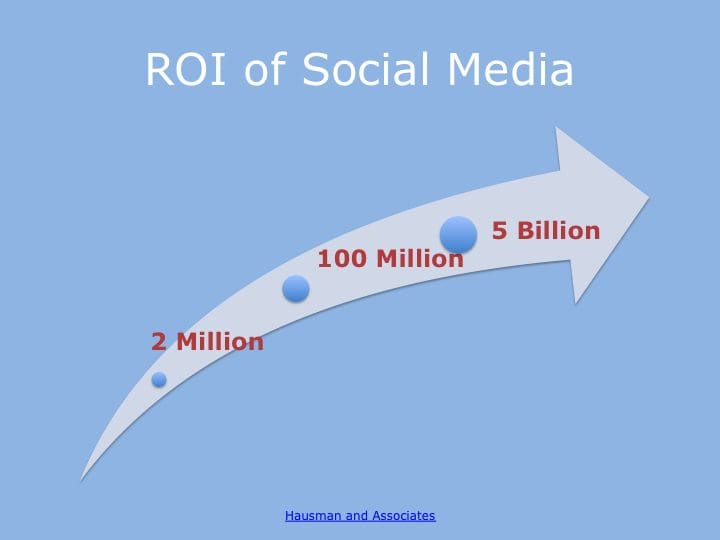
Unlike traditional marketing, digital marketing success requires you to build a community around your brand. Community building requires an understanding of the value of members, an ability to engage them, and accurate timing so your posts are seen by influencers and others in your community.
Community outreach through email marketing and other tactics helps your message spread, which increases awareness, builds a positive image, and promotes market performance. Buffer and the Buffer blog are great tools for helping build a community of engaged customers and prospects.
Conclusion
In this post, we briefly touched on the 17 digital marketing skills you need for your small business. While it’s expensive to hire professionals with the right combination of skill and experience, you might find hiring a consultant or a digital marketing agency fits your budget better, especially if you don’t have enough work to justify hiring a full-time staff member to manage your digital marketing. We’re happy to help with our coaching program or with a full-service digital marketing agency.
Need marketing help to support business growth?
We welcome the opportunity to show you how we can make your marketing SIZZLE with our data-driven, results-oriented marketing strategies. Sign up for our FREE newsletter, get our FREE guide to creating an awesome website, or contact us for more information on hiring us.
Hausman and Associates, the publisher of MKT Maven, is a full-service marketing agency operating at the intersection of marketing and digital media. Check out our full range of services.
Discover more from MKT Maven
Subscribe to get the latest posts sent to your email.


