 logo

The subscription economy is changing how brands make money, moving from one-time payments to regular payments. Imagine a world where you buy nothing outright. Netflix for movies, meal kits delivered weekly, and even expensive software like those offered by Adobe now come with monthly or yearly subscriptions to make them more affordable.
But why is a subscription economy so popular, and how does it help businesses grow? Let’s get into it.
What is the subscription economy?
In a nutshell, the subscription economy is a system where businesses charge customers a monthly fee for a product or service. Instead of buying a product once, customers subscribe and pay monthly, yearly, or weekly. Think Spotify, where you pay monthly to access unlimited music instead of buying individual albums, or Amazon Kindle Unlimited, where you can download an unlimited number of books that are in the subscription as examples of using a subscription model rather than selling individual books or albums.
This model has spread across industries, from fitness apps to software to pet supplies. In some cases, rather than paying a monthly fee, a user subscribes to get a lower price on products purchased frequently, such as pet food. It’s easy for customers and good for businesses.
Why brands love subscriptions
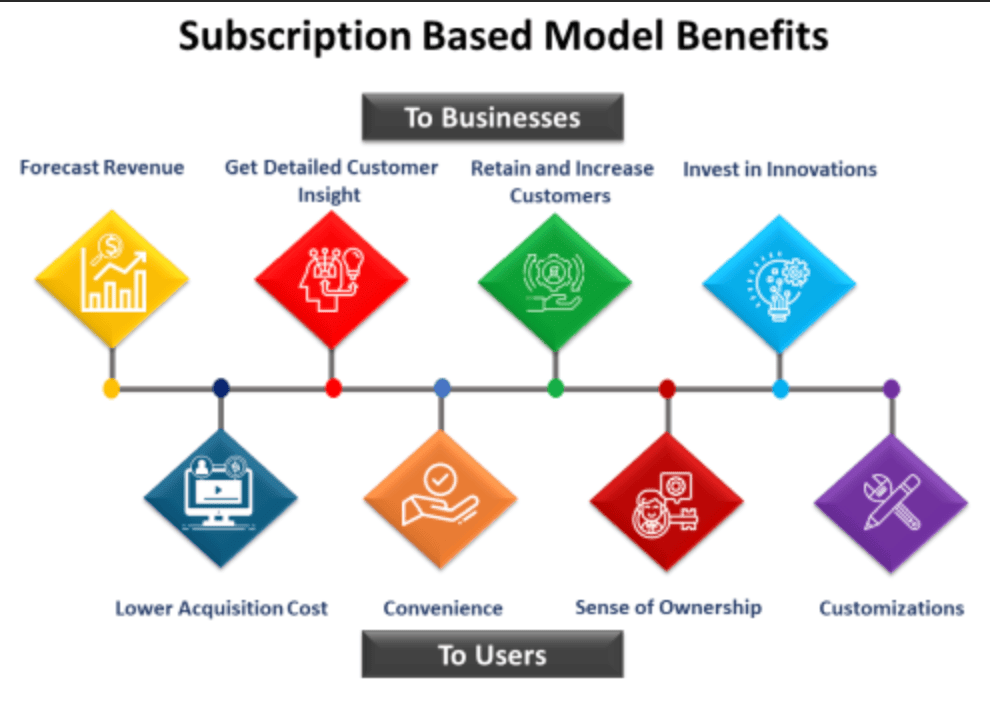
As you can see in the image shared earlier, there are many reasons why brands love the subscription economy. The chief among them is the revenue generated by this model. Let’s delve into them more deeply.
Predictable income
Unlike one-time sales, subscriptions bring in regular, predictable income. A brand knows how much money to expect each month, which reduces uncertainty. Brands can now predict income better, which allows them to engage in data-based decision-making that increases the likelihood of success, especially when the brand’s planning involves high-priced capital improvements or new products.
Although the subscription model commonly allows consumers to cancel at any time, the rate of cancellation is often small (around 12% to 25%), especially for low-priced products such as streaming video services.
Customer retention
When customers subscribe, they’re more likely to stick around. This builds loyalty over time. That loyalty may translate into growth opportunities, especially since many brands participating in the subscription economy offer a one-time discount or reward for customers who introduce a new customer to the brand’s services.
 Upsell opportunities

Companies can offer premium tiers or add-ons that supplement the subscription. For example, a streaming service might provide a higher-priced plan with more features like no advertising. Also, a company subscriber may return to the brand’s product when seeking a new, related product. For instance, if you have a subscription to purchase your pet’s food monthly (or some other schedule), you might seek out a new pet bed or related product from the same brand simply because it’s easier.
Learn more about customers
Since subscribers provide information as part of their subscription and every purchase made offers additional information, you have what you need to improve your recommendation engine to help you acquire and retain customers. For instance, a Netflix subscriber shares their viewing preferences each time they view a product. Netflix uses this information to enhance the recommended products geared to that customer, as well as other customers who share characteristics with the viewer.
Companies can also use information about a customer to better target advertising to prospective customers who share the customer’s characteristics. This increases the likelihood of the prospective customer becoming a subscriber.
Why consumers like subscriptions
Obviously, companies only gain from the subscription economy when consumers choose this mode of purchase. Hence, consumers must receive some benefits. These include:
- Convenience
- Customization of their experience
- Lower costs
- A sense of belonging
Stats and facts on the subscription boom
The subscription economy has grown big time. According to a report from Zuora, subscription businesses have grown 4.6 times faster than traditional retail in the last 10 years. Streaming services like Netflix now have over 200 million subscribers worldwide. This isn’t slowing down – by 2025, the global subscription economy will reach $1.5 trillion.
How an IP VPN fits into the subscription model

Technology services, like an IP VPN, are perfect examples of subscription-based products. An IP VPN protects your online privacy by hiding your real location and securing your internet connection. People pay monthly or yearly for these services because online security is an ongoing need. A one-time payment wouldn’t make sense since threats constantly evolve.
By subscribing to a dedicated IP VPN, users can have peace of mind knowing their data is private. Brands benefit, too, as they can expect recurring revenue and continuously improve their products.
What brands should watch out for
The subscription economy is excellent, but it’s not perfect. One issue is customer churn, which occurs when customers cancel their subscriptions and brands lose recurring revenue, an event called churn. To reduce, companies need to offer real value and communicate clearly about pricing and terms so they don’t upset customers. They can reduce churn by:
- understanding what factors drive churn in customer groups
- optimize the onboarding process to ensure subscribers get the most from their subscription
- gather customer feedback to constantly improve the user experience
- personalize communication and recommendations
- create loyalty programs
- offer flexible, multi-tier pricing options and recommend a lower priced option when subscribers want to cancel
- offer regular feature updates.
The subscription economy is here to stay
Recurring revenue gives brands stability; customers love the convenience and innovation happens. Companies that use this model can focus on long-term relationships, not short-term sales.
Tips for subscriptions for brands
Transitioning to a subscription model can be a total game changer, but it requires some thought.Here are some strategies to help brands do it right and build long term relationships with their customers.
Start small
Going all in on a full subscription model can be overwhelming. Instead, start small.Start with a subscription for one product or service. This allows you to test interest, gather feedback and adjust your strategy without much risk.
For example, if you sell coffee, start with a monthly coffee bean subscription before adding other related items. Starting small lets you work out the kinks before you scale.
Be flexible
No one likes to feel locked in. To build trust with your customers, make it easy for them to manage their subscriptions. This will not only be an advantage for you, but also for your customers to keep them happy.
Let users pause or cancel without jumping through hoops. This might seem crazy, but it actually builds goodwill and gets people to come back in the future. You also avoid the negative social media that might discourage prospective subscribers from joining your program. And this is what you want, right?
Keep it fresh
Subscriptions are about long-term relationships, so brands need to keep the experience new and exciting. Update your offerings regularly with new features, products or perks. For example, a streaming service could introduce new content, a subscription box could include seasonal items.
Final thoughts
The subscription economy isn’t just a trend; it’s a new way of doing business. It allows brands to grow steadily while offering customers value over time. In my opinion, this model works best when companies truly care about their subscribers. Brands that prioritize customer needs will stand out, while those that treat it as a quick cash grab might struggle.
Need marketing help to support business growth?
We welcome the opportunity to show you how we can make your marketing SIZZLE with our data-driven, results-oriented marketing strategies. Sign up for our FREE newsletter, get our FREE guide to creating an awesome website, or contact us for more information on hiring us.
Hausman and Associates, the publisher of MKT Maven, is a full-service marketing agency operating at the intersection of marketing and digital media. Check out our full range of services.
Discover more from MKT Maven
Subscribe to get the latest posts sent to your email.


