 logo

Are you using paid digital advertising?
Are you getting the results you need from this strategy?
If the answers to these questions are no, then this post is for you. Read on to learn why you need paid digital ads in 2025 and how to implement these ads on social platforms and search so you can explode your business.
Why do you need paid digital advertising?
Social media has been a boon to small businesses by creating platforms that equalized the playing field so they could compete with large businesses that could afford huge advertising budgets. With the right strategy, small businesses successfully captured attention on social media without spending money beyond the cost of hiring social media managers and creating content (which didn’t involve high-priced celebrities). Those were the good old days, back in 2012. Today, with social platforms struggling to show a profit for investors, it’s all about revenue. They use algorithms designed to keep users engaged on the platform for more extended periods, which allows them to show users more paid advertising to raise more revenue. That means, for the average small business, organic (unpaid) reach has declined precipitously. The other digital alternative, search, offers similar challenges to small businesses as AI changes the nature of search engine marketing (SEO), which now limits the organic reach opportunities through search engines.
Thus, small businesses need paid digital advertising if they want to stay relevant in a world dominated by algorithms, where consumers turn to the internet as their first source of information on most purchase decisions.
Benefits of paid digital advertising
Paid advertising offers a number of benefits that make it an attractive tactic for small businesses. Among these are:
- Low cost. While most traditional advertising is expensive, digital advertising costs a fraction of this. You can implement a successful social media or search campaign for just a few hundred dollars, especially if you seek a local consumer. I’ve done advertising campaigns where I paid a mere five cents per click on search and reached thousands for a hundred dollars on Facebook/ Instagram. The cost to reach 1000 people for digital advertising ranges between $25 (search) and $37 (social), while traditional advertising ranges between $75 (broadcast) and $450 (direct mail).
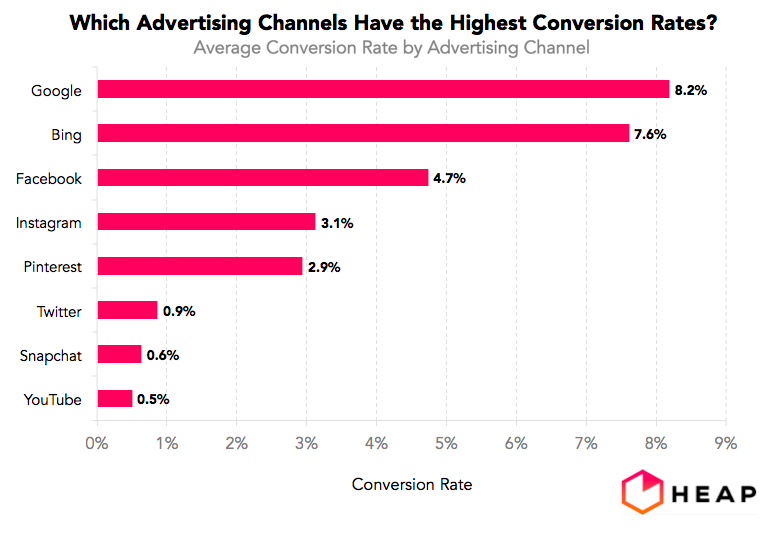
- Digital advertising campaigns reflect high conversion rates when compared with advertising on other platforms.

Image courtesy of Forbes - Highly targeted advertising. While traditional advertising is “spray and pray”, digital advertising allows you to focus on a select group of consumers that fit within the targeted segments of your market. Instead of reaching hundreds or thousands of uninterested users, you reach those most likely to convert. With search advertising, you achieve the additional benefit of reaching people when they’re actively searching for a solution like the ones you offer.
- It’s easy to set up digital advertising and you can quickly adapt your campaign on the fly when you see how your market responds to your initial efforts.
- You can start with a tiny budget, say $25, to see what works. Once you have some preliminary results, you can easily expand your budget.
- Digital platforms offer high-quality metrics that allow you to make informed decisions that optimize your results.
- Most platforms now offer AI tools to help with this optimization task.
How to set up digital advertising
- The first step is to set your advertising goals. For instance, you might want to increase sales, gain email list subscribers, or achieve another terminal goal. Likewise, you might be more concerned with intermediate goals or initial goals, as reflected by metrics such as reach, frequency, clicks, etc. You’ll design your advertising around achieving these goals.
- Know your market by creating personas that reflect your target market segment. You need to carefully target your advertising to one persona or maybe a couple of highly related personas. The more personalized your ad is, the better it fits the persona, the more effective the ad will be.
- Choose the right platforms. You want to choose platforms where you’re likely to find your target market hanging out. Here are some options you might choose from:
- Search and shopping ads on platforms, often referred to as pay-per-click advertising, are available on Google and Bing. You can also advertise on YouTube with the Google Ads platform.
Image courtesy of Piyush - Meta – Facebook and Instagram
- Amazon
- TikTok
- Search and shopping ads on platforms, often referred to as pay-per-click advertising, are available on Google and Bing. You can also advertise on YouTube with the Google Ads platform.
- Generate your creative. Most platforms offer AI to help with this task or you can use another tool such as Canva or Adobe to create your ad.
- Focus on a clear call to action, such as “buy now” or “see details”. Buttons outperform links, so when creating ads consider using a button (although search ads don’t allow this).
- Choose catchy headlines. With Meta, you can use their AI tool to offer suggestions and alternatives. Google Ads allows you to create a bunch of alternative headlines, which it serves up to random users and quickly determines which combination works best for achieving your goal.
- Closely align your ad with the landing page destination for the button or link. NEVER send clicks to your home page. Always create a dedicated landing page that matches each ad.
- Use copy to demonstrate your value proposition and the benefits to your target market rather than description. Keep it short.
- Personalize your content with the qualities of each persona in mind.
- Humanize your content with humor, personal images, backstage images, etc
- Employ precise targeting. With Google Ads, you do this by carefully choosing the keywords as part of your targeting effort. With social ads, you can choose the target for your message using demographics, geography, and psychographic elements such as interests. Retargeting is a great strategy offering much higher conversion rates because you’re targeting folks who visited your website before.
- Set your budget. Below, you can see some averages spent on advertising by companies in popular industries. Use this as a guide. Remember, you can quickly adjust this budget at any time. I like to start with a small budget that allows me to assess performance before spending my entire campaign budget on the optimal ad.
Image courtesy of Zippia - Monitor spending and tweak.
- Don’t just view CPC (cost per click). Your goal likely involves conversion, so follow clicks through your website using tracking codes to determine how many visitors from your ad convert. For non-monetary conversions, like email subscriptions, set a value to the benefit you receive from having more subscribers. This is called ROAS for return on advertising spend. Meta offers pixels you employ when setting up your ad to track the click as the visitor moves through your website, while you must tag the URL when setting up Google Ads or using other social media platforms.
- Ads work best when viewed multiple times by each user. On average, users must have 6-8 touchpoints with your brand prior to converting. So, you must also monitor frequency as a key metric for assessing your ad effectiveness.
- Monitor reach, as the more people you reach, the more opportunities you have to reach your goal.
- Use A/B testing to quickly optimize the performance of your paid digital advertising. Many platforms now offer multivariate testing, which allows you to test multiple elements of your ad at once, while A/B testing requires that each option vary by a single element.
- Ensure your website is optimized before you start advertising or you risk wasting your time and money. Ensure your website is:
- fast
- offers a clear, simple checkout process
- allows multiple payment options that likely appeal to your target market
- displays trust signals
- Make sure you comply with privacy laws and regulations. Most of the developed world requires some form of privacy guarantee, such as opting in for cookie tracking.


Conclusion
If you found all this information new and exciting, look for the video I created around this topic on my YouTube channel (Digital Advertising). This is part of my small business marketing video series and I already posted a number of other videos you’ll find invaluable as you plan and implement your small business marketing.
Coming up next in this series, I’ll get into the weeds about two of the most popular paid digital advertising platforms – Google Ads and Meta (Facebook and Instagram). And, if you prefer to consume your content in short blog posts, you’ll find a summary of that video on this site.
Need marketing help to support business growth?
We welcome the opportunity to show you how we can make your marketing SIZZLE with our data-driven, results-oriented marketing strategies. Sign up for our FREE newsletter, get our FREE guide to creating an awesome website, or contact us for more information on hiring us.
Hausman and Associates, the publisher of MKT Maven, is a full-service marketing agency operating at the intersection of marketing and digital media. Check out our full range of services.
Discover more from MKT Maven
Subscribe to get the latest posts sent to your email.


