 logo

Starting a business is a dream for many people. Actually taking that leap and launching a business is often so daunting that, for many people, it remains a dream. For some, it might be procrastination, that feeling that you’ll put it off until the perfect time when, often, that perfect time never comes. For others, it’s something else. That’s a shame because you just never know where a business could take you, and it might be the best thing you ever do if you could even commit to doing it. But whatever it is that’s stopping you from doing it is just getting in the way of realizing your dream. Today, we’ll discuss common reasons preventing you from launching a business and how to get over the hump to get the future you imagine. So, buckle up!
So that’s the trick—work out what’s stopping you and then find out how to get past that particular obstacle, and you can be on your way to your potentially fantastic future. With that in mind, let’s take a look at what’s stopping you from launching a business so you can take the next essential steps.

Impediments to launching a business

Don’t know how to get started
One of the biggest reasons people don’t start their own businesses, despite an overwhelming desire to do so, is that they find the whole process of launching a business daunting. Sometimes, well-meaning friends offer advice on what you need to do that is uninformed (at best) or self-serving (at worst). They might even discourage you from embarking on the venture for their own selfish reasons. A spouse might fear losing your income, at least in the short run, or having to take on more household responsibilities as they know you’ll be busy getting your venture off the ground. Friends might secretly want to maintain their current social structure, something they see as threatened if you own a business. If the person offering advice is a business professional, they might steer you with information that benefits their own business rather than yours.
If you’re serious about launching a business, your first stop is the US Small Business Administration (SBA) or a similar governmental organization in your country. The SBA offers online resources that cover almost every topic related to starting a business, from financing to planning to technology. Although the regulatory information is geared to the US, obviously, the rest is helpful regardless of your country or industry. The agency also offers events both in person and remotely through their own website as well as offering both events and one-on-one counseling through the SBDC (Small Business Development Council). You’ll find a branch of the SBDC in most US areas commonly offered through local colleges or universities. These are primarily free and staffed by degreed individuals rather than students. You can also find SCORE (Service Corp of Retired Executives), which offers events and counseling sessions, although their knowledge might be a little dated.
Basically, the steps you need to follow before launching a business, regardless of industry or region, according to Forbes, are:
- Before You Begin: Get in the Right Mindset
- 1. Determine Your Business Concept
- 2. Research Your Competitors and Market
- 3. Create Your Business Plan
- 4. Choose Your Business Structure
- 5. Register Your Business and Get Licenses
- 6. Get Your Finances in Order
- 7. Fund Your Business
- 8. Apply for Business Insurance
- 9. Get the Right Business Tools
- 10. Market Your Business
- 11. Scale Your Business
Fear of failure
One of the most significant issues that holds a lot of people back from starting their own business is the fear of failure, and that makes sense. After all, the thought of investing so much time, money, and energy into something only for it to fail is a terrifying one and something that literally paralyzes people into not taking any action at all. It’s often down to the idea that failure (or success, come to that) is a reflection of someone’s worth, and letting people see that failure is embarrassing.
However, suppose you did your planning based on a thorough evaluation of the market, including an understanding of what consumers want and what they’ll pay for it. In that case, you stand a good chance of success in launching a business. As you can see below, these are the most common reasons businesses fail. Manage well with an eye toward avoiding them, and your chances are good.
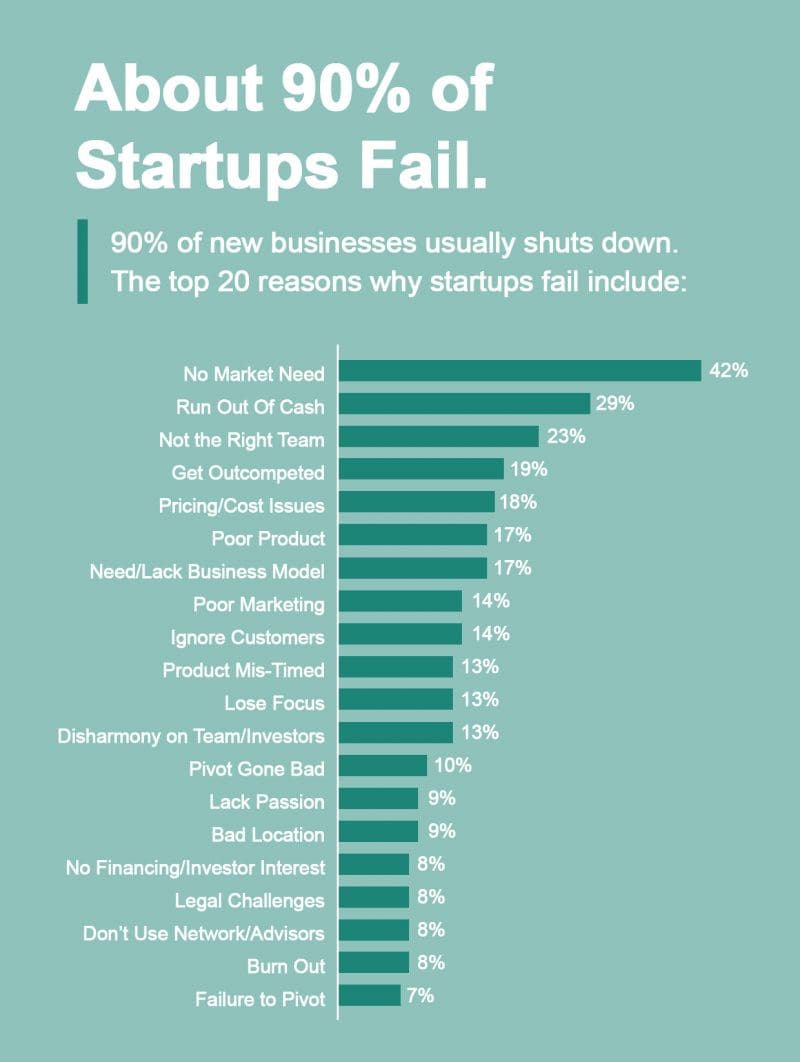
That’s why you need to change your perspective and look at things from a different angle – rather than seeing failure as something to avoid at all costs, think of it as an opportunity to learn, and you’ll feel more confident. That’s especially true when you research some of the biggest and brightest entrepreneurs and see how many times they failed before they made it; the numbers might surprise you.
Lack of capital
Money is another significant barrier for people when they want to start a business because it often requires at least a little investment, and sometimes, it needs a lot of capital to get going. Even if it makes sense to put that money into the idea because of the revenue potential, you’ll actually need to have that money to begin with, and that’s much trickier.
The good news is that if you don’t have the money to put into your business (or you’re worried about draining your savings to do it), there are a few different funding options you can use to get started. Some ideas include finding an angel investor, crowdfunding, borrowing from a bank or other lender, or searching for and applying for various business grants. There are plenty available, depending on your circumstances.
It would help if you also investigated ways to lessen the capital needed to get started. While you do need about six months of working capital when launching a business, you can lower that by doing things like leveraging, which involves renting rather than buying resources, including your human resources. So, instead of hiring staff, you might consider delving into the gig economy through services like Fiverr or hiring an agency rather than staffing. This offers the same quality staff without the high cost of salary and benefits while avoiding the pitfalls of hiring unqualified staff to keep your expenses down. For instance, you could hire people like an SEO company to do the work you don’t have experience with on your behalf. This can save a significant amount of money, as you see in the graphic below, which uses the example of a digital marketing agency.

No confidence
Self-doubt can be crippling in all areas of life, but when it comes to starting a business, it’s definitely something that has the potential to hold you back and stop you from doing anything at all. You might feel you lack the skills, experience, or knowledge you need to start a business and make it successful, and that feeling of not knowing enough can stop you from going after your goals and sticking with the status quo.
Conclusion
If launching a business is something that you really want to do, what’s holding you back? If it’s any of these common situations, you should now feel you can do it. Good luck.
Need marketing help to support business growth?
We welcome the opportunity to show you how we can make your marketing SIZZLE with our data-driven, results-oriented marketing strategies. Sign up for our FREE newsletter, get our FREE guide to creating an awesome website, or contact us for more information on hiring us.
Hausman and Associates, the publisher of MKT Maven, is a full-service marketing agency operating at the intersection of marketing and digital media. Check out our full range of services.
Discover more from MKT Maven
Subscribe to get the latest posts sent to your email.


