 logo

Choosing a website hosting service for your new website or changing up your existing website hosting is an important decision that isn’t easily undone if you discover you made the wrong choice. Switching to a new host means you lose any pre-paid fees for hosting (in many cases, although some companies offer a pro-rated refund). A more significant issue is that switching hosts isn’t as easy as it might seem to the outsider and may result in downtime as you make changes to improve the appearance or functionality once the move is accomplished. The right web host offers a clean back end that is SEO optimized to help your website rank near the top for related searches. Web hosts also differ in the load speed they provide and other factors that similarly impact SEO.

With hundreds, if not thousands, of hosting providers available today, you might find choosing one overwhelming. Not to worry, though, I thought about this and created a list of six things you should consider when choosing the right host for your website:
How to select the RIGHT website hosting
Website hosting involves physically hosting your website’s content on interconnected servers. Naively, you might think that all web hosts are about the same, but that couldn’t be further from the truth. Web hosting platforms differ dramatically in price, speed, and performance. While your choice of a web host is invisible to your visitors, it dramatically impacts their journey as well as how much traffic visits your site.
Your choice of a web host impacts:
- How fast your website loads: The longer it takes your website to load, the more likely prospective visitors will navigate away to another website. If it takes longer than eight seconds for your page to load, most prospective visitors will move on to a different link.
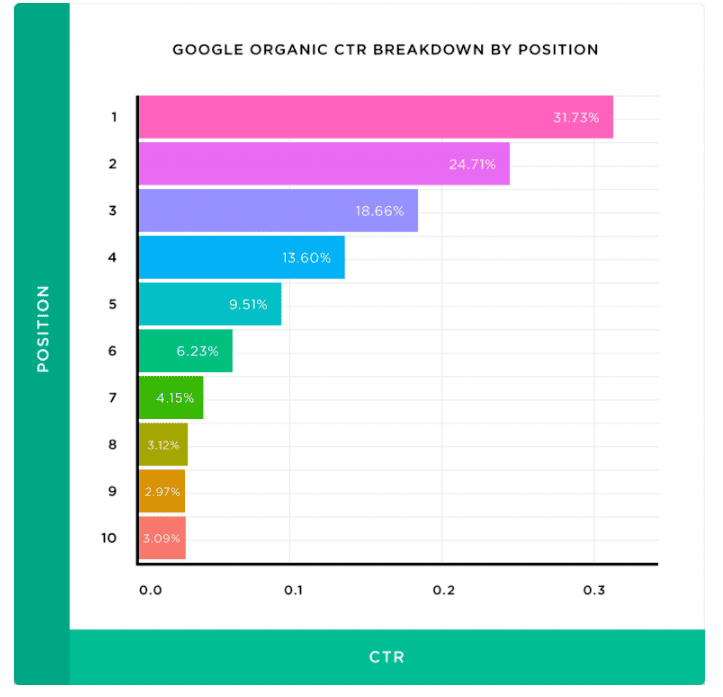
- How much traffic you gain from search engines: SEO, or search engine optimization, involves maximizing your score on the algorithm used by search engines to rank content. Content near the top in search results for a given user query attracts more clicks and, thus, more visitors (meaning more prospective buyers for your company). The top five links listed in the search results garner nearly 70% of all the clicks. If your content ends up on page two of the search results or later, your chances of attracting a click go down to nearly 0. Your choice of a web hosting company impacts multiple factors that make up that algorithm, including security, the location of the server, and the percentage of uptime [source].

Image courtesy of Backlinko - Pricing: You’ll find vast differences when it comes to how much web hosts charge. Depending on the size of your website and the type of hosting you need (see the next section), you can expect to pay anywhere from $2 to hundreds of dollars a month (most companies require you to pay for a year, although some allow you to pay month-to-month).
- Security: Hosting companies vary in the amount of security they offer.
- Extras: Some hosting companies (especially those at the lower end in terms of pricing) don’t offer anything extra or charge an additional fee to provide them. Others offer a package that includes extras like email addresses to match your domain name, backup storage, caching to speed up your site’s load speed, SSL certificates (required for e-commerce sites but a good idea for every website), domain registration, a sandbox to test out significant changes to your site, such as a new template, before moving it live, and a host of other extras. Obviously, or maybe not so obviously to the newbie, you can purchase any or all of these extras separately, as well.
Read on to learn about how to match your needs to the right website host.
1. Differences between hosting types
Suppose you tried searching for the right hosting provider. In that case, you might have encountered terms such as “dedicated, shared, VPS, cloud, reseller, and WordPress” without knowing how these factors impact performance, thus complicating your choice. These terms reflect different types of web hosting, which differ in the performance and speed they offer. Plus, note that not all web hosts offer all these types of website hosting.
Almost every hosting provider, though, provides shared hosting. Shared hosting is when a site shares a server and its resources with other sites. Shared hosting is commonly the least expensive, although it limits the size of your website and the amount of traffic that can visit the site. Many hosting firms offer various tiers of shared hosting, with tiers working just fine for most startup businesses. If you don’t expect much traffic and have a tight budget, then this is the best option. However, as you share the resources, mainly storage, with other websites, you might experience the occasional slowdown or other performance issues.

Meanwhile, larger corporations with colossal traffic visiting their site commonly choose a VPS or dedicated hosting due to their enhanced performance. The former is like a boosted version of shared hosting, except that there are far fewer sites sharing the server and its resources. Meanwhile, choosing the latter means that you get the server all to yourself, allowing you to leverage the full power of a server.
WordPress hosting allows you to build a website in an environment catering to the most popular CMS in the world, which is, obviously, WordPress. That said, you can easily set up a WordPress website on almost all hosting plans.
Reseller hosting, on the other hand, allows you to start your own branded web hosting business without building the infrastructure from scratch. This option is only economical or necessary if you plan to offer hosting to clients, for instance. Cloud hosting is an entirely different beast that allows you to quickly scale your site’s power across numerous servers, although without the typical bells and whistles that come with web hosting.
The pricing for these hosting types and tiers is different from one provider to another, so make sure to shop around. Also, think about what kind of hosting you need for your site today and in the future.
2. Check performance
Another thing that you should consider is the performance of the hosting providers, such as server reliability, security, and uptime scores. Most providers list these metrics on their websites or consider searching for 3rd party reviews for information. Unstable network connections and weak servers often result in downtime. Downtime means your website isn’t available for shoppers or other visitors, resulting in lower market performance and eroding trust. Plus, it also results in low rankings on search engines.
Partnering with a reputable hosting company with excellent uptime scores, preferably those with more than 99.5 percent, is key to your website’s success. In addition, it’s equally vital that you have a secure and trusted hosting solution that can protect your business against all kinds of breaches, data leakages, or cyberattacks. Opting for a DDoS-protected hosting service can safeguard your website from malicious traffic overloads, ensuring uptime stability even during an attack.
3. Site backups
Backup is crucial. Even with all the top-of-the-line security measures in the world, a website may still face some kind of failure, crash, get hacked, or get a virus that can take it down for days, weeks, months, or worse, shut it down entirely. Occasionally, an update to your CMS or a plugin results in something unexpected that takes your site down or corrupts the data, so the website looks wonky.

This is where a good backup policy is crucial. That way, if an incident happens, you can always revert to the saved working website. A reliable hosting provider can then restore your full website or, at least, the majority of it, with minimal downtime to avoid significant losses or damage to your reputation.
Check that your hosting company performs regular backups, or use a plugin to ensure the site is backed up regularly. Also, can you manually back up and restore your files via the control panel, or do you need the support staff to restore the backup files?
4. Future thinking
With growth comes diversification. Although you may be starting with a single site and domain name, you may soon experience the need for multiple sites, domains, and subdomains as your business grows. Thus, before you sign up with a specific service provider, consider the different packages and plans offered. Pay specific attention to whether it allows options for running several websites on a single hosting account.
Also, make sure to check the cost of unlimited site and domain packages, comparing it with other hosting options. Choose the best hosting companies that offer various service plans, allowing you to add new domains and scale over time.
5. Free trials & refund policy
Hosting your website is not cheap. This is especially true if you’re starting out and don’t have a big budget to spend. The good news is that most hosting companies offer some form of a free trial period and/or refund policy that helps reduce costs if you decide the host isn’t working for your needs.
Free trials allow you to safely test the hosting service and plan for a specific period. If it doesn’t fit your site’s needs, then you can always opt out unscathed. Meanwhile, choosing a hosting provider with a good refund policy helps lower the risk of losing too much money should things go wrong.
Also, take note that some companies charge a cancellation fee when you try to opt out during the trial period. Avoid these providers and go for the companies that provide money-back guarantees with pro-rated refunds after your trial period is done.
6. Tech support
Lastly, you need to check just how quick and reliable a hosting provider’s support is. Just imagine your site going down during peak traffic hours. This can be pretty stressful, especially for the non-techy website owners.
A hosting provider with a reliable support team can help you resolve the issue quickly. Ideally, you need a hosting provider with 24/7 responsive tech support, either via toll-free phone call or live chat. This way, they help resolve any issues with your site immediately. Some hosts also offer email support for non-emergency queries.
Hosting recommendations
I’ve used a number of hosting companies over the years. Here are my recommendations:
- HostGator
- BlueHost
- SiteGround

I currently use SiteGround, and I highly recommend it. The price is in the middle of the range for shared hosting; they offer superior support, and many extras are free or at a very low cost. Bluehost is on the inexpensive side, so it’s a great place to get your feet wet when you’re new to website ownership. They don’t offer as much support, but the price is right.
Using website builders like Wix, Squarespace, and Weebly is very inexpensive (or free) and offers the seeming ease of a drag-and-drop website. However, they’ve got you once you sign up, and you can end up paying a bundle for these hosting options over time because they charge for every little extra and don’t make it easy to switch to other hosting options (some are nearly impossible to move). The sites look cookie-cutter at best, so you can’t stand out from your competition, and they are much harder to build if you want a website that looks reliable, despite the companies claiming the ease of creating a website. Instead, use standard website hosting and add a plugin like Elementor or Sitebuilder (which are free) to add drag-and-drop functionality that actually looks good.
These sites also make it nearly impossible for your website to show up when users search for anything related to your website or its products because they have terrible SEO. Now, that might not mean much to you, but it’s a big deal. Most websites discover over time that at least half their traffic comes from what we call organic search, and sites built with Wix and other website builders don’t show up on the first page in search results.
Conclusion
Choosing the right web hosting provider can be pretty stressful and overwhelming. However, with the above considerations, you should now be able to make sound web hosting decisions that benefit your results.
Need marketing help to support business growth?
We welcome the opportunity to show you how we can make your marketing SIZZLE with our data-driven, results-oriented marketing strategies. Sign up for our FREE newsletter, get our FREE guide to creating an awesome website, or contact us for more information on hiring us.
Hausman and Associates, the publisher of MKT Maven, is a full-service marketing agency operating at the intersection of marketing and digital media. Check out our full range of services.
Discover more from MKT Maven
Subscribe to get the latest posts sent to your email.


