 logo

Over the last few years, it’s become increasingly hard to attract visitors to your website through SEO and social media organic visits (see graphics below). That means you need to focus even more on crafting landing pages that deliver high conversion. Similarly, you need to retain those customers, convincing them to make larger purchases or to stay longer if you want to succeed. Read on to discover how to improve your landing pages and use them to retain customers for the long haul. Finally, you’ll find an interactive landing page checklist to make your job easier.

The ultimate landing page
Your first step in building the ultimate landing page is to determine which pages aren’t delivering by focusing your analytics on key metrics (KPIs). Below, you’ll see some of the ones you should include in your analytics dashboard to monitor on a daily basis. This is based on the marketing funnel that assesses how successfully you move visitors through the process involved in conversion. Some of these metrics assess the overall performance of your website, while others are specific metrics to assess your landing page.
- Load speed – visitors will only wait a few seconds for your page to load, less when using a mobile device.
- Website uptime – poor website performance that takes your website offline sends a message that can damage trust.
- Conversion rate
- Cart abandonment rate
- CTR (click-through rate)
- Bounce rate (which reflects the percentage of visitors who leave after visiting a single page). A high bounce rate suggests visitors aren’t finding what they want on your page.
- Average time on page
- Scroll depth – how many pages the visitor views before exiting
Once you’ve identified which landing pages aren’t delivering conversions, you can work toward improving those pages first. Here’s an example of a well-designed landing page to help you get started:
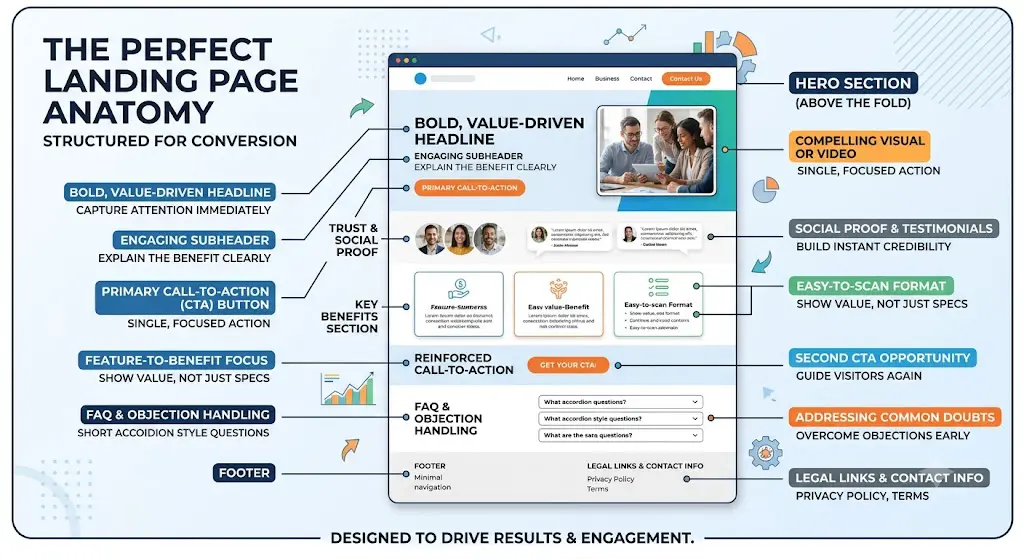 Beyond what you put on your landing page, consider the content that brings traffic to your page. If you’re sending traffic to your homepage, rather than the specific content that was promised, you’ll discover that you generate a high bounce rate.
Also, consider your target marketing when creating a landing page. High-performing websites offer between 10 and 15 landing pages because they generate (on average) 55% higher conversion than websites with fewer than 10 pages. In fact, websites with 40 or more landing pages tend to deliver 500% higher conversion. Thus, there’s no real upper limit on landing pages. You need to create pages that match the wants, needs, and desires of each specific target market. In fact, subtle differences, such as an image that doesn’t match your target market, can quickly turn off a prospective buyer.
Here are other tips to convert visitors into customers:
- Eliminate friction by clearly communicating your value proposition. Your headline should clearly articulate this.
- A hero image that attracts attention, demonstrates your offer, and matches your target market. Once, I saw data demonstrating that a license plate that didn’t match the geography of the intended market underperformed compared to when there was a match.
- Use a single CTA (call to action) with a contrasting button above the fold. Use CTAs that entice conversion and match your product.
- Free trials, demos, and get started for a SaaS product
- Add to cart, buy now, and get yours before they’re gone
- Download (lead magnet) or get the guide for lead generation
- Begin with a verb and consider the visitor’s stage in the buying process when crafting a CTA. Learn more is good with cold leads, while Buy now is better for warm leads.
- Use social proof to build trust. Reviews, media mentions, and ratings are great for building trust. Showing how many products you’ve sold or years in business is also great for building trust.

- Optimize navigation for mobile. Never confuse your visitor about where to go next.
- Focus on the benefits you offer, rather than features. Consumers buy solutions to their problems rather than products. Benefits show how your product solves a problem, while features are difficult to translate into how the product helps.
- An FAQ section can help, but it should be below the fold. Alternatively, a chatbot is great as long as it is properly trained.
Turning customers into repeat buyers
Small business owners often focus more on attracting customers than retaining them. The reality is that it’s 5X cheaper to keep a customer than to replace them. Retaining customers not only results in future sales (60% tp 70% higher conversion), but existing customers often buy more (67% more) than new customers (we call this AOV or average order value). The longer you keep a customer, the more value they have for your brand.
While lots of factors play into customer retention, depending on the industry, customer satisfaction is the single biggest factor in retaining customers. To satisfy customers, you must:
- Offer superior product quality
- Value rather than low price generates satisfaction
- Delivering on promises made to customers. One vision of customer satisfaction views it as the gap between expectations and experience. Meeting expectations generates satisfaction, while failing to meet them generates dissatisfaction. Greatly exceeding expectations generates delight. Ultimately, you’ll find a customer who isn’t satisfied with your goods or service. Don’t hide their complaints under a rock. Instead, own the problem, demonstrate your commitment to fixing it for the customer, and show how you’ll change your operation to limit the possibility that the problem will occur again.
- Effective communication. For instance, if delivery is delayed, prompt communication eases dissatisfaction.
- Personalized experiences generate satisfaction
Satisfied customers not only return to purchase products again, but they also share their positive experiences to encourage others to make a purchase. Dissatisfied customers are more likely to share a negative experience than satisfied customers are to share a positive one. Moreover, negative word of mouth travels 5X faster and farther than positive word of mouth.
Satisfied customers also act as advocates for your brand. They might offer suggestions to others considering making a purchase or defend your brand against attacks from dissatisfied customers.
Here are some specific ways to satisfy your customers:
| Strategy | Tactical Implementation | Business Impact |
| Seamless Onboarding | Send an immediate, warm welcome email detailing expected delivery, product usage tips, or next steps. | Reduces buyer’s remorse and lowers customer service inquiries. |
| Personalized Re-engagement | Utilize past purchase data to send targeted recommendations, replenishment reminders, or exclusive discounts. | Increases Customer Lifetime Value (LTV) and repeat purchase frequency. |
| Proactive Customer Support | Follow up after delivery to ensure satisfaction before issues escalate to negative public reviews. | Protects brand reputation and builds long-term customer trust. |
| Loyalty & Referral Incentives | Offer perks, early access, or referral rewards for repeat purchases and friend invites. | Turns satisfied clients into active brand advocates while reducing acquisition costs. |
Conversion optimization checklist
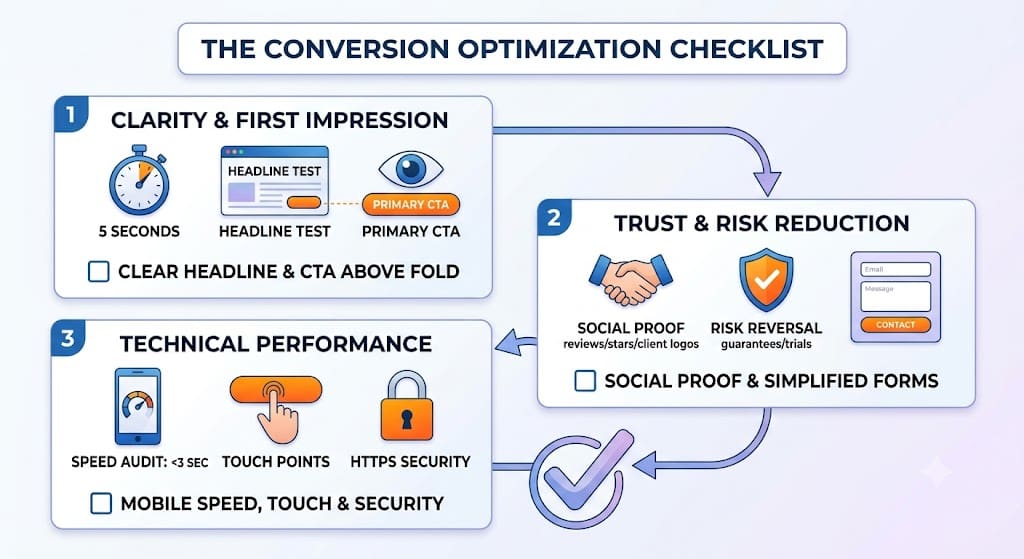
Here’s a checklist to help you create the ultimate landing page and to ensure you retain customers over the long run:
- Create the perfect first impression
- Headline: Does your headline clearly show your value proposition (who you are, what you do, who you’re for) within 5 seconds?
- CTA is a button above the fold in a contrasting color to attract attention
- Does your flow direct the visitor’s eyes to your offer?
- Landing page content motivates conversion
- Don’t hide important information until the end of the conversion process. For instance, if there’s a shipping charge, show it upfront. If delivery takes longer on an item than normal for your website, clearly state the expected delivery date.
- Use descriptive words and action verbs
- Your hero image matches your target market
- Do you offer a variety of payment options? For large purchases, do you offer quick approval or options to split payments over time? Do you offer major credit cards and/ or crypto payment options? For small businesses, do you accept PayPal, Zelle, or Venmo to make buyers feel like their personal information is protected?
- Do you work toward building trust and ease conversion?
- Your social proof is compelling and placed near the CTA
- You offer guarantees or other assurances that unsatisfied customers can get refunds or other ways to limit risk, such as a free trial
- Forms and checkout don’t require extraneous information or require a visitor to create an account
- Is your website optimized?
- Does your landing page load quickly, as well as seamlessly direct visitors through the conversion process?
- On a mobile device, are images and text readable, are buttons far enough apart to avoid misclicks, and do landing pages provide sufficient information to make a purchase decision?
- Is your site secured with an SSL certificate to protect visitor information? This is required if you accept credit cards.
Your landing page isn’t the end, but the beginning
Often, visitors don’t buy during their first visit to your website. You have a variety of tools to help you convert visitors who leave without making a purchase. For instance,
- Use remarketing to target visitors on social media or Google Ads. All this takes is a snippet of JavaScript and these ads are directed to prior visitors to keep them warm until they make a purchase.
Image courtesy of Google - Attempt to capture leads using a lead magnet so you can follow up with visitors who didn’t buy.
- If a visitor left an item in their shopping cart, send a reminder for them to complete the transaction. If possible, offer an alternative product (in case the product viewed isn’t quite what the visitor wanted) or offer a discount to purchase the item (or another item you sell).
- If a visitor made a purchase, send a thank-you email to ensure the item was delivered and the customer was satisfied.
- Send periodic emails with new products, special offers, celebrating milestones, or even recognizing birthdays and anniversaries.
- To accurately assess the performance of the various visit sources involved in the transaction, using multiple attribution models to attribute a sale to all those sources that precede the transaction, not just the last one.

Conclusion
Your landing pages are the most important pages on your website, so they deserve 100% of your attention and effort. You must:
- Build optimized landing pages for each target market
- Monitor landing page performance consistently to tweak it as it might not perform as well over time
- Work toward delivering superior customer satisfaction to every customer, every day.
- Follow up with customers after a purchase to ensure complete satisfaction
- Quickly address any failures, owning up to your inability to deliver satisfaction publicly and showing how you will fix the problem for the customer and all future customers.
Need marketing help to support business growth?
We welcome the opportunity to show you how we can make your marketing SIZZLE with our data-driven, results-oriented marketing strategies. Sign up for our FREE newsletter, get our FREE guide to creating an awesome website, or contact us for more information on hiring us.
Hausman and Associates, the publisher of MKT Maven, is a full-service marketing agency operating at the intersection of marketing and digital media. Check out our affordable coaching programs to help your business thrive into the future.
Discover more from MKT Maven
Subscribe to get the latest posts sent to your email.


