 logo

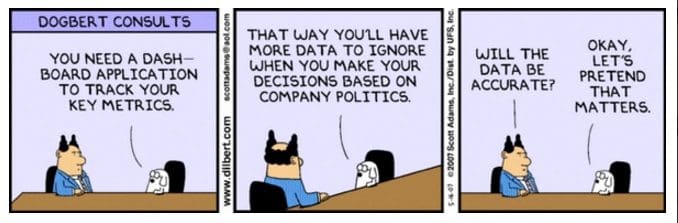
As you see in the cartoon below, translating analytics to action is fraught with problems. Not the least of which is the political nature of organizational decision-making.
When it comes to ROI, we see lots of organizations jumping on the analytics bandwagon — happy to have more insight into which pages, which messages, which segments are driving returns. A whole host of digital tools can transform your data into pretty dashboards to help improve ROI.
In fact, I have a list of great articles to help you measure, understand, and improve ROI from your digital marketing efforts–simply scroll through the 14 great articles to optimize ROI. To gain access to this list, provide your email in the comments at the end of this article, and I’ll send it out.
Overall, businesses do a great job of monitoring, understanding, and using ROI information–translating it into effective actions. These relatively simple metrics guide managers on which messages, segments, products, and channels are working best, allowing them to tweak strategy to improve market performance. Still, you sometimes run into issues of data quality and politics that impede the implementation of the right actions based on available data.
Translating analytics to action
Translating analytics to action, especially when you’re talking about advanced analytics (which we’ll discuss in a minute), involves developing understanding and trust among users — often something in very short supply.
First, there’s a serious shortage of business analysts capable of developing insights, as you can see in the graphic below. Further, finding managers who understand analytics and big data who can interpret and evaluate the insights to translate them into action is rare. Notice in the graphic below that finding folks with data analytics and insights skills is the biggest challenge when building a team, despite their relative importance.

It’s especially challenging to find team members who possess both marketing skills (in terms of concepts and application) as well as analytic skills. See my earlier post that explains why there’s such a gap.
Translating analytics to action faces many challenges. It:
- Requires managers to first understand the data they’re seeing. At a deep level.
- Next, managers must trust the data they’re getting
- Managers need to detect anomalies that require a better understanding or further investigation
- Finally, managers must understand how to translate analytics to action by understanding what the models are telling them they should change.
Below are the five biggest challenges businesses face when translating analytics to action.
1. Translating analytics to action: Right metrics
It’s tempting to analyze all the data available in today’s digital marketing ecosystem; however, not only will you find yourself overwhelmed with too much data, but you’ll also find that much of that data doesn’t impact your performance. Wasting effort and money to improve your metrics when those metrics don’t translate into better performance (termed vanity metrics and include metrics such as follower counts) ignores the higher value possible by spending those limited resources on metrics that do.
Choosing the right metrics also goes beyond what are called terminal metrics, such as conversions. Instead, you must develop metrics that assess performance at all stages of the conversion funnel from awareness to loyalty to advocacy. Below is an image that offers some key performance indicators (KPIs) related to your website performance.

To adequately assess performance, you need KPIs across various marketing channels and campaigns that cover the entire conversion process, as well as post-purchase attitudes and behaviors, such as satisfaction, referrals, and retention.
That requires a more sophisticated analytics process that tracks conversions back to the communications and consumer behaviors that led to them. Consider the following situation that’s very common:
We’re getting a higher conversion rate from traffic coming through X (formerly Twitter). So, we put more money into our Twitter advertising strategy. However, it’s entirely likely that X is just the “last touch” in a multichannel conversion process that started with an Ad campaign, another social media platform, or an email message leading to multiple visits to our website through direct clicks or remarketing. Multichannel attribution models are an example of advanced analytics that can tease out the impact of each communication event on conversion. This gives you a clear picture of the relative impact of various marketing campaigns, leading to better decision-making.
Increasingly, C-suite managers realize the value of advanced analytics and big data; they’re just unsure how to proceed. Consider this from Harvard Business Review:
Even so, our experience reveals that most companies are unsure how to proceed. Leaders are understandably leery of making substantial investments in big data and advanced analytics. They’re convinced that their organizations simply aren’t ready. After all, companies may not fully understand the data they already have, or perhaps they’ve lost piles of money on data-warehousing programs that never meshed with business processes, or maybe their current analytics programs are too complicated or don’t yield insights that can be put to use. Or all of the above. No wonder skepticism abounds. (Source)
2. Translating analytics to action: understand data
I was working with a team of students on an analysis project using Google Analytics data. I quickly saw they had misunderstood what one of the dimensions meant and were using it incorrectly in their analysis.
Obviously, any effort at translating analytics to action requires you to create a codebook containing the meaning behind the measures you’re using. Managers need training so they completely understand what each measure captures, where it comes from, and what it means in terms of consumer behavior. For instance, how does Facebook translate the “Impressions” label, and is that the same as how Google Ads does?
Managing the data explosion is another problem faced by analysts, as it interferes with translating analytics to action. Below is a framework for managing the flow of increasing volume, variability, and velocity faced by most modern businesses.
Translating analytics to action also requires that you understand the analytics platforms. For instance, how do you create a multichannel attribution model in Google Analytics, or how do you create events for easy tracking? Or how do you tag individual posts on social media to allow you to assess the impact of each individual post on conversion?
You should also use appropriate data visualizations to ease the interpretation of data, since humans aren’t good at evaluating tables of numbers.
In developing algorithms (predictive models), managers need input into the factors they consider important in building better predictions. This improves both the accuracy of the model and the manager’s understanding of the data.
3. Translating analytics to action: detect anomalies
Analysis involves finding anomalies and correlations between data points that point to better or worse returns. In the days of AI, finding anomalies is much easier, especially in the era of big data, but that leads to another problem: finding spurious correlations between variables.

This cartoon, from Avinash Kaushik of Occam’s Razor and data guru at Google, shows how even really smart people don’t fully appreciate the role of predictive analytics in translating analytics into action.
By their very nature, predictive analytics are probabilities. That means that they’re right more often than they’re wrong, but they’re not ALWAYS right.
Again, here’s from Harvard Business Review:
Data are essential, but performance improvements and competitive advantage arise from analytics models that allow managers to predict and optimize outcomes. More important, the most effective approach to building a model rarely starts with the data; instead it originates with identifying the business opportunity and determining how the model can improve performance.
Many of the worst predictive models follow a data-first approach. This includes data mining, which is still fashionable in many analytics circles and a feature of many analytic tools. Data mining looks at existing data and seeks correlations (relationships) among the fields within the data. Thus, it’s a rather mindless approach that totally discounts any understanding of marketing concepts or consumer behavior. Not surprisingly, the resulting algorithms are often totally useless. The bigger the dataset, the bigger the risk you’ll produce a useless algorithm.
Combining conceptual knowledge in determining which data to include in your model-building results in much greater utility.
For instance, I once created an algorithm using readership among subscribers to predict who would be a sales lead for the organization. I used conceptual understanding, building on the conversion funnel shown above, to score articles based on content– content further along the conversion funnel got a higher score than general interest content. Using this method, we assigned a score to each subscriber and, once the subscriber passed a threshold, it generated a lead for a salesperson. This resulted in better quality and higher quantity of leads to the sales force.
4. Translating analytics to action: trust
Make the data as clean as possible to ensure managers trust the data. Also, predictive models need sufficient testing, and those test results should be shared with managers, so they trust the algorithms.
Sometimes factors go a little wonky, sending your algorithms off and increasing distrust in your models. Managers need sufficient analytic skills to detect such anomalies. I recently worked with a client and we discovered a conversion rate that just didn’t make sense. He was initially upset that conversion was much lower than industry standards, so, needless to say, I was very motivated to understand why the anomaly arose.
Spending some time poring through the data, we detected a change in the data coming into our database, which pushed subsequent data into later (inappropriate) columns. Hence, we were combining factors in a manner that didn’t make sense. We simply corrected the problem by changing the factors in our algorithm and things went back to normal.
Had we not detected the anomaly early, we might have gone on making bad decisions or spending unnecessary efforts to build a new algorithm.

5. Translating analytics to action: Implementation
Sometimes an analysis shows you exactly which actions to take: poor performance of a piece of content, write content similar to that which performed better.
In other cases, it’s not clear how you should translate analytics into action.
In that case, you often resort to A/B testing to determine which actions improve market performance based on insights from the analytics. Or, you have to dig beneath the algorithm, into the data itself, to determine what actions are appropriate.
In a worst case scenario, you spend money and other resources to glean insights using trained analysts and powerful tools, only to have managers ignore the data-driven recommendations. If I had a nickel for every client who told me “that’s not the way we do things here” or some variation, I could retire as a millionaire. I once worked for a client who wanted to test their new product before launch, despite the engineering department’s argument that they’d already spent a lot of money developing the prototype and planning production.
Nevertheless, we spent time interviewing customers who purchased an earlier version of the product and conducting focus groups with them. We produced a report that said their customers overwhelmingly rejected the new product as too prone to failure, with all the bells and whistles the engineers built into it. Instead of making a decision based on our report, the company decided to introduce the new product, which was a dramatic failure that didn’t break even for years.
Conclusion
Translating analytics to action isn’t easy and will take time to implement, even if you already have the right people, right skills, and right culture to make it happen. But the benefits far outweigh the costs.
Need marketing help to support your business growth?
We welcome the opportunity to show you how we can make your marketing SIZZLE with our data-driven, results-oriented marketing strategies. Sign up for our FREE newsletter, get our FREE guide to creating an awesome website, or contact us for more information on hiring us.
Hausman and Associates, the publisher of MKT Maven, is a full-service marketing agency operating at the intersection of marketing and digital media. Check out our affordable coaching programs to help your business thrive into the future.
Discover more from MKT Maven
Subscribe to get the latest posts sent to your email.


