 logo

Have you invested in SEO and paid digital ads only to see your traffic leave before making a purchase? The critical step that turns traffic into sales requires more than a catchy ad or showing up first in the search results. It also takes more than implementing GEO (generative engine optimization) to achieve mentions in AI. This is called the Traffic Fallacy. And, with the drastic decline in organic reach due to the AI models, turning traffic into sales is even more essential for success than before. That’s why I put together this 6-point action checklist to help you achieve success. First, we’ll start by discussing how to fix the traffic fallacy.

The traffic fallacy
The traffic fallacy is the misguided belief that bringing more traffic to your site will automatically result in higher conversion rates and more revenue. Despite this belief, the reality is that there’s really no significant relationship between traffic and revenue (which is what you really care about). Lots of sites have strong traffic numbers, but still fail. In fact, you can generate sales without ever bringing traffic to your website, especially if you optimize for GEO, using brand mentions as a tool to build awareness and encourage consideration. The traffic fallacy is why we consider traffic-related metrics, vanity metrics.
If you want to stop burning through your marketing budget without achieving your growth numbers, you need to bring the right traffic to your website and then create a conversion engine that drives visitors toward conversion. Here’s a framework for turning visitors into paying customers:
- Diagnose the traffic that isn’t converting with behavioral data
- Above the fold is where your conversion starts. Optimize this content.
- Remove friction from your conversion process.
- Use trust signals and social proof to reduce fear.
- Establish a strategy for building a relationship and reaching out to aid conversion.
- Create dynamite calls to action (CTAs)
- Continuously monitor key metrics.
Fixing the traffic fallacy to improve conversion and revenue, you first need to learn why visitors leave without making a purchase. Otherwise, you risk making matters worse or wasting effort (and money) changing things that won’t fix the problem. That’s why we’ll discuss each of these seven issues in the next sections.
1. Diagnose the traffic that isn’t converting with behavioral data
Maybe you have already checked out metrics such as number of visitors, time on site, and bounce rate on a regular basis. While there’s nothing wrong with that, there are other metrics that offer more insight. Among these are:
- The exit rate on landing pages or pages associated with the conversion process indicates whether there’s a problem on these pages. However, a high exit rate may not indicate a problem with these website elements. The problem may lie further upstream.
- A major reason why traffic doesn’t convert on your website is a function of who you attract to your site. If you attract the wrong people in the first place, they’ll never convert. You need visitors who possess the need, authority, money, and desire to purchase your product. We’ll discuss how to diagnose this problem later.
- If your conversion process is too cumbersome or confusing, or if you request too much information, or you don’t accept payment options that appeal to your prospective customers, you’ll find it hard to complete a sale.
- A high bounce rate likely indicates you aren’t communicating effectively. For instance, the ad or social post might promise one thing, while the landing page doesn’t reiterate the promise. Or, the landing page doesn’t match the ad (for instance, sending ad traffic to an unrelated page, like the homepage, when the visitor expects to see a product page, price list, or other content). BTW, this also reduces your quality score, making each click more expensive.
- Speaking of a landing page, you likely need multiple, so the offer, image, and text match individual groups of consumers. For instance, a group of seniors might want to see images that reflect their lifestyle, rather than a bunch of teenagers.
- Is your primary CTA in the first 20% of the page? If not, you need to move it so it shows above the fold. More on this later. BTW, you should only have a single CTA on the page to avoid confusion. A CTA in button form outperforms a link.

How to fix a leaky bucket that creates a traffic fallacy
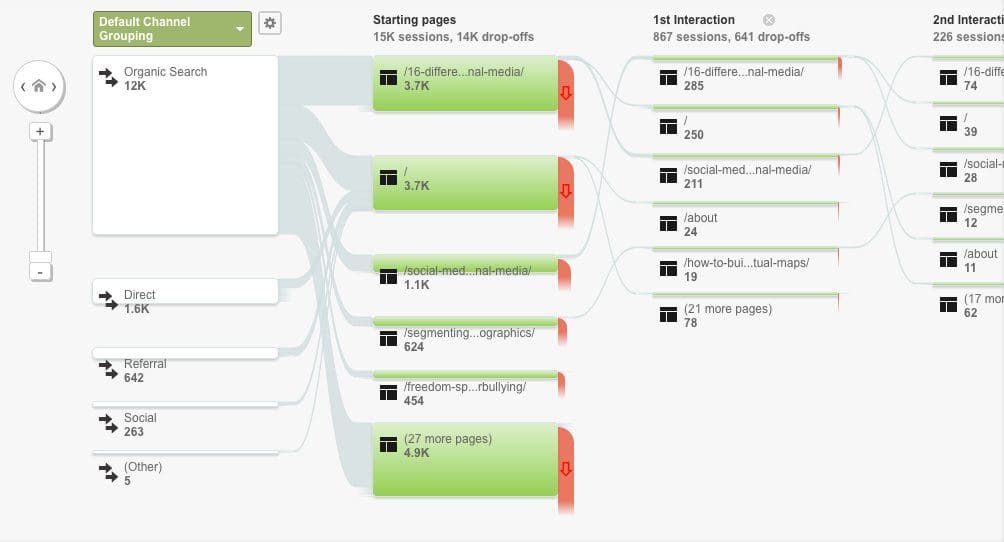
- Use a heatmap (such as Hotjar or Microsoft Clarity) to visualize how visitors move through a page. By the same token, you should look at how traffic moves between pages using Google Analytics and monitor exit pages.
- Find broken links using a tool like AIOSEO Broken Link Checker.
- Track actual sessions using anonymized recordings of a user’s journey to see where you have problems.
- Find your top problem pages as targets for your improvement efforts.
- Repeat.
2. What’s above the fold
Above the fold is defined as the content visible without requiring the visitors to scroll down. Because you have only 3 to 5 seconds to capture a visitor’s attention, it’s essential to avoid the traffic fallacy by making the initial section of the page as enticing as possible.
Remember that consumers don’t buy products, they buy solutions to their problems. That means you MUST convince a visitor that your product offers the best solution by emphasizing benefits rather than features. This is encompassed in your value proposition.
Visuals, especially video, are particularly effective in enticing visitors. My colleague recently sold her house in an all-cash deal based on a visual walkthrough from a buyer who never saw the house in real life. A hero image, a large, enticing image near the top of the page, is particularly effective.
Here’s what you need to convert effectively:
| Element | Function | Common Mistake to Avoid |
| Headline | Clearly states the primary benefit or outcome. | Using clever, vague slogans (e.g., “Empowering Your Future”). |
| Sub-headline | Explains how you deliver that outcome and who it is for. | Jargon-heavy feature lists that confuse non-experts. |
| Hero Visual | Supports the value prop (product screenshot, video, or context image). | Generic, decorative stock photos that add no context. |
| Primary CTA | Directs the immediate next step. | Blending into the background or offering vague copy like “Submit”. |
Another element to consider is cognitive overload, which causes visitors to delay making a purchase or abandon their search. The best solution is to offer visitors relevant filters to eliminate products that don’t fit their needs. For instance, we were looking for a dress for my daughter’s beach wedding. We wanted something without a train to avoid dragging sand everywhere. Unfortunately, the website’s filters didn’t include this option and contained a lot of filters that we didn’t care about. Aim for 3-5 choices to help consumers make decisions without suffering from decision paralysis.

Adding multiple CTAs is another tactic that increases cognitive load. I realize that it’s an effective sales tactic to offer a trial close and a backup close, but that doesn’t work on a website. Instead, use a single CTA per landing page to reduce choice. It’s acceptable to repeat the same CTA several times within the landing page, however. Each landing page should be tailored to meet the needs, preferences, and characteristics of each persona you’ve identified. In fact, websites with 40 or more landing pages deliver up to 500% higher sales than websites with 10 or fewer.
3. Remove friction from your conversion process
We’ve all experienced this major flaw in the customer journey. You put something in your shopping cart only to abandon it when you’re not happy with the conversion process. Instead, you navigate away only to buy the product from someone else. This is another example of the traffic fallacy – a reason why your website isn’t converting as it might.
Of course, numerous factors lead to a dysfunctional customer journey beyond a wonky conversion process. In fact, the traffic fallacy starts before your page even loads. If it takes more than three seconds for a page to load, up to 50% of the traffic will navigate away rather than wait for your page. Even before the three seconds, the probability that a visitor will bounce increases by 32%.
Other key factors that add friction are:
- A poor mobile experience where the page loads too slowly, buttons are too close to allow easy navigation, or the visitor has trouble finding the information on your page. Mobile users are often on the go, so they need your address and phone number most commonly. They also are often in the immediate buying mode, so provide good access to purchasing drivers such as menus, hours, and specials.
- Requiring visitors to log in or create an account to place an order. You should always allow for guest checkouts.
- Asking visitors to provide extraneous information that’s not essential for completing the task at hand. If you want additional information, send a follow-up email with that request.
- Consider adding financing options for high-ticket items and accepting a wide range of payment options to meet visitor needs and risk tolerance (since providing your credit card is risky if you don’t know or trust the site).
- Offer easy customer service options to allow visitors to ask questions. Chatbots MUST be effectively trained to answer the most common questions, or they risk alienating visitors.
- Include a variety of views of the product and a full product description.
Below is an image highlighting factors that create a dysfunctional customer journey:

4. Use trust signals and social proof to reduce fear
It’s always a little scary to buy from a website you don’t know, which contributes to the traffic fallacy. If visitors don’t feel they can trust you with sensitive personal information. They won’t buy if they don’t trust the value of your products or are afraid they’ll never get them. That’s where trust signals come into play to reduce the traffic fallacy.
Social proof goes a long way toward convincing visitors they can trust your brand with their information and money. You can include:
- Honest reviews (Amazon takes great pains to eliminate fake reviews so visitors can trust the products they sell)
- Media mentions
- Price and product guarantees and liberal return policies
- Trial versions of the product before requiring a purchase
- A metric reflecting the amount sold or the number of years in business. You may be too young to remember when McDonald’s displayed the number of hamburgers sold on their signage. This one simply shows billions were sold. You can also show logos of clients/ customers who trust your brand (see my homepage for mine).

5. Build and nurture relationships
The traffic fallacy also assumes that every visitor makes a purchase during a visit. That’s simply not the case. Sometimes a visitor needs to think about a product or compare prices before they buy. In fact, only about 5% of visitors are ready to buy today. Lead nurturing is essential to avoid the traffic fallacy by turning visitors into buyers over time.
To build effective, long-term relationships, you must:
- Allow for micro-conversions by offering guides, white papers, interactive quizzes, and calculators to help visitors determine whether a purchase is right for them.
- Stimulate visitors to subscribe to your email marketing by offering a lead magnet, such as an ebook, calendar, or other resource. Deliver this lead magnet immediately. Ensure that your email sequence provides value and doesn’t overwhelm subscribers with useless information or too many emails.
- Educate visitors with a blog that provides insightful information related to your product.
- Use remarketing ads on social media and search to reach prior visitors.
6. Optimize your CTA
Focus on the value provided by your product, the solution it provides, and tell visitors exactly how they should move forward. A strong call to action offers a promise, and you must keep that promise as quickly as possible. Learn more is a very weak CTA, compared with “See how we increased sales by X%”
Ensure your CTA attracts attention by using a button, a contrasting color that stands out, and white space that helps it stand out on the page.
Use this graphic to help you create a better CTA.

7. Continuous improvement is the name of the game
Use tools such as A/B testing to test key elements of your landing page. Newer solutions allow for multivariate testing to simultaneously test multiple elements at once.
Periodically, glean insights from your visitors using surveys, interviews, or by observing how real people move through your site to avoid the traffic fallacy.
Monitor performance, including funnels, on a daily basis using tools like Google Analytics. Set up an interactive dashboard with the key metrics so you can see your results in one place.
The action checklist to avoid the traffic fallacy
As shown in the image above, the action checklist includes:
- Daily analytics audit
- Heatmap software
- Rewriting the hero section of your landing pages
- Audit the information required to complete a sale
- Adding targeted social proof
- Creating a secondary op-in to collect subscribers using a lead magnet
Conclusion
The traffic fallacy can quickly sink your business; encouraging you to spend resources on the wrong things and failing to deliver sufficient revenue to keep the business afloat.
Use this information to help you avoid the traffic fallacy.
Need marketing help to support business growth?
We welcome the opportunity to show you how we can make your marketing SIZZLE with our data-driven, results-oriented marketing strategies. Sign up for our FREE newsletter, get our FREE guide to creating an awesome website, or contact us for more information on hiring us.
Hausman and Associates, the publisher of MKT Maven, is a full-service marketing agency operating at the intersection of marketing and digital media. Check out our affordable coaching programs to help your business thrive into the future.
Discover more from MKT Maven
Subscribe to get the latest posts sent to your email.


