 logo

Today, we share the top 10 marketing questions (along with their answers) that every small business owner should be asking in 2026.
Small business owners and managers face significant challenges when it comes to optimizing their revenue, with severe shortages of time and money. They might also face challenges with the skills needed to excel within these constraints. Asking the right questions helps both set priorities and identify actions likely to make a significant contribution to the firm’s bottom line. So, read on!

Top 10 marketing questions with answers
Since you likely have a limited amount of time to spend doing marketing with everything else you have to manage, it’s important that you maximize your time. By addressing these 10 marketing questions, you’ll be better positioned to effectively allocate your time and money. These 10 marketing questions are based on recent industry trends and common pain points, as identified by AI (in this case, Google Gemini). So, sit back and read through them carefully.
1. What does my target market look like?
Based on my experience working with thousands of small business owners (and wanna be ones) over the years working for the Small Business Administration, I can vouch for the fact that the topic of target market is one of the most profoundly misunderstood marketing concepts among this group.
Rather than limiting you, the concept of a target market helps focus your efforts on those consumers most likely to make a purchase. This means you waste less time and money on those unlikely to convert. It doesn’t mean you turn anyone away from your business just because they don’t fit your target market.
Face the reality that consumers buy solutions, not products. And, not everyone has the same problems, not everyone is motivated to solve a problem (since consumers face any number of problems and they can’t afford to solve them all), and not everyone believes a specific product will solve their problem. For instance, I buy for a small family, so Costco’s huge cans of beans just don’t fit my needs and it doesn’t matter that the big can is cheaper than the small one. I don’t want to waste the food, so it doesn’t solve my problem.
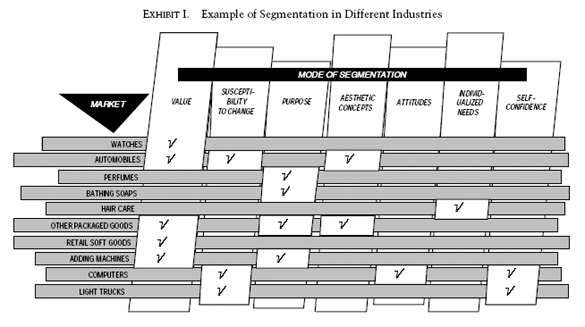
We also know that people aren’t the same; they have different incomes and lifestyles, different wants and needs, and different attitudes and beliefs. These differences make for a richer world, but they can play havoc on your marketing strategy since consumers who love one brand are indifferent or may even hate another. Take a look at this graphic to demonstrate how businesses might segment the market based on the products they sell.
So, how do you identify your ideal customer (your market persona in marketing parlance)? You must start with real data, not assumptions. This data may come through formal market research or less formal observational techniques. Social media forms a great source for this type of research.
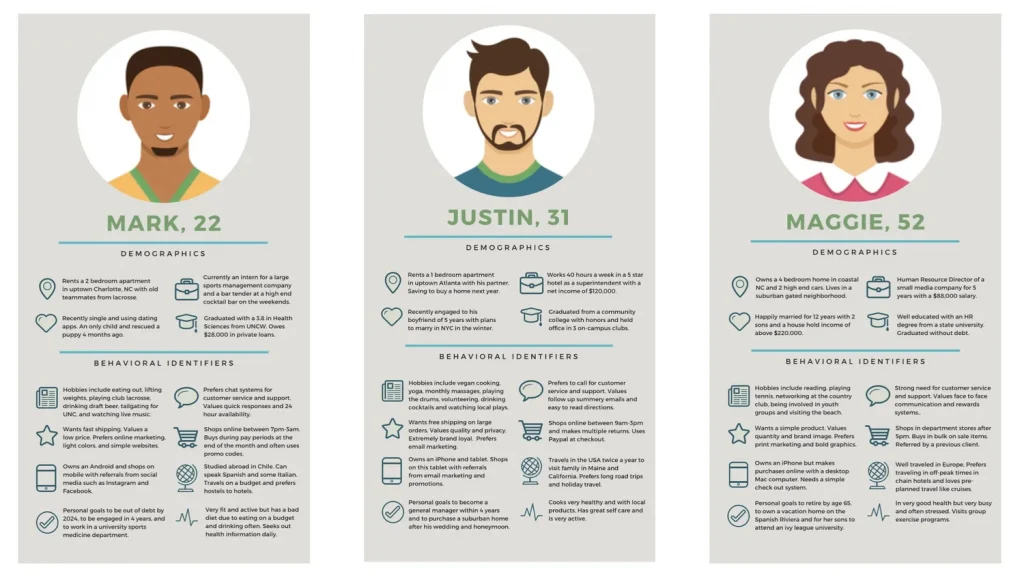
Armed with data identifying naturally occurring groups that might find your products viable solutions, your next step is to build personas that depict the demographics, lifestyles, values, and preferred media for each group. You’ll end up with something like you see in the image below.
How much should I spend on marketing?
Commonly, businesses allocate marketing funds based on projected revenue. Percentages differ widely depending on the source, but you’ll find values of 3% to 7% cited frequently. Of course, this is a crude estimate of what you’ll need to spend that depends on using real data to make accurate projections. New businesses or those with new products often must spend much more (15% to 35%) than the formula suggests to build an awareness of their new brand. Similarly, firms facing intense competition must spend more to match the spending of their competition. Established businesses that lead the industry often spend less than the formula suggests. B2B companies often pay less for marketing and remain successful, compared to B2C ones. Below, you can see the suggested marketing budget based on your industry (note this is based on your overall budget rather than projected revenue).

3. Which social media platforms are worth it?
Next in our top 10 marketing questions is related to choosing social media platforms. Which platforms you choose depends on a number of factors, including:
- Your target market, since various platforms attract different audiences and there’s a great variability in how much time users spend on the platforms they use. Currently, TikTok, Instagram Reels, and YouTube capture users the longest, although these platforms generally attract a younger user.
- Your goals. None of the platforms does a great job of sending users to your business website or store unless you use advertising (organic reach is highest for TikTok, Instagram, and LinkedIn at around 9%, and Facebook is lowest at around 1.65%). If your goal is awareness or creating a brand image, choose the one or two platforms that match your target market best.
- Your time allocated to marketing. It’s better to use your time to optimize one or two platforms than to do a poor job across multiple platforms.
- The type of content you produce dictates your platform choice, to an extent, since some platforms are based on video marketing, while others require images.
- The platforms used by your competition also impact your choice.
4. How can I effectively use AI?
This is maybe the most often asked of the 10 marketing questions, since AI is all the rage today. You can’t pick up a paper or listen to a news program without hearing the debate over legitimate uses for AI. Sure, AI is a bonanza for the overworked business owner who sees tools like ChatGPT and Gemini as huge time savers. The problem occurs when your email or social media posts start to sound like a robot rather than a human being wrote them or they contain elements that aren’t true.

Using AI is a great way to brainstorm ideas or outline a topic you know very well (which allows you to expand on the outline and identify missing or inaccurate elements)> AI tools also help you think more broadly about your topic to remove internal bias.
Always rewrite AI results to conform to your brand voice, making your writing more natural. Also, expanding on AI results creates value to your community beyond what they could get by asking a question of the AI tool. This is especially critical given the tendency of search engines to prioritize an answer snippet as the first search result.
5. What’s my unique value proposition (UVP)?
If you think about it, if your business looks like every other business offering the same products, consumers have no reason to choose your business over any other company in the market. Thus, it becomes a matter of chance as to whether they choose your brand or a competitor’s. Don’t you want to do better than split the market with your competition? Don’t you want to attract as many of the potential buyers to your offerings as possible? Well, a unique value proposition gives consumers a reason to choose you. That’s why you need to craft a compelling UVP that aligns with your target market and your offerings.
Before we get into the weeds on how to create a great UVP, I want to share some great examples from Wordstream.
- Uber – The Smartest Way to Get Around
- Apple iPhone – The Experience IS the Product
- Unbounce – A/B Testing Without Tech Headaches
- Slack – Be More Productive at Work with Less Effort
- Digit – Save Money Without Thinking About It
- LessAccounting – Bookkeeping, Without the Hassle
- CrazyEgg – Website Behavior Tracking at an Unbeatable Price
Obviously, your target market and product are important elements in defining your UVP as you want to identify and address the hot buttons shared by your market when positioning your brand. You also want to occupy a spot where your competition isn’t. A product positioning map (or perceptual map) like the one below is an effective tool in identifying your UVP.

6. How can I determine if my marketing is working?
Making data-based decisions is a key element of turning data into growth. Use your data analytics tools to identify components that are working as well as those that are not working. Look at the results you achieve before determining where to spend your money and effort. Beyond just cataloging metrics, you need to use data to build insights. For instance, by segmenting your results based on available demographics, you might determine that your success in selling products is low among older consumers.
Start by identifying the metrics that reflect success against the goals you created and ignoring vanity metrics that look great but don’t correlate with success, such as the number of followers. Pay close attention to intermediate metrics, such as engagement and awareness that lead to revenue, not just terminal metrics, like gross revenue or ROI. Monitor metrics along the entire customer journey (see below).

Gather all your metrics onto an interactive dashboard that allows you to see the results of your marketing efforts in one place, as well as evaluate your performance across years, products, regions, or other divisions important for your success. Using data visualization tools allows you to assess the impact of these metrics far better than facing tables of numbers, allowing you to draw insights effortlessly.
7. Do I need a full redesign of my old website?
This is another of the top 10 marketing questions I’m asked. My answer depends on how well your current website performs. It may only take a bit of tweaking, such as adding clear call-to-action buttons on your landing pages or increasing the score of your content to improve search engine rank.
Other changes aren’t so effective without a full overhaul. For instance, improving speed often takes a full website overhaul, including moving to a better type of hosting, adding caching, and changing the way you store images.
8. How do I get more Google reviews for my business profile?
Reviews are a critical aspect of making a sale, as prospective buyers look for reviews to guide their purchase decisions. For local businesses, gaining these reviews on your Google Business Profile is key to local SEO. These reviews act as social proof to buyers, but also to search engines.
The best tool for getting more and better reviews is to provide superior customer service and quality products. Beyond this, don’t be afraid to ask for a review once customers receive their products. Interact with customers when they post a review to encourage them to post additional reviews in the future.
9. If I only have two hours a week for marketing, how should I spend the time?
With everything else going on, you may find it hard to dedicate more than this amount of time to your marketing efforts. My answer to this one of the top 10 marketing questions starts by setting aside dedicated time for marketing. Otherwise, you’ll find yourself either forgetting about marketing, delaying efforts because of other demands, or squeezing in marketing when you’re over-tired or stressed.
Next, invest in tools to maximize your time. Marketing automation tools, like Buffer, allow you to schedule an entire month’s worth of posts in a short time. Then, it’s a matter of monitoring the scheduled posts to ensure they still reflect your goals. Analytical tools such as Cognos (dashboarding) and Google Analytics allow you to set up reports once, then spend a few minutes every day to check that everything is going well (or not).
To help you, I created (with the help of Gemini) a schedule for how to optimize your two hours a week with the assumption you’re running an e-commerce site. Check it out.
Review and adjust (15 minutes)
Check your key metrics to determine if your visits are growing, monitor your conversion rate, determine who visits and conversion rates for each group, which products are purchased/ viewed most frequently, monitor shopping cart abandonment, and determine the path visitors take when they visit your website. Also, monitor the performance of your email marketing and social media.
If the results don’t match your expectations, determine how to fix the problem.
Email marketing (45 minutes)

Draft and schedule posts as well as monitor your lead generation emails to ensure you have content that matches your desired contacts per week. Send broadcast email messages that vary between educational, social proof, promotional, and personal (such as getting to know the staff or highlighting your commitment to social projects).
Since email marketing offers the highest return, it justifies spending nearly half your allocated time on this marketing tactic.
Content batching (45 minutes)
Use this time to create content for your website and social media. Ensure you invest in high-quality content that creates value for your target market, such as long-form posts and videos.
Community and retention (15 minutes)
Today’s marketing isn’t a one-way street. Spend time responding to comments on your posts and social media, DMs, and interacting with customers who made a recent purchase to thank them and ask for a review.
Rotate through these deep dive tasks once a month instead of the community block
Audit your cart abandonment
Update your homepage hero image to keep it fresh
Update product descriptions to improve SEO
Perform competitor research to determine what’s working for them.
10. Should I hire an agency?
In the beginning, there’s likely no alternative to doing it yourself. However, I offer a coaching program with a small monthly fee that fits nearly any business’s budget. This coaching gives you the tools and allows you to ask questions or get feedback on your marketing activities. Remember, marketing is your key to growth and success. Without marketing, you won’t bring in the customers needed to keep the business alive.
As you grow, it makes sense to hire an agency. Not only are there increased demands on your time, but hiring an agency brings in folks with the skills, experience, and tools needed to generate revenue effectively. As you can see, hiring an agency is more cost-effective than hiring internally.

Conclusion
These are the top 10 marketing questions I see asked by small business owners and managers. I hope my answers set you on the right track to grow your business and explode your revenue.
Need marketing help to support business growth?
We welcome the opportunity to show you how we can make your marketing SIZZLE with our data-driven, results-oriented marketing strategies. Sign up for our FREE newsletter, get our FREE guide to creating an awesome website, or contact us for more information on hiring us.
Hausman and Associates, the publisher of MKT Maven, is a full-service marketing agency operating at the intersection of marketing and digital media. Check out our affordable coaching programs to help your business thrive into the future.
Discover more from MKT Maven
Subscribe to get the latest posts sent to your email.


