 logo

How do you choose the right social media platforms for your small business? The answer is complicated, since you can only choose two or three of them with the limited resources most small businesses can harness. Trying to be everywhere often results in not doing a good job (defined as consistently publishing high-value content), burnout, and a low return on your investment. No small business can sustain this without damaging its reputation or shorting other efforts with too few resources. Today, we’ll discuss how to choose the right social media platforms to support your marketing efforts.

Choosing the right social media platforms
Since you can’t maintain a presence on every platform, it’s crucial to choose the right ones. Obviously, you want to choose the ones where your target market is active and engaged. Beyond that, you should choose social media platforms that match the type of content that best positions your brand in the eyes of these consumers. This step-by-step guide walks you through the process of choosing the right social media platforms, starting with understanding your target market.
- Mapping your target market
- Consider aspects of your industry
- Assess your ability to create content given resource constraints
- Key questions to ask
Map your target market

As you can see, each social media platform reflects a unique demographic composition. Beyond simple age, however, each social platform attracts users with different intent and uses the platform to satisfy different needs. They also distribute their time across these platforms, spending more time on some than others. It’s important to ask yourself about the composition of your target market and why they’re on a particular social media platform when choosing the right social media for your marketing campaigns.
In general, here are the differences among the various social media platforms [source]:
– Facebook generally attracts a diverse, older demographic than other platforms. They’re looking for community engagement with family and friends as well as recommendations from the people they trust. They might also use Facebook for customer service, exchanging items on Marketplace, or requesting product options to meet their needs.
– Instagram tends to attract a younger demographic, although there’s some overlap with Facebook among middle-aged consumers. Instagram is a highly visual platform focused on building brand awareness, product inspiration, and e-commerce. Instagram Reels is a video platform. It attracts influencers as well as brands. A challenge when using Instagram for business marketing is that you can’t include links in your posts until you reach a minimum number of followers.
– LinkedIn is focused on professionals, including B2B buyers, job seekers, and thought pieces on business topics. Groups allow users to participate in specific business areas. Users are interested in professional development, networking, and finding solutions to business problems. Long-form content does well on this platform, as well as direct messaging to colleagues and prospective customers/ employers.
– TikTok attracts a younger demographic than other social media platforms, including Gen Alpha (born after 2010). These short-form videos, often relatively unpolished ones created on a mobile device, focus on authenticity, trends, humor, and product discovery. Many younger consumers use it for entertainment, but it also has a dark side, with some dangerous trends promoted by influencers.
– YouTube is used by a broad range of consumers of all ages. Its main uses are entertainment (especially if you have a YouTube Premium subscription), educatainment, and instruction. Videos tend toward long-form rather than short videos.
– Pinterest attracts mainly female users with high purchasing power who like to plan DIY, home design, fashion, and are looking for visual inspiration. One challenge of Pinterest from a marketing standpoint involves easy navigation back to the source of an attractive visual.
Obviously, these are just the top social media platforms in the Western world. Choosing the right social media might mean choosing one that focuses on a non-Western market such as WeChat in China or KakaoTalk in South Korea.
Match the right social media platform based on industry
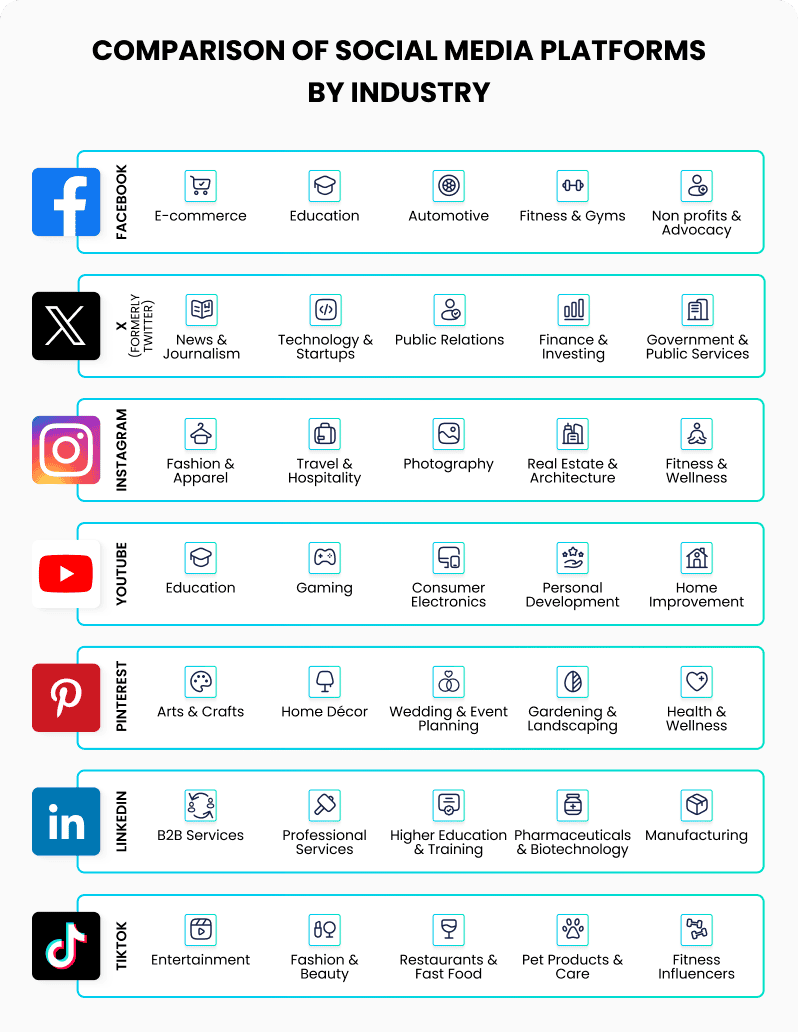
As you can see in this image, different social media platforms do best for different industries. This is related to our earlier discussion of what users look for on different platforms. However, these distinctions aren’t absolute. For instance, LinkedIn consists primarily of business users, so it’s a great place to find B2B buyers, as well as those in consumer markets. But buyers are also people, so you’ll also find them hanging out and engaging on other social media platforms. You might choose LinkedIn as your primary social platform, then choose another as your secondary based on the composition of the folks who have responsible positions in the companies you target.
Because B2B and professional services involve long sales cycles and higher volume purchases (with higher profit potential), LinkedIn is the logical choice. This platform allows you to become a thought leader among decision-makers. Complex products might do better on YouTube, where you can post explainer videos, do product demonstrations, and offer webinars. A good secondary channel might be Facebook, where you can build a community among its older consumers, as well as offer customer service.
For local businesses, Google Business Profiles are a must. Although not technically a social media platform, this platform allows you to share customer ratings and reviews, post hours of operation, and link to your website that appear as part of a Google search. Facebook and Instagram are also a must, as you can share social proof, as well as images that show off your work. Because these platforms attract a wide range of users and, in the case of Facebook, offer groups based on geography or interest, they offer specificity in reaching your target market.
Retailers and e-commerce firms do well with visual platforms, like TikTok, Instagram, and Pinterest. These platforms, in addition to visual representations of your products, offer in-platform sales options that allow you to sell to users without forcing them to leave the platform. You can also take advantage of influencers and user-generated content to help promote your brand.
Firms offering educational or coaching programs will likely find YouTube invaluable. Adding TikTok or Instagram, depending on your target market, can also help build trusting relationships as well as offer proof of the value you offer those who engage your services.
Something else to consider in choosing the right social media platforms is the decline in organic traffic from social media (as well as organic search). Thus, you must seriously consider your ability to advertise on your chosen social media platforms when making your decision on which are the right social media platforms for your business. Consider not just the availability of advertising, but the ease of setting up campaigns, how you choose the target for your ads (the more targeted your ads are, the better they’ll perform), and the metrics provided by the platform to analyze your campaign results.
Facebook might be the right social media when you consider the ease of crafting an advertising campaign by simply boosting a post rather than the more complex setup required on other platforms.
What can you create
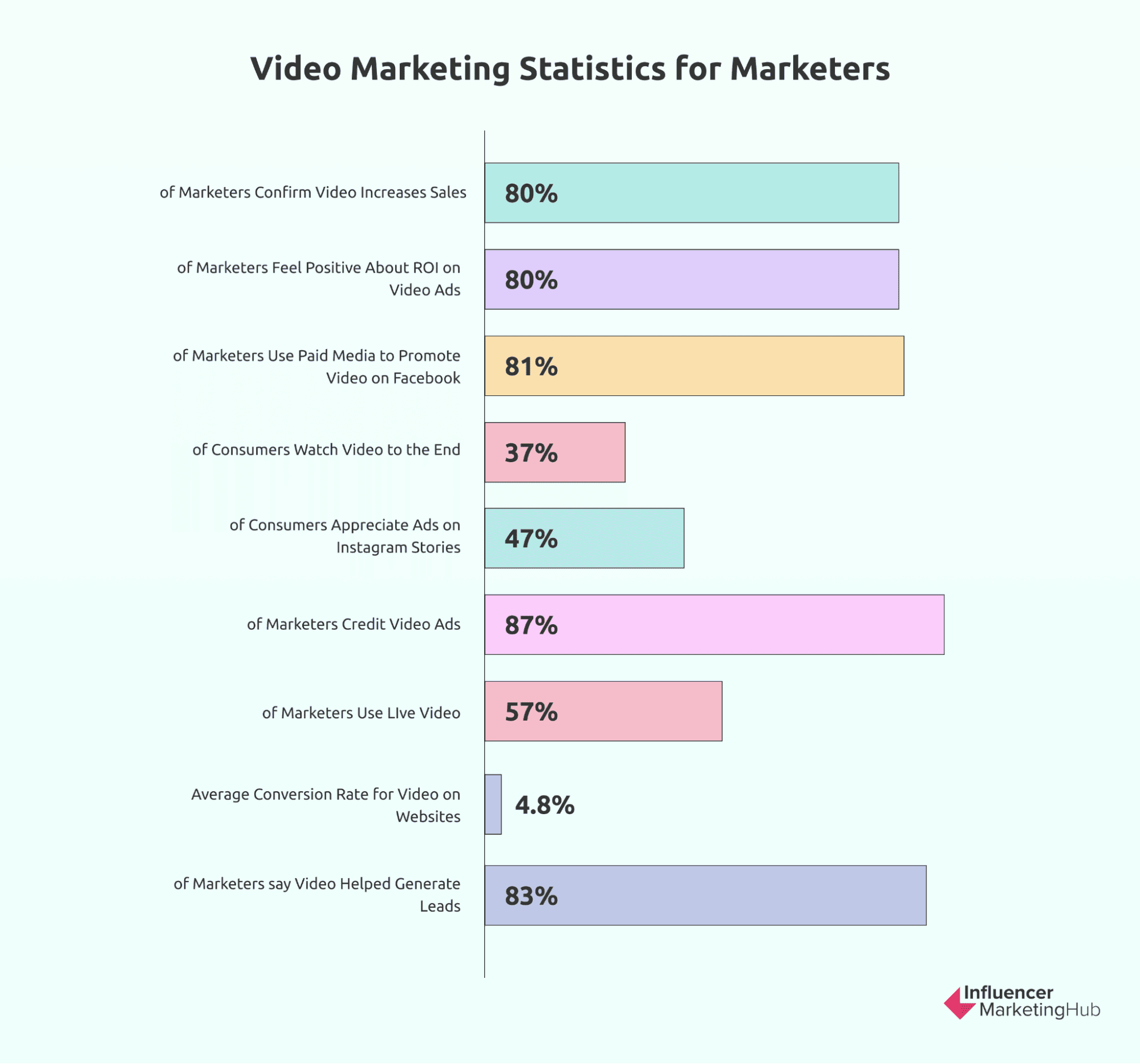
This graphic shows the value businesses get by using video marketing. However, the skills, time, and resources necessary to create videos are substantial, especially for long-form video on YouTube. You need to assess whether you can commit to crafting video content on a consistent basis, as one-offs don’t produce much value for your brand.
Other platforms, such as LinkedIn and Facebook, rely on crafting text content that provides value to users. You must be able to write well, know your product domain thoroughly, and write engaging content, which is no easy feat.
Crafting high-quality images and graphics is a necessary skill when choosing Instagram and Pinterest, while if you’re looking to build a community that engages with your brand, you might choose a Facebook group or craft a LinkedIn newsletter.
In choosing the right social media platform for your brand, consider opportunities to repurpose content across the two platforms. For instance, you might cut a YouTube video into a couple of TikTok videos or Instagram Reels, then transcribe it (or extracts from it) to create a post on Facebook or LinkedIn. The ability to repurpose content on your chosen social media platforms is a critical consideration since small businesses don’t have the resources to craft unique content for each chosen social media platform.
Questions you should ask when choosing the right social media
When choosing the right social media, you should ask yourself the following questions:
1. Where are my competitors active? Do they get engagement on this platform? What types of content are they sharing? If your competition is seeing success on a platform, it’s likely a good bet you can, as well.
2. Does the platform offer the tools I need? For instance, TikTok offers everything you need to craft short-form videos, from music to editing to capturing video, all in one platform. You don’t need to learn complicated video editing tools, like Adobe Premiere Pro, to craft effective videos on this platform. Other tools to consider are: messaging, shopping, and targeting for ads.
Some platforms are indexed by search engines (some even allow an image search) to provide more opportunities to attract potential buyers. Others offer ways to engage with those who are more likely to make a purchase. For instance, Facebook uses a Pixel (a small snippet of JavaScript) that allows you to advertise directly to users who visited your website in the past.
3. Can you sustain the demands of crafting valuable content on the platform based on the schedule norms? For instance, Facebook requires daily posts, while YouTube often performs well with a weekly posting schedule, especially if you post on the same day each week so subscribers can count on finding something new on that day. X (formerly Twitter) requires posting multiple times per day, while TikTok works best with posting once or twice a day.
Consider the options for repurposing your content from one platform to your other platform. Also, consider the demands of your other marketing efforts in deciding which are the right social media platforms. For instance, if you already post to your website’s blog, consider ways to repurpose that content in choosing the right social media. I automatically send a custom-crafted post to Facebook and LinkedIn (my chosen social media platforms) after publishing each post. I use my YouTube videos as a guide in crafting blog posts, then embed the video in the blog post.
4. Analytics are critical for improving your social media performance over time. Platforms that offer the right metrics to allow a nuanced analysis of results often represent the right social media platforms, especially if you don’t have a lot of experience across platforms.
Conclusion
Choosing the right social media platforms not only helps you maintain your sanity but also helps you achieve optimal ROI (or ROAS – return on ad spend) for your efforts. Your best option involves choosing a core channel where you spend your most resources (time, money, effort) and a secondary channel for cross-posting or to repurpose the content from your core channel. This optimizes your resources.
The right social media channel helps you achieve your marketing goals because it:
- Features a high percentage of users that match your target market in age, geography, and interests.
- Builds on the intent of users when they log in to the platform. What are they looking for and what will get them to engage with your content?
- Contains content that fits your industry and audience behaviors without demanding content that is beyond your capacity or skill level.
- Offers tools that help you optimize real metrics rather than simply offering vanity metrics.
Need marketing help to support business growth?
We welcome the opportunity to show you how we can make your marketing SIZZLE with our data-driven, results-oriented marketing strategies. Sign up for our FREE newsletter, get our FREE guide to creating an awesome website, or contact us for more information on hiring us.
Hausman and Associates, the publisher of MKT Maven, is a full-service marketing agency operating at the intersection of marketing and digital media. Check out our affordable coaching programs to help your business thrive into the future.
Discover more from MKT Maven
Subscribe to get the latest posts sent to your email.


