 logo

What’s the future of privacy and AI as the world moves ever faster into a future where AI dominates everything in our lives? If you listen to the media or even casual conversations among people, it seems everyone is talking about AI as if it’s the technology that will solve every problem, creating world peace, ending hunger, and leading to a utopian society where everything is always good.
That ignores the negative impacts of AI, such as an estimated net job loss of nearly four million in the US alone over the next five years, increased income inequality, the increased carbon footprint needed to energize AI, the danger posed by increasingly realistic deep fakes, and increased bias and discrimination resulting from algorithm manipulation. But, AI also represents a serious threat to individual privacy and control over how their personally identifiable information is used.
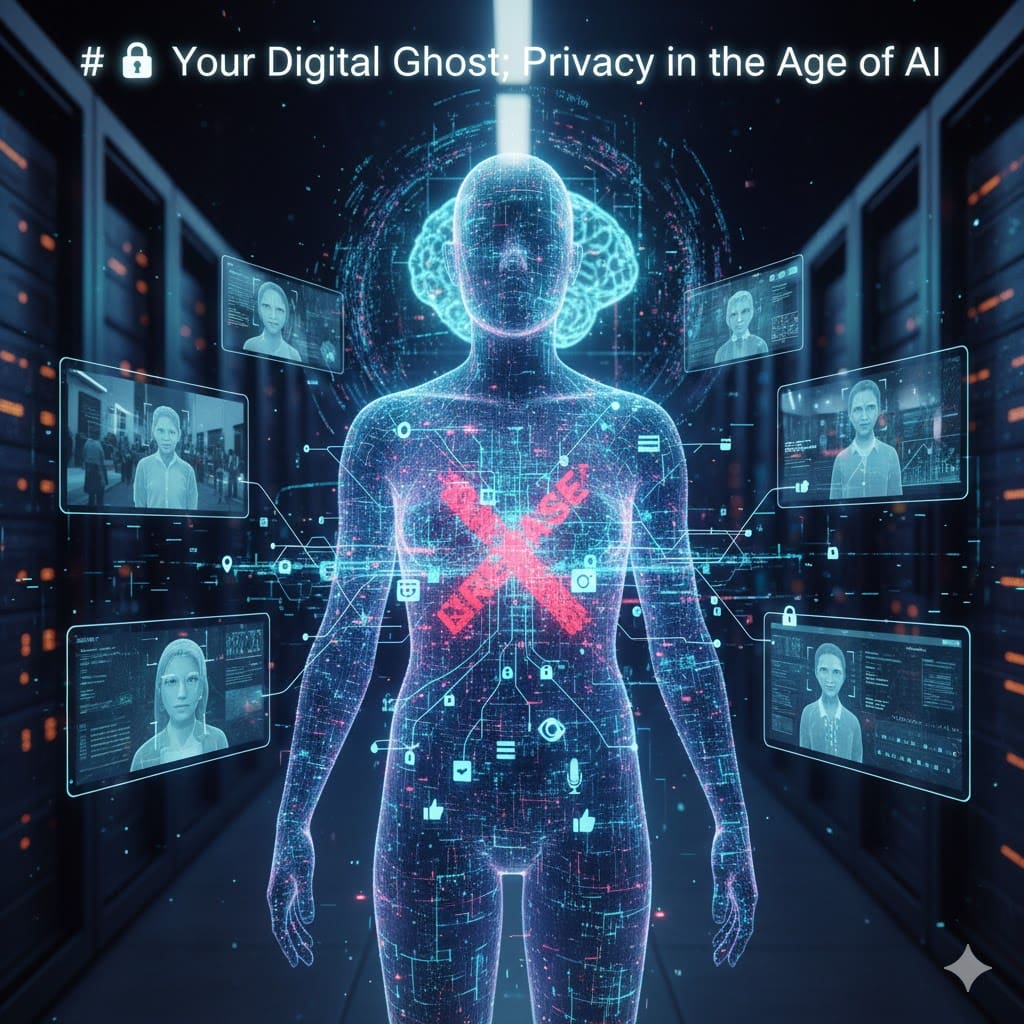
Privacy and AI
Everywhere you turn today, it seems AI is there. From AI-generated text in your local newspaper to nearly every internet search you run, AI is there to offer assistance through its accumulated knowledge of every scrap of public information ever uploaded online. To enhance the knowledge (and possibly the utility) of AI, it needs to learn, classify, and predict based on every bit of data it can get its metaphorical hands on. Can privacy and AI coexist to serve customers better, or are the two diametrically opposed, with no hope of ever existing peacefully? That’s our question today.
The issue of privacy has consistently raised its head at every technological advance. The internet caused concern over the protection of personally identifiable data, requiring companies to develop long, legalistic privacy policies that no one ever reads and companies ignore with abandon. With the rise of social media, we cautioned users against oversharing, even on supposedly private profiles, as even this step doesn’t protect you from loss of privacy. Just harken back to the bruhaha with Meta (Facebook) over privacy breaches (intentional or unintentional) over the last two decades, leading to massive fines. No wonder I always advised students to only post on social media what they were comfortable sharing on a billboard on Main Street. They often didn’t listen.
Privacy and technology have always involved a tradeoff, as consumers recognize that sharing some information with companies provides a benefit. For instance, when Amazon reminds you to reorder products based on your recent purchase patterns, you benefit from this invasion of privacy. Or when Netflix recommends a new movie based on those you’ve already watched, it saves you time and effort when all you want is to relax with a movie you’ll enjoy. But when technology shares personal information that allows a company or political actor to reinforce your biases by showing you only posts consistent with those biases, we all suffer, as demonstrated in recent election interference cases.
When it comes to privacy and AI, this new technology hasn’t so much amplified the risks and privacy concerns as created entirely new ones. Yet, every day, more AI models are introduced by entrepreneurs and tech companies bent on acquiring the vast wealth potential of this new technology. Individuals and companies flock to these models, such as ChatGPT, Gemini, and AI embedding in many digital tools, to reap the benefits they provide by reducing effort and time.
Are we headed for an apocalypse, a la George Orwell’s 1984, or the future shown in the Minority Report? Do we no longer control our image, allowing critics to manipulate even what we’ve done or said by demonstrating that if you see it, you must believe it? Can we no longer hide our foibles behind closed doors, allowing opponents to weaponize our private behaviors to cause damage?
Privacy and AI: The dilemma
As you can see below, Americans are concerned with data privacy, including how companies and the government collect, store, and use private information with little control over how it’s used.

Yet, Americans and other people around the world act as if they aren’t concerned about privacy by sharing private information without regard for how it’s used by bad actors. So, what are the most dangerous outcomes from the intersection of privacy and AI? Let’s explore the top three.
1. Unchecked surveillance and behavior monitoring
AI enables the systematic, large-scale monitoring that was imagined in the dystopian science fiction works cited above and previously impossible.
With systematic surveillance, AI-powered tools like facial recognition, location tracking, and biometric identification can find you in any public space (and increasingly in private ones). While an undeniable tool when used properly by law enforcement to catch criminals, using these abilities to infer political views, social connections, and behavioral patterns by bad actors has vast potential for harm. Because facial recognition is notoriously inaccurate with non-white populations, the potential for mis-identification can result in serious harm.
You might argue that a spouse could reasonably use this information to catch a disloyal spouse, but you can see how easy it would be for a competitor to suss out a potential merger to manipulate your stock or an individual wanting personal revenge can use this data for harm.
With surveillance comes the potential for inferring sensitive data by using the ability of AI models to aggregate innocuous data, like purchasing habits or location history, to infer personal information such as health status or your intentions to leave your job. Harnessing the power of maximum likelihood to build complex algorithms based on aggregated data from millions of individuals surveilled, AI models can easily make these inferences, although there’s no guarantee of their accuracy. However, the damage is done before assessing actual facts.
Loss of control
We like to think we control our image, our thoughts, our private actions, and our intellectual property. Privacy and AI don’t agree on this most basic right. Instead, large language models (LLMs) and generative AI are trained using massive datasets, including everything we said in an email or text, every image we ever uploaded, our online diaries, and even our artistic and intellectual contributions, such as videos, books, and monographs. This happens without explicit permission or compensation for our work. It’s no longer just artists and celebrities who find themselves acting and saying things that aren’t real or inventors who find their intellectual property stolen.

Unfortunately, this loss of control is irreversible. Privacy and AI are at odds because once personal information is so deeply embedded in an AI model, it’s impossible to comply with requirements within the GDPR and other privacy laws (which aren’t very strong in the US except for in California) that provide the right to forget information.
The damage potential increases because the AI model repurposes your data without your knowledge or consent, allowing anyone using the model to access it. Data you shared for a purpose, such as an image for a company badge or a complaint filed with HR, once used to train the AI model, can be used for anything.
3. AI-enabled misinformation and identity theft
We already alluded to some of the dangers of privacy and AI used for evil. These include:
- Deepfakes using generative AI to create images, video, and audio that distort your identity to damage your reputation.
- Targeted cyberattacks by bad actors to phish for private information, such as logins, and the use of voice cloning to evade security designed to limit access to information or destinations.
- Importantly, these AI efforts are very difficult to detect, even using the best technology, and the damage is often done before many who see them even try to detect a fake.
The path forward regarding privacy and AI
The path forward regarding privacy and AI isn’t at all straightforward, requiring a coordinated effort between government legislators, regulators, developers, company policymakers, and individuals. Let’s review some of these efforts.
- Regulatory frameworks require stricter, AI-specific laws (such as the EU’s AI Act) that require transparency about how AI models are trained and used, especially with respect to facial recognition. There must also be regulations that provide a right to delete information.
- Design privacy into the design of AI models with built-in privacy safeguards.
- Individual actions that balance a company’s need for information to promote customer service and maintain a competitive advantage with an individual’s need for privacy.
Prioritize transparency and consent to build trust
These are the first steps toward balancing privacy and AI. Here are the fundamentals:
| Strategy | Description | Key Action |
| 1. Radical Transparency | Clearly and openly communicate what data is collected, why it is collected, how it is used to benefit the customer, and who it is shared with. Provide plain-language summaries alongside dense legal policies. | Provide a conspicuous, easy-to-read Privacy Policy and notify customers immediately of any changes in data practices. |
| 2. Granular, Informed Consent | Move beyond “all-or-nothing” consent. Give customers granular control over which specific data points are collected and for which specific purposes (e.g., “Allow data for personalization,” vs. “Allow data for third-party marketing”). | Implement a clear Opt-In/Opt-Out mechanism for non-essential data collection and sharing. |
| 3. Focus on First- and Zero-Party Data | Prioritize data voluntarily and directly provided by the customer (First-Party Data), or data explicitly shared to enhance a service (Zero-Party Data, e.g., “Tell us your favorite color so we can personalize your experience”). This builds on a direct, consensual exchange of value. | Minimize reliance on intrusive Third-Party Data collection methods like third-party cookies. |
Leverage privacy technologies
We need more privacy-enhancing technologies that allow companies to derive insights from data without exposing the underlying personally identifiable information. Here are some ways to accomplish this:
| Technology | Privacy Mechanism | Business Value (Utility) |
| Data Minimization | Collect and retain only the minimal amount of data absolutely necessary to achieve the specific business purpose. | Reduces data storage costs, minimizes the scope and risk of a data breach, and increases data quality. |
| Differential Privacy (DP) | Inject “statistical noise” or randomness into datasets or query results to ensure that an individual’s data cannot be identified, even when the aggregated data is analyzed. | Allows for accurate population-level trend analysis and aggregated insights without compromising individual privacy. |
| Synthetic Data | Generate artificial, statistically realistic datasets that mimic the properties and correlations of real-world data but contain no actual personal information. | Enables safe testing, development, and AI model training in sensitive sectors (e.g., finance, healthcare) without privacy risk. |
| Pseudonymization/Encryption | Replace direct identifiers (e.g., name, email) with artificial identifiers (pseudonyms) or transform the data into an unreadable format. | Preserves data utility for internal analysis while preventing immediate, unauthorized identification. |
Build a privacy-first culture

Corporations must recognize that their goals are best met by balancing privacy and AI to build trust by acting ethically in how they build and use AI, with a multi-pronged approach involving all these groups. Here’s how:
- Integrate privacy by design
- Establish clear data governance that identifies data ownership and accountability
- Implement strict security measures to prevent the unauthorized use of data
- Prioritize ethical intent guided by principles of only acquiring data for a legitimate purpose and a commitment to fairness and non-discrimination.
Conclusion
As you can see, the issue of privacy and AI is a thorny one without a clear resolution that protects both the rights of the individual to privacy and their interests in reaping the benefits AI provides them by helping companies and governments become more responsive to their needs. It also involves bad actors who don’t have the best interests of either group and whose goal is damage. I hope this information helps you design an ethical means of addressing these twin issues within your own purview.
Need marketing help to support business growth?
We welcome the opportunity to show you how we can make your marketing SIZZLE with our data-driven, results-oriented marketing strategies. Sign up for our FREE newsletter, get our FREE guide to creating an awesome website, or contact us for more information on hiring us.
Hausman and Associates, the publisher of MKT Maven, is a full-service marketing agency operating at the intersection of marketing and digital media. Check out our full range of services.
Discover more from MKT Maven
Subscribe to get the latest posts sent to your email.


