 logo

Is Your content marketing working? Integration is the answer! A 2019 study found that marketing campaigns using three or more channels resulted in 287% higher sales than campaigns using fewer channels. Marketing integration across marketing channels is a key factor in optimizing market performance, yet a recent study of nearly 1000 marketers found poor digital marketing integration across channels.

According to a recent report by Oracle Marketing Cloud and Econsultancy (see infographic below for details), marketers report poor integration across marketing channels threatens ROI, with only 7% of respondents agreeing with the statement they are “very much set up to deliver effectively orchestrated cross-channel marketing activities”. In comparison, 62% acknowledge fragmentation across digital marketing platforms. In a study by SmartInsights, results were similar, with 59% of companies describing their digital marketing as fragmented.
Digital marketing integration
So, what do we mean when we talk about digital marketing integration?
Indeed, we’re talking about the look and feel of various social profiles using a unified color scheme and images. But integration goes well beyond these simple visual cues.
Integrated digital marketing requires businesses to synergize their marketing efforts across various media in real-time. Campaigns can no longer be thought of as vaguely measureable units of marketing expenditure.
That means your marketing and IT staff work together to create a seamless customer experience. In researching this article, I ran into a post where a user responded to a PPC ad for a particular product only to find the product out of stock on the website. A remarketing campaign offered her the same product at a lower price the next day, but she found the product still out of stock, and the reduced price wasn’t reflected on the website when she added the product to her shopping cart.
This example shows an apparent failure that not only wasted the firm’s time and money but annoyed a potential customer (or even lost them a loyal one), which can have far-reaching negative consequences. The example also demonstrates that digital marketing integration goes beyond communication strategies like IMC (integrated marketing communication) to encompass delivering on the promises of integrated marketing communications.
Measurement is also a key element in digital marketing integration. Knowing what works and how various channels work together to deliver ROI highlights the interconnectivity between platforms in the customer journey. In the Oracle study, only 19% of marketers measured the ROI of cross-channel marketing efforts and only 14% measured the impact of cross-channel campaigns in achieving customer retention.
Why you need cross-channel marketing
As mentioned earlier, integration across multiple channels leads to much higher conversion rates. Today’s marketers have the option for dozens of marketing channels, including both digital and traditional ones, well in excess of the necessary three. That’s because, according to Forbes, it commonly takes seven to eight touchpoints to convert a new customer.
Here are other benefits of using cross-channel marketing:
- A broader reach since consumers choose various channels that fit their interests and preferences.
- You can deliver content in multiple formats, such as video, images, podcasts, and texts, to reach consumers in a way that resonates and convinces them to buy.
- Retaining existing customers results in 67% higher sales than new customers. Using integrated cross-channel marketing is a great way to remind customers to make additional purchases by suggesting new products, reminding them it’s time to reorder, or share discounts with them.
Digital marketing integration is hard

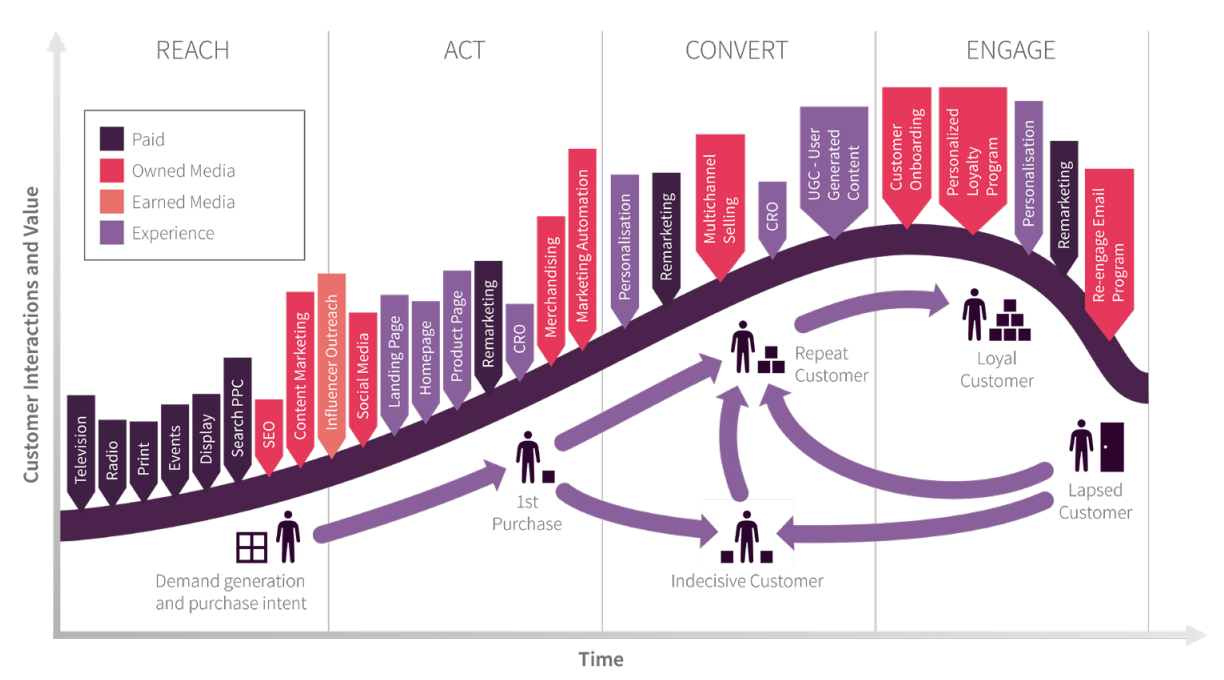
Some sites offer simplistic solutions to the problem of digital marketing integration, primarily focusing on the easy bits, like creating a stylesheet to ensure all marketing communications share a similar look and feel. That doesn’t solve more complex issues like the example shared earlier. The graphic above shows the complexity involved in coordinating across the various channels used to reach consumers.
This type of integration is hard, and simplistic solutions involving graphic design and a common message won’t move you far enough in the integration process. Among the advice you’ll hear is:
- Create a unified marketing strategy
- Build cross-functional teams
- Reduce politics and ownership of specific marketing channels
Again, this is good advice, but you won’t achieve digital marketing integration by implementing these solutions.
Consider these six elements of digital marketing integration from Synecoretech:
- digital presence management
- content marketing
- targeted discovery
- online engagement
- social, mobile, local
- performance management
Understanding the customer journey
Even this advice ignores the realities of the customer journey, which isn’t the linear process you learned in college or other marketing training. Self-reports in the Oracle study show only 43% of marketers feel they understand the customer journey and adjust digital marketing efforts to accommodate consumers in different stages. Based on my experience, I would guess the actual number of firms doing an adequate job at matching the customer journey is much lower because most firms have no clue what the customer journey even looks like.
Most firms think of the customer journey as a straightforward progression that looks something like this:
 Unfortunately, the customer journey is a much more convoluted process than envisioned in this Google graphic (which, BTW, is nominally based on their data for search). This diagram shows social as the beginning of the customer journey and the corporate website as the end. But is that accurate?
Now, if you added loops within this diagram, I think you’re getting closer to what a customer journey really looks like. Let’s take a look at a possible scenario to see what a customer journey looks like:
Sally sees a post from a Facebook friend who’s vacationing in Hawaii. She’s jealous that her friend is spending time in the sun — she looks tanned and relaxed. Later, Sally runs into her friend at a networking event and asks about the vacation. She gets a glowing recommendation from her friend and determines to consider Hawaii for her upcoming vacation.
Sally begins her exploration by visiting a travel site like Orbitz or Travelocity (a prior bad experience with Expedia eliminates then from future travel consideration — remember the importance of customer satisfaction. Studies show a small increase in customer retention creates a large increase in ROI). She loves looking at various hotel and resort options, but she isn’t sure.
Sally cuts and pastes URLs from various hotel and resort websites into her Facebook or Twitter streams asking her friends for feedback. She also sends her friend who recently returned from Hawaii a text asking her opinion of the various travel options.
Sally gets feedback from a couple of folks on her Facebook post, but doesn’t feel like they’re very helpful, so she goes to a review site like Yelp. There she finds opinions are all over the place with some folks really liking a resort and others hating it.
What should Sally do?
Sally visits the Facebook pages from a few of her favorite options to see great pics of their facilities. She asks a question about activities for her kids, but she never hears back.
Sally starts noticing ads on Facebook and through organic searches promoting resorts and hotels in Hawaii. A few look interesting, so she shares them with her friends hoping to get better responses this time.
A few days later, Sally gets an email from a hotel offering a discount on their Hawaiian holiday vacations. So, she books it.
Instead, the customer journey is a set of concentric circles that look like this, except for the straightforward decisions made when buying convenience goods or impulse buys. For most products, the customer journey looks like this:
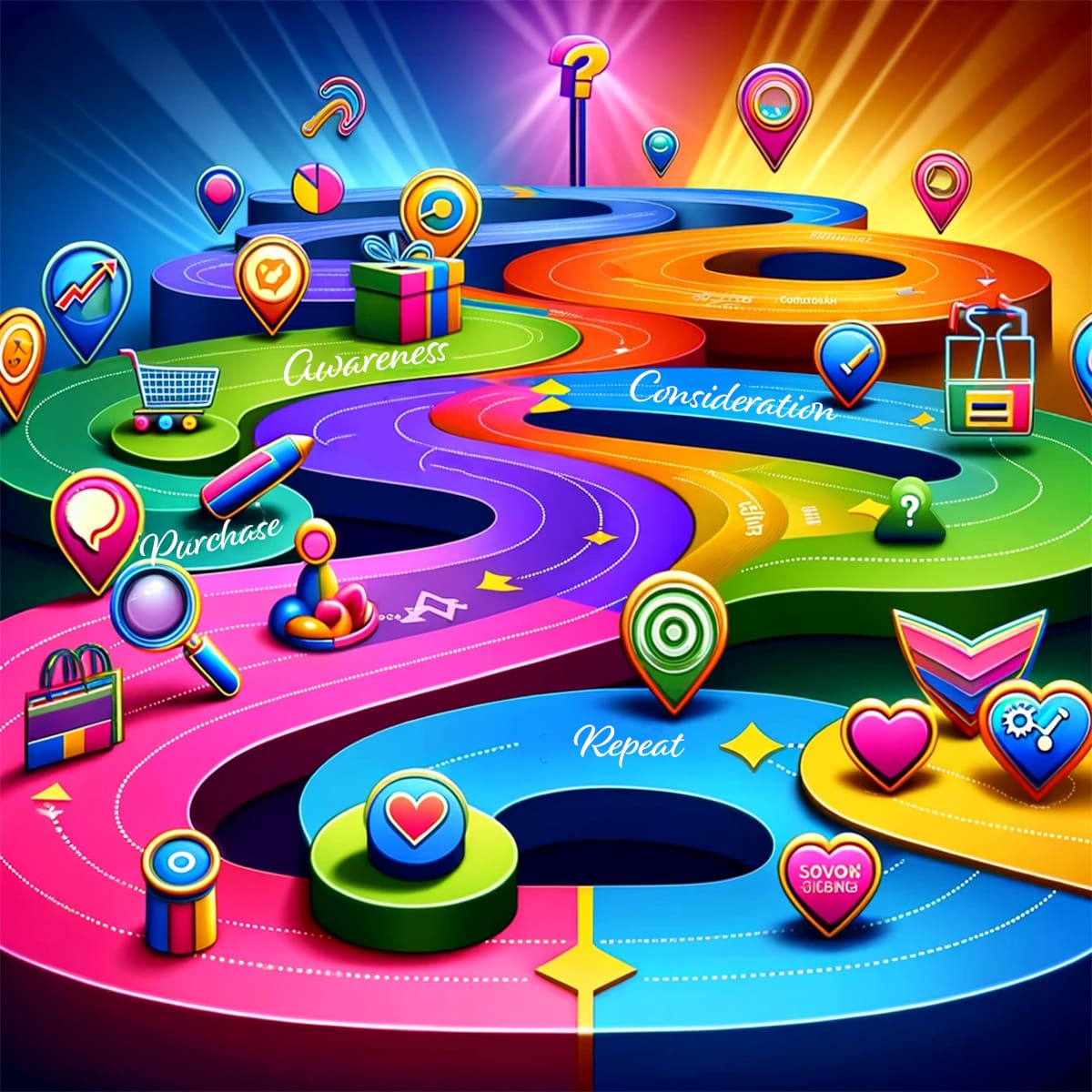
This reality impacts consumers by preventing them from seeing a product and buying it immediately. Instead, they recognize they need something and figure out what products might fill that need (solve their problem, e.g., hunger). They may search out products that fill their needs or scour their mind for products they already know about from past experience, recommendations, or company communications (that’s the awareness stage). They consider available options until they make a decision. They then purchase the chosen option and file away elements such as satisfaction for later consideration. The result is that they might repurchase the product the next time the need arises.
Throughout the journey, consumers learn more about products from various channels, including social media, search advertising, recommendations, traditional advertising, and the news. Consumers integrate this information to form attitudes and beliefs about products, which influence their decisions since details from these channels form these attitudes; discordant information or information that doesn’t fit together nicely results in muddled attitudes that make it easy for a consumer to discard your brand.
A casual look at Google Analytics would show that the journey for visitors on their site starts from multiple points and goes through various pages before it ends with either a purchase or exit. Since most of the conversion data you’ll see in your Google Analytics is based on last-click attribution, you may not know the impact of multiple journeys visitors take before conversion. Multichannel Attribution Modeling, available through Google Analytics, parses out the impact of various channels to give you a better view of how each channel contributes to your success. Even this advanced modeling technique can’t account for online influences, such as recommendations from friends and family, news reports, traditional advertising, and product placement.
Let’s agree that digital marketing integration is hard and requires significant effort to achieve success.
How digital marketing integration makes the sale
So, how can digital marketing integration make or break the sale in Sally’s journey?
- Encourage website visitors to sign up for your email list, thus integrating your website and social platforms through email marketing. Email is an effective means of reaching out with special offers or simply keeping your brand top-of-mind as consumers journey toward purchase.
- Reach out to influencers to get them to share information about your brand. Many customer journeys rotate through social several times before closing. Consumers trust their connections and want their opinions before purchasing products. So, integrate your blogger/ customer outreach with your other digital marketing efforts to amplify your messaging.
- Using marketing automation is a great way to ensure an integrated message. Automation tools not only simplify and streamline the process, allowing you to focus efforts on messaging, but they can also help achieve better integration by sharing data across channels.
- Engage visitors to your social platforms by answering queries in a timely manner. This sounds simple, but many brands fail at it.
- Avoid data silos by using tools to create dashboards that integrate data from various sources to aid in integration.
- Ensure you hire people with the right skills to deal with data and messaging integration across platforms.
- Offering a discount code is a great way to ensure Sally sees your offer when she makes a purchase, but some users get confused about using discount codes. So, make sure your website reflects the offer made to Sally in her email by customizing it based on past interactions with a particular customer.
Remember, digital marketing transformed the relationship with consumers and put them in charge. Your goal is to provide them with tools to make purchases and integrate across channels to optimize market performance.
Conclusion
Digital marketing integration offers tangible benefits to your organization, but it isn’t easy. It requires a top-down commitment to data sharing and cross-functional cooperation among your various teams. Institutional politics and inertia can stymie your efforts to integrate your messaging and that’s just the easiest part of integration. Integrating customer data so you can address consumer needs at each stage in the customer journey is much harder but it’s necessary if you want to optimize your marketing efforts.
Need marketing help to support business growth?
We welcome the opportunity to show you how we can make your marketing SIZZLE with our data-driven, results-oriented marketing strategies. Sign up for our FREE newsletter, get our FREE guide to creating an awesome website, or contact us for more information on hiring us.
Hausman and Associates, the publisher of MKT Maven, is a full-service marketing agency operating at the intersection of marketing and digital media. Check out our full range of services.
Discover more from MKT Maven
Subscribe to get the latest posts sent to your email.


