 logo

Over the years that I have run this website, marketing has transformed dramatically from what it was 10 years ago. Today’s businesses need different marketing skills, especially those related to business analytics, AI, and a new way to get traction through search engines. Rather than slow down, I expect this evolution in marketing to speed up, demanding an ever-increasing skill set from marketers.

Whether you’re looking for a new job or an employer looking to hire competent marketers, you need to constantly update the skills required for competent marketers. Take a look at recent job descriptions to see a list of skills that are currently demanded by employers. If you lack these skills, there are lots of ways you can acquire them. For instance, you could use one of the online training platforms or simply begin reading materials published by industry marketing leaders.
Why do you need 21st-century marketing skills?
The answer to this question is simple. Without 21st-century marketing skills, businesses cannot succeed, especially when you consider that their competition has these skills.
The landscape of business has changed dramatically over the last decade, with the emergence of digital data-driven and customer-centric marketing strategies. Without the technical know-how and the soft skills like communication and strategy that help you understand consumer behavior, build loyalty, and assess performance, there is no way to succeed in this market. Traditional marketing strategies are just not enough in an environment where you must be able to leverage technology and data to provide personalized experiences.
Why don’t businesses have the right marketing skills?
As a marketing professor over the last 30+ years, I’ve come to the conclusion that we’re not teaching enough of the right marketing skills to students.
There’s a little history behind that, but it came down to criticism that we were teaching too many applied skills and not enough marketing theory. So, in the ’70s, everything changed almost overnight. We developed theories, borrowed from economics, psychology, sociology, and, later, anthropology, to generate theories to explain consumer behavior and guide the development of marketing strategy.
What resulted was a great body of conceptual thinking, but we spent so much time teaching this stuff to students that we forgot to teach ANY applied skills (I would argue we also failed to teach them the application of the concepts we taught, but that’s for another discussion).
Companies, in response to our failure, thought they could retrofit other majors to fill marketing roles — engineers are a common one because they have the analytical skills. Or they’d hire English majors (they can write) or political science majors (they’re cheap), maybe a psychology major or two.
Great. These folks have some of the skills you need to market a 21st-century company, but they’re missing the key skill—marketing.
And, believe me, marketing concepts matter. Understanding consumer behavior (influence, motivation, self-identity, decision-making), building 21st-century marketing strategies (using BCG, etc.), managing innovation (adoption, diffusion, tech management, valuation), and many other marketing concepts are indispensable for marketing a brand and there’s simply NO substitute for knowing marketing concepts.
So, it’s not like solving a math problem where you can either get an answer or not. Not knowing marketing concepts leaves you in the dark — you think you’re doing a good job, but you would do MUCH better if you understood marketing.
What you don’t know, you don’t know you don’t know.
What skills do you need in the 21st century?
Good question.
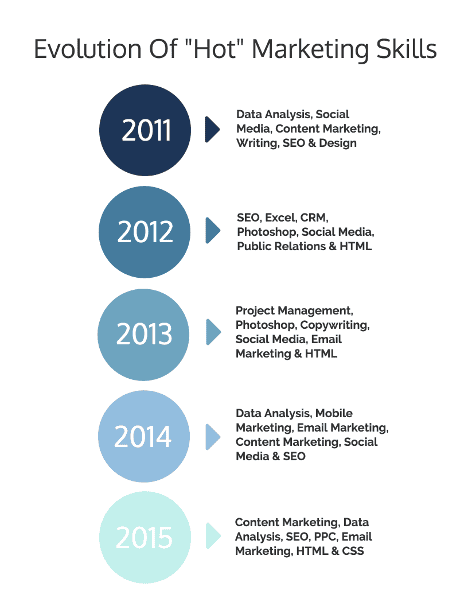
While dated, a colleague sent me this infographic, which I believe summarizes the marketing skills needed in the 21st century and charts the change over the last 5 years.
So, let’s take a look at the top trends in hot skills for marketers: [source: Evolution of Marketing Skills |
In the intervening 10 years since this infographic was created, the marketing world has shifted yet again. While these skills are still incredibly essential for success, you need additional skills to survive in today’s world. One of the biggest changes comes from artificial intelligence. Not only has AI changed the way that marketers do their work, but it’s also changed the way that consumers search for products and their expectations from the companies they buy from.
Consumers now expect companies to offer personalized solutions beyond simply adding their name to an e-mail. Now, instead of typing in a search word to find solutions for their problems, they ask questions of their voice devices, such as Siri. This means that their queries are now longer and more sophisticated, which means that companies need to change their keyword strategy.
Speaking of search queries, users now find an answer snippet at the first position and their search results that answer their questions. This means that customers no longer must visit your website to learn about your products. SEO has evolved into GEO (generative engine optimization), where your brand name showing up in this snippet is now more important than driving users to your website.
Skills to focus on
Analytics, analytics, analytics
Appearing throughout the infographic are data analysis skills. Unfortunately, most marketing programs only include market research, which is a great source of primary analytics, but fails to mention analysis of secondary data. With the rise of digital, these secondary information sources dominate. That’s where companies think hiring an engineer or data scientist will bail them out.

An understanding of marketing concepts is needed for answering the tough questions (and knowing which questions to ask in the first place), which engineers and data scientists can’t.
As an example, take a look at this report from Google Analytics. What insights can you gather from it?
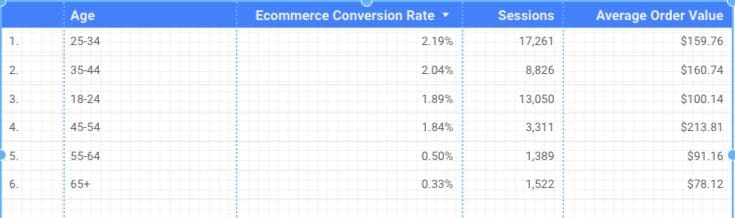
Well, that depends on asking the right questions and knowing a little about consumer behavior.
First, we know 25-34-year-olds convert at a higher rate — that says your messaging works with this age group and, to a lesser extent, with those slightly older — 35-44. Strategy, continue focusing the message on this group.
However, these groups spend less money, on average, on your site — suggesting they don’t have the money to buy as much product as they might want (they’re either buying lower-priced products or fewer of them). So, a strategy might be to either offer ways to extend their purchase ability (financing, discounts, etc) or change their perceived cost (break down to pennies/ day, for instance). This is even more true for the 18-24 age group, which offers great potential as more of them visit than almost any other age group.
The group 45-54 converts to a lesser extent, but has the highest purchase value. Maybe they’re buying for their kids? Maybe the message just isn’t resonating with them. Strategy: create messages that resonate better without annoying the younger demographic, or, if they’re buying for their kids, emphasize this in messaging.
Notice that the appropriate strategy is a combination of understanding the numbers (that AOV is more important than conversion rate and much more important than sessions) and an understanding of consumer behavior. No BI guy can reliably generate such insights.
Marketers also need to understand tagging so they can effectively assess the return on various types of sharing and do effective A/B testing.
Content marketing/SEO
Traditional SEO was replaced by content marketing years ago, yet businesses still think of them as separate. Here’s where the English majors get hired to do marketing — hey, they can write, can’t they?
But, there’s a critical difference between knowing how to write and knowing what to write and that’s where marketing comes in. Understanding influence, decision-making, group dynamics, and sales makes a huge difference in the ROI of content marketing. Remember, your goal is to sell stuff, not just drive visits with your content. Marketing skills play a huge role in making the cash registers ring from your content marketing strategies.
Ancillary to content marketing, marketers need skills that support content creation, such as:
Photoshop – since you don’t have time to send every image needed through an art department, as you do in traditional advertising. As a marketer, you need to be able to create Photoshop images, add titles, do a little editing, and optimize sizing for your various needs.
HTML/CSS – not that you need to code websites from scratch, but you should be able to tweak a website or add a little JavaScript to make a post look just so.
Social media – because it’s important for SEO (as it’s one of the factors in the algorithm that determines SEO) and for generating visits and motivating sales. But, social media is also a huge benefit for traditional market research (qualitative) as you can discover attitudes toward your brand, unmet needs, problems with your product/ services, and even learn more about your target markets.
Of course, artificial intelligence has changed content marketing significantly. First, knowing how to use AI effectively in your content creation efforts is important; otherwise, you sound like a robot wrote your content, and you may find yourself penalized for duplicate content. In addition, schemas are now a critical element necessary if you want to show up when prospective customers search for solutions that you provide. AI uses schema to help train its models, and if your content is not organized effectively into schema, the models might overlook your content.
Marketing channels
Email marketing, mobile marketing, PPC, and the rest are marketing skills needed to understand various channels. Just like knowledge of marketing tools, you need to master the intricacies of various channels to ensure you optimize your marketing return.
Integrating across these channels is expected by today’s consumers. Consumers want to start on one device within one platform and easily move between platforms without losing prior information.
What if I don’t have the right marketing skills?
Well, you’re in luck. There’s never been a better time to learn and master better marketing skills. A number of free sources offer training or guidance in developing marketing skills. Here’s a partial list:
- Copyblogger and Buffer both offer great tips for content marketing (and of course, my blog)
- Occam’s Razor and the Google Analytics blogs are both perfect for learning more about analytics
- Codecademy is a great place to learn any type of coding. They also offer certifications and testing for less than $20 per month. I think their interactive classes are great.
- After years, Adobe now offers training for its suite of creative tools, like Photoshop. Check them out. Image tools like Canva and Adobe Express make it easy for novices to create custom images with minimal experience.
- A number of online certificate programs offer training to help you acquire any or all of these marketing skills.
Need marketing help to support business growth?
We welcome the opportunity to show you how we can make your marketing SIZZLE with our data-driven, results-oriented marketing strategies. Sign up for our FREE newsletter, get our FREE guide to creating an awesome website, or contact us for more information on hiring us.
Hausman and Associates, the publisher of MKT Maven, is a full-service marketing agency operating at the intersection of marketing and digital media. Check out our affordable coaching programs to help your business thrive into the future.
Discover more from MKT Maven
Subscribe to get the latest posts sent to your email.


