 logo

Expanding your e-commerce business internationally is an exciting yet complex venture, and finding the right solutions can make or break your success. From payment gateways to culture to legal structures to shipping logistics, navigating international e-commerce requires careful planning and the right tools. This article provides you with your ultimate guide to international ecommerce solutions.
Key considerations for international expansion
International e-commerce might seem like a logical extension of your business operations since the Internet goes everywhere without stopping at national borders (with only a few exceptions in China and similar countries). Plus, with more people, especially younger consumers, speaking English, your concerns over language are far less than ever before. Despite this, international e-commerce represents a host of challenges for your business and you must overcome these challenges if you have any hope that your venture will succeed.
Below, we discuss some of the significant changes faced in international e-commerce and offer some ways to overcome these challenges. So, read on!
Consumers are different around the world
You might think that consumers are the same all over the world, but that’s not true. While a band of consumers, especially younger ones, tend to share similarities because of ubiquitous access to social media and international news, there are still significant differences in values, customs, and lifestyles. For instance, below, you can see the differences between the VALS (values, attitudes, and lifestyles survey) between the US and China. This suggests your marketing messages, products, and other elements of your international e-commerce campaigns must be very different when aimed at these countries. Similar differences occur across other cultures, although maybe not so pronounced as in this comparison.
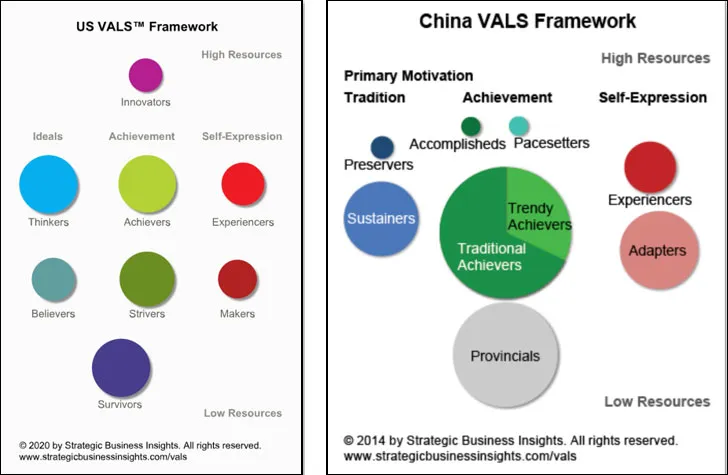
Thus, one of the most important things you should do before expanding your e-commerce business internationally is to conduct extensive market research. Understanding the target market’s needs, preferences, and shopping behaviors will help you tailor your products, incentives, calls to action, and marketing strategies to maximize your efforts in each culture.
You should examine the demand for your products in different countries and the local competition, as well, as you may find significant differences in these marketing aspects across countries and regions. Research local pricing strategies, potential customer concerns, and how similar businesses are performing.
Assessing logistics, such as the costs of shipping and the amount of time it takes to deliver, is also very important.
Cultural sensitivity
The cultural norms, values, and expectations of individuals from various nations can have an impact on the manner in which they engage in Internet shopping, their product preferences, and their sensitivity to marketing messages, as mentioned earlier. A few examples of things that can have different connotations in different cultures include colors, images, and even language. For instance, a US president once wore a cap displaying the colors associated with the opposition party when visiting a country without realizing the insult he was indirectly communicating to his host.
Customizing your website, product descriptions, and marketing campaigns to suit the local culture helps you build trust and attract customers. For instance, while English might be the global language, local languages should be used on your website to enhance communication and make customers feel more comfortable.
Another issue that varies across cultures is family size and composition. This may impact not only product preferences but also the sizes demanded by consumers. For instance, the family in some Latin American cultures is extensive, consisting of multiple generations. These consumers may prefer to buy in bulk to accommodate the family size.
Religion is a significant part of culture in some countries and relatively less important or more diverse in others. For instance, consumers in dominant Muslim countries see specific types of dress as inappropriate. Adapting images to conform to their religious sensitivities is imperative.
Legal and regulatory compliance
Different countries have their own laws related to data protection, consumer rights, product safety, advertising, international trade, and taxes. Familiarizing yourself with local regulations is essential to avoid legal issues that could delay or stop your expansion.
For instance, some countries may require certain certifications for selling specific products, while others may have restrictions on how you can advertise. A good example is advertising prescription drugs, which are only legal in the US and a couple of other countries.
Additionally, consider how tax rules work in international markets and ensure your pricing structure accounts for local taxes and duties. A big tax issue is tariffs, which are taxes assessed on imports that might impact what consumers pay for international e-commerce purchases and may make them unaffordable despite your pricing. Another related issue is rules governing taxation on profits earned overseas, as well as restrictions on bringing those profits to your home country.

Payment solutions for international markets
Multiple payment methods
Customers in different countries have varying preferences for how they pay online. Some may prefer credit cards, while others might use digital wallets, bank transfers, or even mobile payment options like PayPal, Apple Pay, or local services such as Alipay in China or UPI in India. Cryptocurrency may also be an option in some countries.
By providing a wide range of payment options, you ensure that customers can choose the method they are most comfortable with, which can help increase sales.
Currency conversion
As you expand globally, your customers will want to pay in their local currencies, which inserts a certain element of uncertainty as currency fluctuations are rapid. You should offer currency conversion tools on your e-commerce platform, allowing customers to see the prices in their native currency before making a purchase and be prepared to adjust prices with sizable changes in conversion rate. Be careful, however, to avoid changing prices with every change in the exchange rate, or you’ll end up frustrating consumers. Keep in mind that currency conversion can involve fees, so it’s essential to be transparent with your customers about any additional charges.
This feature helps avoid confusion and makes the payment process smoother. It’s also essential to work with payment processors that handle currency conversions easily, ensuring that transactions are processed at competitive exchange rates.
Fraud prevention
The likelihood of fraud increases in proportion to the global expansion of your company. It’s essential to have strong security measures in place to protect both your business and your customers.
Use tools like secure payment gateways and encryption to ensure that all transactions are protected. Implement fraud detection systems that can flag suspicious activity, such as unusual payment patterns or high-risk locations. Additionally, two-factor authentication (2FA) and other verification methods should be used to confirm that transactions are legitimate.
Marketing strategies for international markets
Digital advertising
Online platforms like Google, Facebook, Instagram, and local search engines offer powerful tools to target audiences based on their interests, location, and behavior. For international markets, it’s important to adjust your ads for local preferences and languages. Using localized images, videos, and messaging that resonate with the local culture can help improve engagement. Additionally, be mindful of the digital platforms that are most popular in each country.
While Facebook and Instagram are widely used globally, some countries may have other platforms, like WeChat in China or VKontakte in Russia, that are more effective for advertising.
Local influencers and partnerships
Influencers have a large following and can help promote your products in a way that feels authentic to the local audience. They understand the culture, language, and preferences of their followers, making them an excellent resource for building trust with new customers.
Choose influencers who align with your brand values and have an engaged, relevant audience. In addition to influencers, consider forming partnerships with local businesses that complement your brand.
International email marketing
Email marketing is a powerful tool for reaching international customers, but it needs to be tailored to each market. Personalizing your emails for different regions, languages, and cultural norms is key to success. Start by segmenting your email lists based on location, preferences, or buying behavior. This allows you to send targeted messages with relevant offers, updates, and promotions. For instance, you might highlight local sales or holidays in your emails to make them more appealing to each audience.
Additionally, use email automation to send follow-up emails or cart abandonment reminders, helping increase conversion rates. Make sure your emails are mobile-friendly, as many international customers access emails on their phones.
Achieve global success today
The digital marketplace is vast, and with the right tools and mindset, your global success is within reach. Don’t wait – start implementing these solutions today, and watch your e-commerce business thrive on the international stage.
Need marketing help to support business growth?
We welcome the opportunity to show you how we can make your marketing SIZZLE with our data-driven, results-oriented marketing strategies. Sign up for our FREE newsletter, get our FREE guide to creating an awesome website, or contact us for more information on hiring us.
Hausman and Associates, the publisher of MKT Maven, is a full-service marketing agency operating at the intersection of marketing and digital media. Check out our full range of services.
Discover more from MKT Maven
Subscribe to get the latest posts sent to your email.


