 logo

Why a post about integrated digital strategy today? Haven’t we known about integrated marketing strategies since the 1980s? What’s new enough to justify a new post about the topic? Well, only everything. Today’s integrated digital strategy combines the previously separate marketing tactics of search, content, and commerce into a single, connected strategy that recognizes that consumers today don’t shop the way they did even a few years ago.
They want a single experience that seamlessly allows them to search, discover, and buy products with a single action, thus blurring the lines between the once separate strategies. In the next sections, we’ll discuss how to implement this new strategy and provide examples of how small businesses like yours can take advantage of this integration to explode your business.
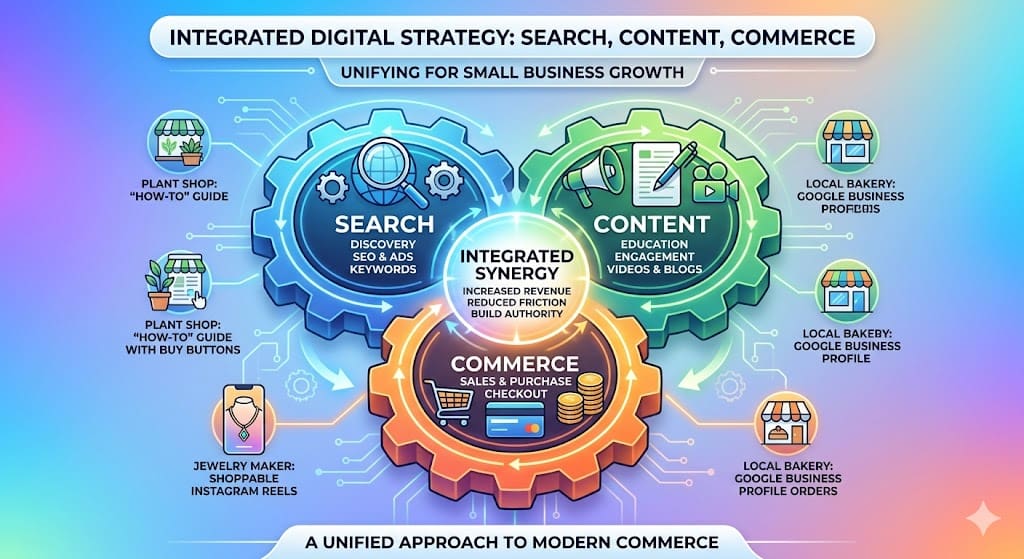
Integrated digital strategy: Combining strategies
Once you had separate strategies:
- Your search strategy focused on elements of SEO and advertising, such as keyword planning to draw prospective buyers by creating awareness.
- A content marketing strategy focused on creating content that informed consumers about the benefits your products provided, how-tos to help them get the most from their purchases, and inducements to motivate a purchase.
- Selling was focused on building landing pages, shopping pages, and elements of the conversion process, such as a shopping cart and payment portal.
This strategy, which often employed different teams (or personnel if you run a small company) with different expertise. It was built on an archaic notion visualized as a funnel that imagined discrete stages in the consumer buying process that looked like this:
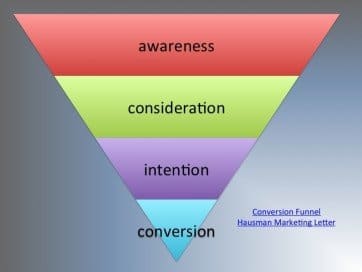
If that was ever the way consumers approached a purchase decision, it doesn’t reflect the way they approach this same task today, which looks more like this:
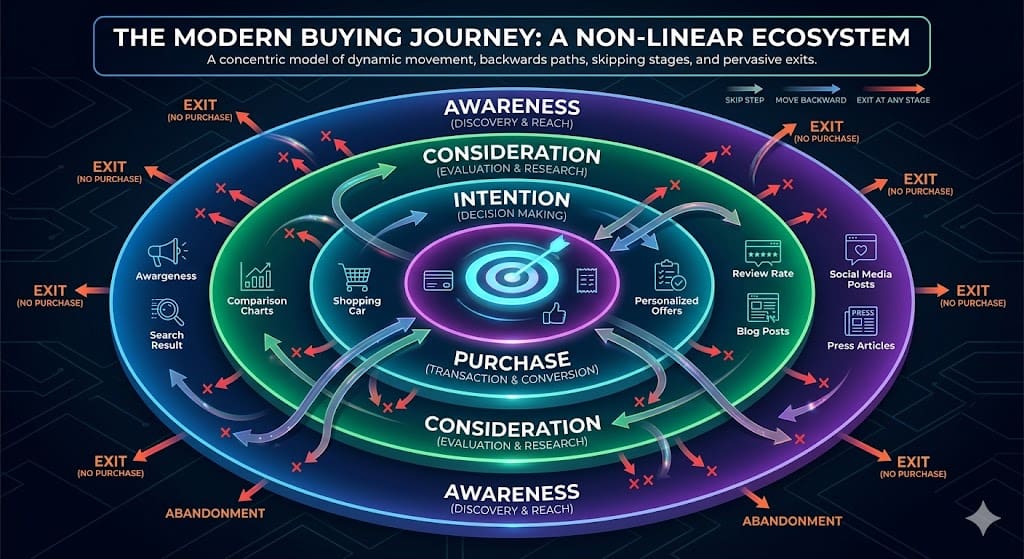
Note that rather than visualizing the process as a linear one, this image reimagines the process as a series of concentric circles. Consumers enter anywhere in the process, move between circles either forward (toward conversion) or backward (toward awareness), with the potential to jump to any circle rather than move linearly as the stages blend from one to another.
For instance, a consumer might encounter a shoppable video either by searching for a problem solution, viewing an ad on social media, or simply filling time with Instagram or TikTok browsing. The video provides all the information they need to make a decision, then links to a portal allowing the consumer to complete the purchase. In what’s often called an impulse purchase (often more a reflection of some other mechanism in place, such as habit buying), you may see the process driven by awareness, jumping straight to purchase without consideration. Similarly, a major purchase might involve consumers moving through the process in an uneven fashion, such as this:
- See an ad or social post that creates awareness of a gap between where you are and where you’d like to be. The solution to bring you to your preferred position is a product involving significant risk, such as buying a new car (financial and safety risk) or a new dress for an event (social risk).
- Begin exploring alternatives. You might use heuristics, such as turning to a brand you favored in the past or turning to trusted information sources, such as magazines showing current fashions or consumer reports. This might result in a consideration set.
- You see a social media post from a trusted source recommending a product not currently in your consideration set.
- You gather information on this new purchase option.
- After careful consideration, you decide to purchase product X.
- Product X is too expensive, isn’t available in your local area, or doesn’t offer attractive financing.
- You go back to step 2 or decide to delay making a decision.
- Another product is chosen from that set.
- Repeat until you finally make a purchase or discard the notion of buying any product at all. You determine you’re OK with where you are and no gap exists.
- Lather, rinse, repeat as often as you want over time.
Meanwhile, a stage often ignored in the visualization of the consumer buying process is the role of producing satisfied customers who return to make future purchases and post reviews that influence new consumers to give your brand a try.
The consumer uses a variety of influences across their individual journey, including brand content, social media posts from influencers and peers, ads (including remarketing ads on search and social), reviews, and email reminders (especially if they abandoned the shopping cart). Reflecting the real journey consumers take before potentially converting, this image reflects the notion of an integrated digital strategy as a superior tool for success over one that’s more fragmented. For small businesses, with their nimbleness and employee expertise with multiple tasks, they have a distinct advantage if they employ an integrated digital strategy that allows them to punch above their weight class. Rather than content created for a single purpose, such as the one below, the business now creates content that integrates across various tasks that you need to fulfill in order to reach conversion.

Why you need an integrated digital strategy
Why do you need to implement an integrated digital strategy rather than relying on a strategy that focuses your tactics on sequential stages of the buying process? That’s an easy one — because your performance benefits from recognizing the real way consumers move through the buying process and matching your strategies to this reality. Here are the ways you’ll benefit from this change:
Shorten the time between stages
By implementing this new way of managing the consumer buying process, you shorten the distance between awareness and purchase. Any delay or dithering over a decision gives your competitors a chance to swoop in and steal the sale. You don’t want that, obviously.
By integrating a shop within your video or adding a buy now link, you help consumers act on their purchase intention while they’re thinking about (or feeling) the purchase.
Your content does double duty
Content is expensive. You must create it, promote it, and monitor it. You want to get the most from your money and effort. By producing integrated content, your content does double or even triple duty, which optimizes your ROI. For small businesses that often struggle to create, promote, and monitor enough content to generate returns, this is a great tool.
Optimize insights
We’ve talked extensively about the importance of monitoring your marketing performance. If your metrics are parsed between your website (monitored via Google Analytics, your social media ads (monitored via a Meta dashboard or on TikTok, or both), and your CRM (monitored via Salesforce), your ability to derive insights from your data is limited, especially for small businesses that can’t afford platforms that integrate this data seamlessly.
How to implement an integrated digital strategy
1. Turning content into a digital store
Nothing impacts digital marketing more than the shift in search engine marketing. Part of that shift is recognizing user intent based on the nature of the search query. With more voice search, queries are now more specific and ask for how to do something, not just a product. AI has also transformed your ability to attract users to your website, which means you have to consider ways to convert without the intermediate step of a site visit.
Hence, an integrated digital strategy focuses on showing up in an AI-assisted search for how to do something related to your product. Then, you embed a purchase link within that content, thus addressing awareness, consideration, and conversion within a single piece of content.
For instance, you might craft a blog post addressing how to do something like “How do I get my kids to stop fighting bedtime?” Embedded within the advice you provide are links to buy the products you recommend. Now you’re helping to solve a problem while aiding your bottom line by easing conversion.
2. Capitalize on social conversion

Note the conversion elements embedded in this shoppable video. By including the right keywords, you are searchable (YouTube videos, as well as those posted to major social media platforms, are also indexed for Google search and available to train AI models) and by including a description that addresses user intent, you capitalize on that intent while the information and emotion are at the forefront.
For instance, a retailer or brand might create a video that addresses the intention of finding a handbag big enough to hold all your work stuff while still reflecting a stylish image. By embedding a buy link within the video, viewers are directed to the shopping cart to provide details for conversion.
3. Create product descriptions designed for intent
Don’t use the boring manufacturer product descriptions on your product pages. Instead, treat product descriptions as a tool to create awareness, provide reviews or other information to aid consideration, and include a “BUY NOW” button. If necessary, add specifications and other information that visitors might require near the bottom of the page, with a link to help visitors who are interested find this information easily.
Consider the role of your product page in helping your products rank well in search by addressing user intent and showing up in AI results by establishing your authority when crafting your page.
For instance, a garden tool might feature an FAQ to address common questions, such as why this product is the perfect accessory for the avid gardener. You might include a short video demonstrating the product and embed the buy link within the video. You can bury the specifications near the bottom or include them in the FAQs with a focus not on the technical, but on the benefits imparted by each specification. For instance, rather than listing the information that the product has rubber handgrips, you might focus on user comfort, especially when used frequently or for an extended time plus the control they provide.
4. Don’t forget local search
Local businesses rely on local customers to sustain the business. If you run one, you likely already know the importance of claiming and constantly updating your Google Business Profile. Implement an integrated digital strategy by updating this page frequently with information and online shopping options to transform your listing into a conversion tool.
For instance, a local restaurant might ensure the menu is up-to-date with current pricing and specials, their hours of operation are accurate (including holiday changes to these hours), and include an online ordering portal.
Easy first steps to build an integrated digital strategy
If you’ve read this content, you realize that we’re talking about a massive change in your digital strategy. Recognize that you don’t need to throw out the baby with the bathwater by ditching your existing content. Instead, consider the changes necessary to build an integrated digital strategy when planning for your next quarter or next year. Thus, moving forward, your performance will benefit from this integration of search, content, and commerce under one umbrella rather than as a sequential strategy divorced from your overall goals.
Next, consider your top-performing content. By adapting this content based on an integrated digital strategy, you can turn this content into a self-contained digital funnel to improve performance.
Conclusion
Don’t forget that final stage of the conversion process that’s often left out of discussions — the role of customer satisfaction in driving repeat purchase and encouraging reviews that bring in new customers. Including reviews as part of your integrated digital strategy is a part of this. People consult reviews before making a purchase, and those posting the review like the recognition provided by seeing their post.
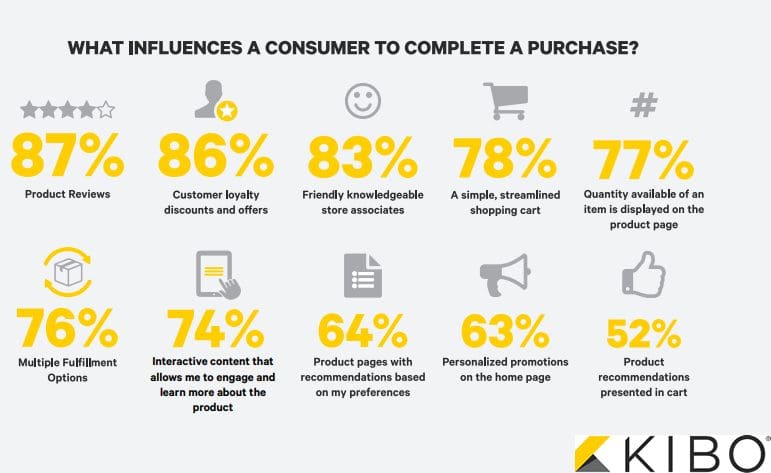
Also, integrating email into your digital strategy provides additional benefits. You can:
- Use email marketing to thank customers for making a purchase
- Remind users who left a product in their shopping carts
- Request reviews from customers
- Offer personalized suggestions for additional purchases
Need marketing help to support business growth?
We welcome the opportunity to show you how we can make your marketing SIZZLE with our data-driven, results-oriented marketing strategies. Sign up for our FREE newsletter, get our FREE guide to creating an awesome website, or contact us for more information on hiring us.
Hausman and Associates, the publisher of MKT Maven, is a full-service marketing agency operating at the intersection of marketing and digital media. Check out our affordable coaching programs to help your business thrive into the future.
Discover more from MKT Maven
Subscribe to get the latest posts sent to your email.


