 logo

Can small brands really smash big brands? Yes, but not if they continue playing by the big brands’ rules. Stop playing the big brand game on their terms. Here’s why your size isn’t a limitation—it’s your greatest unfair advantage. Small brands cannot win a war of attrition against enterprise budgets, economies of scale, or sheer ad spend. To compete, smaller players must play an asymmetric game—turning structural agility, customer proximity, and specialization into distinct competitive advantages.

How small brands can smash big brands?
One of the most common challenges that smaller businesses face is competing with the bigger brands in their industry. These much larger companies have the funds and reputation to dominate the market, and this can make it difficult to survive as a smaller company. Although it will always be a challenge, a few steps can level the playing field and help a smaller company compete, and a smaller brand can even use a few advantages to succeed.
- SEO/ GEO
- Agility
- Targeted advertising
- Delivering customer value
- Build a loyal community
So, if you are wondering how smaller brands can compete with the bigger brands in your industry, then read on to find out more.
1. SEO/GEO
SEO (search engine optimization) is vital for businesses of all sizes in all industries in today’s day and age. But many large companies have been doing SEO for years, building massive amounts of content to rank at the top of results. While you may struggle to reach the very top of search engine results pages (SERPs), investing in SEO can help you reach the first page and compete with these large brands. Using local SEO, it’s still possible to smash big brands by understanding the local market. If you can get more people to visit your website, you have every chance of making a sale, but the website must be of the highest quality in order to succeed.
In contrast, GEO (generative engine optimization) offers a great opportunity to smash big brands because few companies have adopted strategies for this essential tactic in a world dominated by AI-generated answer snippets. In fact, data show that only 16% of big brands are focused on GEO. Here’s the data,

Meanwhile, even these paltry numbers don’t convey the impact that these companies might achieve by fully implementing GEO, since most only allocate 1% of their budget toward this tactic. By learning how to effectively optimize your content to generate clicks from AI tools like ChatGPT and Gemini, you can smash big brands before they’re able to leapfrog ahead of you.
A small brand with expert GEO ability can easily smash big brands that lag behind on this innovative tactic to get their name out to interested consumers. Since queries often demonstrate buying intent, focus on delivering on this intent through a combination of SEO and GEO. Demonstrating your expertise in a certain area also boosts GEO.
Consumers will always choose a brand that is an expert in the field, no matter whether it is a large corporation or a small startup. Social media is a terrific platform for showing your expertise, which can level the playing field and provide you with the chance to persuade your target customer to switch to your brand. You can do this by creating helpful, entertaining, and valuable blog posts. Share posts on social media and then engage with your target customer in the comments, which has the added benefit of boosting SEO.
Being memorable by appearing in AI-generated answers in search engines or when consumers use an LLM (large language model), such as ChatGPT, to show options puts you top of mind when consumers make a purchase decision. More often than not a consumer will use the first company that springs to mind (provided that they have had a good experience with them before). This means that by making your brand more memorable, you can compete with the biggest names in the industry. This is, of course, challenging, but a memorable brand name, strong branding, excellent customer service, and a high-quality product/service is key to boosting your market performance.
It is challenging for a small company to compete with the larger, household brands when they do not have the same money and resources. It is possible to compete with these larger companies, however, using these recommendations so smaller brands can compete using the most effective strategies.
2. Use your agility
You can smash big brands by using your natural agility to move fast when an opportunity arises. Small businesses usually feature less bureaucracy, which allows you to deploy a new campaign quickly or test market acceptance for new products or features that might take a big brand months or years to bring to market. Of course, that requires a leader who doesn’t micromanage every aspect of the business and isn’t risk-averse.
Instead, the organization must hire good people, then give them the authority to make decisions about their given area of responsibility. The team must also communicate effectively if the company hopes to work cohesively toward established goals. This means a corporate culture reflecting a learning organization with a flat structure that allows for rapid adoption of new processes and takes advantage of what it learns.

3. Targeted advertising
Big companies often have multiple products that appeal to large markets because they require massive sales and the resulting revenue to maintain their operation. Small companies often target a smaller, less diverse market. You can smash big brands by using advertising options, such as social media and search, to target these niche markets.
Because these digital advertising options allow you to target your message, value proposition, and timing toward users based not only on demographic and geographic variables, but also on interests, which helps you smash big brands by focusing your ad dollars on those most likely to buy your products rather than wasting resources reaching a broad market that might never buy your brand or spreading your ads too thinly to make an impact. After all, it takes eight touches (on average) to make a sale. That assumes you’re using the right timing and message
When you own a market niche based on an underserved group of consumers, you can not only target marketing and advertising precisely toward that niche, but also provides an opportunity to gain market share and brand awareness that can help propel you when you decide to expand to other market niches or a mass market. Targeted flywheels help you outbid and smash big brands that must focus on broader markets. Here are some examples:
| Strategic Dimension | Enterprise Playbook | Small Brand Counter-Strategy |
| Search & Discovery | High-volume, head-term paid bidding | Long-tail intent, informational content, and Generative Engine Optimization (GEO) |
| Influencer Marketing | Multi-million-dollar celebrity sponsorships | Micro- and nano-creator seeding with genuine product advocates |
| Customer Acquisition | Paid acquisition blitzes at scale | Organic referral flywheels, niche community partnerships, and owned email/SMS |
| Pricing Strategy | Price cuts and volume discounting | Value-driven pricing rooted in superior experience and craft |
4. Deliver customer value
One area where larger brands often struggle is customer service because it is hard to provide a personalized experience when you have so many staff and issues to resolve. Smaller brands can take advantage of this by making customer service a priority. Consumers need to feel important and heard throughout the customer experience, so make sure that your staff is friendly, helpful, knowledgeable, and willing to go the extra mile. If you strike up relationships with your customers and get on a first-name basis, then you can retain customers, which is the key to success (more on this in the next section).
Because large companies serve thousands or millions of customers, handling customer service is often an afterthought. The reasoning is that you can afford to lose a few customers who aren’t happy with you and remain profitable. Of course, that ignores the fact that it costs five times more to replace a dissatisfied customer than to keep that customer happy. Thus, you can smash big brands with your expert and personalized customer service if you make it a priority.
Personalize your customer service by hiring dedicated customer service staff, training them thoroughly, and conducting periodic customer service audits to ensure you deliver high-quality service every day. Gather feedback from your staff and share it with those responsible for products (whether manufactured or purchased), advertising (to ensure you can keep your promises), and management to ensure you reduce customer complaints. Monitor social media to search for customer complaints proactively, since 96% of dissatisfied customers will leave, while only 4-5% will voice a complaint. By ensuring your product quality with routine monitoring, you can reduce dissatisfaction, reduce customer acquisition costs (since they share their displeasure with others), and smash big brands that don’t take these factors seriously.
As you can see, companies that manage the customer experience see revenue increases of between 10 and 20%.

Building on this, you can also level the playing field with your company website as part of your end-to-end customer experience. Nothing deters a customer quicker than a dated, clunky, and unattractive website, but it is possible to design a professional standard website for an affordable price, even if you have no prior experience. Trusted cloud hosting companies like Krystal.co.uk provide a high-quality, reliable website along with an easy-to-use site designer tool that makes it easy, with no prior experience or coding. Make sure that the website you create explains why the visitor should choose you over the competition, and you should see a spike in sales.
5. Build a loyal community
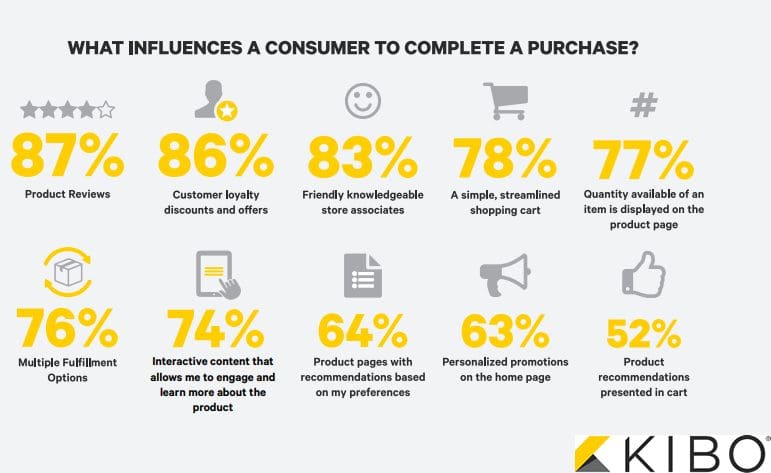
A loyal community of consumers helps you smash big brands because loyal customers return again, share their positive experiences with others to spread awareness, and offer reviews that encourage other consumers that your products are worth the expense. As more customers offer reviews, your ability to drive them through a personalized customer experience and good customer service works to effectively increase sales. The lack of personalization from big brands doesn’t offer the same incentive to leave a positive review. These reviews, along with customer loyalty, are strong influences on consumers considering a purchase, as you can see below.
Obviously, you can’t build community, let alone energize that community to benefit your brand, unless you understand the individual users making up that community. Building a massive community doesn’t offer any benefit unless you build trust and engagement with that community that translate into enhanced reach, support for your brand, and willingness to purchase from your company.
In the early days of social media, you heard that nirvana was achieving virality with your posts, trying to get the most likes possible. Today, we understand that, while reach is important, it’s more important to attract and engage a community than to build a lot of likes.
Thus, you should join in conversations rather than simply post content. Join groups related to your business, such as local groups or those related to your niche and participate in conversations on those groups. Focus on providing meaningful support and information rather than spewing out promotion.
Not only does this focus on community build a stronger community that will support your marketing goals, but it also means you match the Facebook algorithm, so you show up more frequently on users’ newsfeeds.
You build community through transparent storytelling that highlights your people, behind-the-scenes action, and humanizes your brand. You can smash big brands by showing your commitment to the values held by your target market. For instance, supporting the local Little League team or sponsoring a blood drive in your community helps you build a local community. When you share these efforts on social media, you also build an online community.
Conclusion
You can’t easily smash big brands that have more money to put into advertising or their economies of scale, but by implementing these five advantages offered when you organize your small business along the lines suggested in this post, you go a long way to smash big brands.
Need marketing help to support business growth?
We welcome the opportunity to show you how we can make your marketing SIZZLE with our data-driven, results-oriented marketing strategies. Sign up for our FREE newsletter, get our FREE guide to creating an awesome website, or contact us for more information on hiring us.
Hausman and Associates, the publisher of MKT Maven, is a full-service marketing agency operating at the intersection of marketing and digital media. Check out our affordable coaching programs to help your business thrive into the future.
Discover more from MKT Maven
Subscribe to get the latest posts sent to your email.


