 logo

This comprehensive SEO checklist contains everything you need in today’s marketplace. If you want your brand to grow and succeed, the first step is getting found online. Recent changes wrought by AI mean that users no longer turn to Google search when they want to find a solution to their problems, or at least they don’t filter through the top links to find one.
Instead, they turn to an AI tool like ChatGPT or use the answer snippet (that paragraph containing the answer appearing before the ranked links), where they find answers more quickly and with less effort. This means you must adapt to these consumer behaviors if you want them to consider your products as a solution, which means changing your SEO strategies to continue ranking well with search engines, and adding GEO (generative engine strategies) to gain brand mentions in AI tools.
Table of contents
- SEO checklist caveats
- Killer SEO checklist
- Your SEO checklist must now include GEO strategies
- Need marketing help to support business growth?
SEO checklist caveats
First, it’s important to recognize that SEO changes on a regular basis. Google, which still accounts for over 70% of search, tweaks its algorithm used to determine where content shows up in SERPs (search engine results pages) on a nearly daily basis, with major updates coming at least once a year. That means things that are on today’s SEO checklist might disappear tomorrow.
The key to doing good SEO is understanding what customers search for, then delivering high-quality content on a consistent basis to satisfy their need for information. Do that and you’ll always be in step with Google, because that’s what they’re trying to do.
You’ll find a significant overlap between factors on the SEO checklist that improve ranking and those that are best practices for marketing — ie, social sharing and reducing bounce rates.
Play games or use “black hat” tricks and your sites could see severe penalties. At best, you’ll have to change the content to conform to Google’s rules to gain back your rankings.
When I first started blogging about 6 years ago, I was told to load up my content with keywords. While that worked then, it would cause my content to get penalized now for something called “keyword stuffing”.
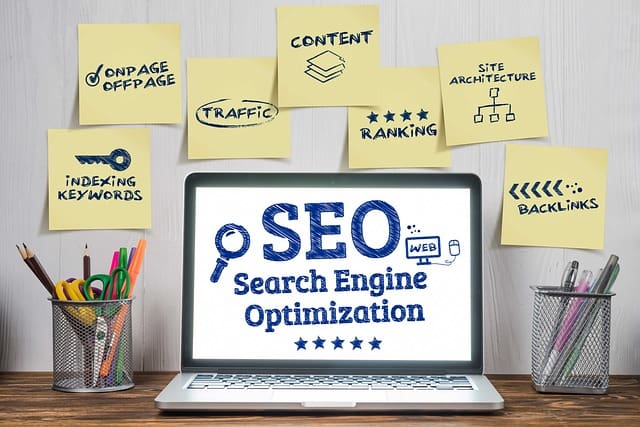
Luckily, for me, I ignored this advice and produced content I thought would be valuable to the audience I sought to attract. As a result, when Google changed the algorithm, my page rank shot up, while much bigger sites suffered penalties.
The same goes for buying backlinks.
When reviewing this checklist, I advise you to weigh it against your long-term marketing strategy and goals. Don’t do anything you think is in conflict with the reputation you’re trying to build online.
I also advise you to add a plugin like Yoast SEO (if you’re using WordPress) or a similar solution to help you manage your SEO consistently.
Now, let’s take a closer look at the SEO checklist.
Killer SEO checklist
This is a massive checklist. You should spend some time reviewing each aspect of the checklist, then comparing it to your own content marketing strategy.
To help assimilate the essence of the SEO checklist, I’ll break down some elements that appear to have a major impact on SEO rankings.

SEO checklist when creating a new site or modifying an existing one
- Domain names matter. There’s some debate as to how to choose a domain name, with some folks saying your domain should contain your keywords, while others suggest your domain name should be something evocative of your brand. I’ll leave that decision up to you. The undisputed key to a good domain name is that it’s totally unique. And, by totally unique, I mean there are no other domain names that look or sound like yours. Don’t add another word to come up with a unique name if someone already has your preferred domain name unless you’re already an established brand that’s well-recognized by your target audience.
- If you need to change your domain name to make it totally unique, use a 301 redirect to ensure you don’t lose the authority or traffic from the original site.
- Buy related domain names to ensure other sites don’t steal the traffic you worked so hard to build. As an example, WhiteHouse.com is a porn site capitalizing on users who automatically add the .com extension rather than the .gov. Think about buying domains with similar names. For instance, when I bought the domain “Buried Ladies” to promote my novel with that working title, I also bought “Buried Women” in case people made a mistake in remembering the exact title.
- Buy the best host you can afford. Look for uptime > 99% and speed.
- Be consistent in whether you use www or not. Consider investing in a security protocol, like HTTPS, to demonstrate secure communications with encrypted data transfer between your website and browser to ensure privacy, integrity, and website authentication. Consumers feel safer using websites with secure protocols and credit card processors require them. Many hosting companies provide this as an added service.
SEO when setting up your site
- Set up breadcrumbs. They improve navigation, which has an impact on SEO by improving the user experience.
- Submit sitemaps to Google’s Search Console to ensure the txt robot crawls your content when ranking results to users’ queries. Optimized XML sitemaps improve the performance of these robots. Reduce broken links by using a tool to monitor when other sites delete or change the links you use in your content. If you change your content, be sure to redirect to the new URL.
- Make sure your site is responsive (looks great on mobile). Test on different screen sizes.

Image courtesy of Webfx - Create a Google Business Profile if you serve a local community. Filling out the profile completely, including adding images, means your information is more likely to appear in an enhanced format near the top of related search results.
- You should also include a contact us page and a statement of privacy to comply with regulations.

SEO when creating content
- On-page SEO is critical for page ranking. Be sure to use keywords that match your customers’ search queries and user intent. Use Google’s Keyword Planner or MOZ Keyword Tool to generate a list of 15 – 25 keywords. Use long-tail, meaning they are phrases, not single words. It’s easier to rank for a phrase and, with an increase in the use of voice search, these phrases are getting longer and more conversational. Note, Google’s tool is part of Google Ads, so you’ll need an account, but you won’t have to actually use the platform unless you want to. Both tools are free to use.
- Use ALT tags on images, add meta descriptions, headings, and tags that feature your keyword.
- Your title and URL should contain your keyword. Use your keyword appropriately within the text. An SEO tool like Rank Math SEO can help with content creation by showing an SEO score for your work, highlighting areas for improvement.
- Include outbound and internal links to demonstrate the authority of your work. Just like references, these links show you’ve done your research. Plus, links are important to comply with “Fair Use” regulations that protect intellectual property.
- Make content high-quality by ensuring it’s valuable to readers and improve readability by chunking content and breaking it up with images. Focus on depth and quality versus quantity, while still ensuring you publish consistently. Quality content, especially unique images and videos, helps you gain backlinks from high-quality sites. You can even reach out to share your content or develop relationships with some related, quality sites in hopes of gaining backlinks.
- Schema markup was always important and it’s becoming more important with the advent of AI. Use markups like Article, Product, FAQs, and LocalBusiness for rich snippets and enhanced visibility.
- Make it easy to share your content on social networks. Since social media engagement is a big ranking factor, shares help with this element of the ranking algorithm.
Image courtesy of WordStream - Longer content is currently outperforming shorter content according to Buffer. Aim for 2000+ words.
- Reduce or eliminate on-page advertising. Too much advertising will negatively impact rankings.

Monitoring SEO
SEO isn’t a set-it-and-forget-it thing. You need to consistently monitor performance using Google Analytics (which requires a small piece of Java in the HEAD section of each page), as well as metrics from your social networks. Monitor metrics like time on site, bounce rate, click-through rate, engagement, brand mentions, and reputation.
- Develop detailed user personas, then tailor content to these personas. Anticipate and answer the types of questions they might pose.
- You should optimize your social sharing to improve reach without spamming your followers.
- Monitor broken links using a plugin or Webmaster Tools. Broken links are not only frustrating for visitors, but they also damage your site’s ranking. Repair broken links or redirect them to similar content.
- Look for the link profiles of your competitors. Compare them to your own profile to find opportunities for new backlinks.
- Set up an RSS feed for your website and focus on building a subscriber list for email marketing. This allows subscribers to stay up to date with new posts.
Image courtesy of Maven Marketing Lab

SEO checklist for GEO
SEO isn’t a set-it-and-forget-it thing. You need to consistently monitor performance using Google Analytics (which requires a small piece of Java in the HEAD section of each page), as well as metrics from your social networks. Monitor metrics like time on site, bounce rate, click-through rate, engagement, brand mentions, and reputation.
- Create answer-ready content that’s easily accessed by large language models (the LLMs that fuel AI). Structure your content with clearn concise answers to the questions users might pose. Use headings, lists, bullet points, and summary boxes to help AI extract the answers. Support the validity of your content with accurate, up-to-date links to quality resources.
- Demonstrate deep subject matter expertise. Including a resume and bio for key contributors is a good way to support your knowledge. We refer to this as E-E-A-T for experience, expertise, authoritativeness, and trustworthiness.
- If you use AI tools to aid in creating content, ensure that you use these tools for brainstorming, outlining, and drafting, but reserve the final draft for a human to ensure quality, originality, and accuracy. AI tools make mistakes. Try to develop and maintain a strong brand voice.
- Monitor your success by testing queries to determine if your brand gets mentioned. You may also find that you gain visitors through AI tools by monitoring your Google Analytics.
Conclusion
I hope this SEO checklist, which includes changes wrought by GEO, helps you in 2026 as you seek to grow your business and succeed. Note that you can’t ignore SEO just because we’re now living in a world where AI engines are supplementing or replacing traditional methods used by consumers as they seek to solve their problems.
Need marketing help to support business growth?
We welcome the opportunity to show you how we can make your marketing SIZZLE with our data-driven, results-oriented marketing strategies. Sign up for our FREE newsletter, get our FREE guide to creating an awesome website, or contact us for more information on hiring us.
Hausman and Associates, the publisher of MKT Maven, is a full-service marketing agency operating at the intersection of marketing and digital media. Check out our affordable coaching programs to help your business thrive into the future.
Discover more from MKT Maven
Subscribe to get the latest posts sent to your email.


