 logo

- While SEO focuses on search engine results, GEO also considers AI tools like Gemini and ChatGPT.
- There’s increased emphasis in GEO for creating clear, structured content that’s easily adapted for providing answers, such as lists, TOC, and short paragraphs that provide comprehensive answers. Synthesize information from multiple sources to provide depth and cite your sources via hyperlinks to reputable websites.
- To perform best with GEO, think about using schema, such as a how-to or FAQ section in your content.
Why do these differences matter?
As you can imagine, the differences between generative engine optimization and SEO mean you’ll improve performance when you generate content that takes advantage of those elements that work for both types of content optimization. That’s because users are already adapting (and loving) the changes they find when using search engines. Likely, more changes are on the way as technology advances and consumers continue adapting to changes.
Thus, GEO represents the future of search. With the declining effectiveness of social media as a source of traffic for your website, you’re left with the decision to either adapt your content marketing strategy or resign your business to declining visits, which limits your business’s online potential (and maybe its offline potential, as well).
While currently only available in the US, the generative search experience is rolling out to the rest of the world. Companies that develop a strategy now will have a first-mover advantage over other companies, potentially creating search value that’ll be hard to compete with in the future and allowing small companies with nimble strategies to pull ahead of their larger competitors. We saw that with the advent of social media marketing, when King Arthur Baking came from obscurity to compete with much larger brands and maintains that advantage even today.
How to add generative engine optimization to your strategy
You can use the principles of generative engine optimization to adapt your existing content to implement the principles of GEO or you can create fresh content that employs the principles.

In the how-to section shown below, you see both suggestions for implementing a GEO strategy in your business, as well as an example of a schema type that encourages AI-powered search engines to pick up my content. We’ll start with an implementation checklist.

Start with questions, not keywords

Sure, keywords still matter, especially long-tailed keywords, as traditional SEO still impacts search performance. However, you need to consider the questions users might ask about where you want your content to show up. For instance, I would love for this content to show up when someone asks, “How can I add GEO to my search engine strategy?”
You can collect this information from sales calls, Google’s “people also ask” sections of results pages, or the questions you collect when training your Chatbot. Social media might also offer insights into the questions users might ask.
Generate and revise content for GEO
* You might consider revising your old content, especially posts that perform well, by adding schema, lists, and tables to those posts. You’ll also want to employ this strategy as you write new content.
* Consider how to answer the questions you think users might ask. Provide short paragraphs to address them, using clear headings/ subheadings to make the content stand out.
* Include hyperlinks to credible sources for the information in your post to build trust and credibility in your content.
Add structured data
Remember that artificial intelligence will be reading your content, so make it easy for the tools to interpret your content by using schema within your content. For instance, this section employs a “how-to” schema. Most of the most popular SEO plugins provide this ability when using the block editor within WordPress or other CMS. Other types of schema, such as FAQs and tables of contents, also help search engines categorize your content.
Build trust and authority
With more users simply turning to an AI tool when they want answers, even small businesses can compete effectively by sharing their expertise. Within your content, include hyperlinks to authoritative sources to demonstrate your credibility and expertise. Even though the information might come from a variety of published sources, you can still add value by integrating these sources into a cohesive document written in clear language. That’s especially true when you include data, reviews, or case studies.
Other aspects of building trust and authority are site-wide. For instance, include a bio for key contributors to your content.
Connect with traditional SEO
Don’t throw out the baby with the bathwater. Hence, you still need to employ all the tools you used to rank before the introduction of generative search optimization, including local SEO.
Test and improve

As with any element of your digital strategy, you need to establish KPIs (key performance indicators) to monitor your performance. Develop insights from these metrics so you can optimize your performance. Use advanced analytical tools, like GA4, to ensure you track metrics across the entire user journey, not just clicks, and develop deep insights by parsing that data using the rich reporting structure available on this platform.
Conclusion
Generative engine optimization is the wave of the future. Follow this advice, then use the checklist to ensure you’re implementing it effectively, so you appear in search results sections that answer user queries. If you run a small business, you might start by implementing GEO moving forward, then slowly updating existing content to help it perform better.
Need marketing help to support business growth?
We welcome the opportunity to show you how we can make your marketing SIZZLE with our data-driven, results-oriented marketing strategies. Sign up for our FREE newsletter, get our FREE guide to creating an awesome website, or contact us for more information on hiring us.
Hausman and Associates, the publisher of MKT Maven, is a full-service marketing agency operating at the intersection of marketing and digital media. Check out our full range of services.
How is generative engine optimization replacing SEO? If you’ve noticed a change in your visitor counts, it’s probably because the old way of doing SEO isn’t working as well as it once did. That’s because search engines, like Google, changed to serve users better by focusing on providing answers, not just links to your content. Now, instead of a results page that contains a list of links and meta descriptions, Google provides the answer to the user’s question right at the top of the results, which means users no longer need to click to get their answer.

Added to this, users increasingly turn to an AI tool, such as ChatGPT or Gemini, when they need an answer. If your content doesn’t show up in the results shown on these platforms, you’ve not only lost clicks, but your attempt to share your content with your target market is now gone. Again, generative engine optimization can help solve this problem. In this post, we’ll introduce you to what generative engine optimization is and how you can still rank in a world where it dominates.
What is Generative Engine Optimization?
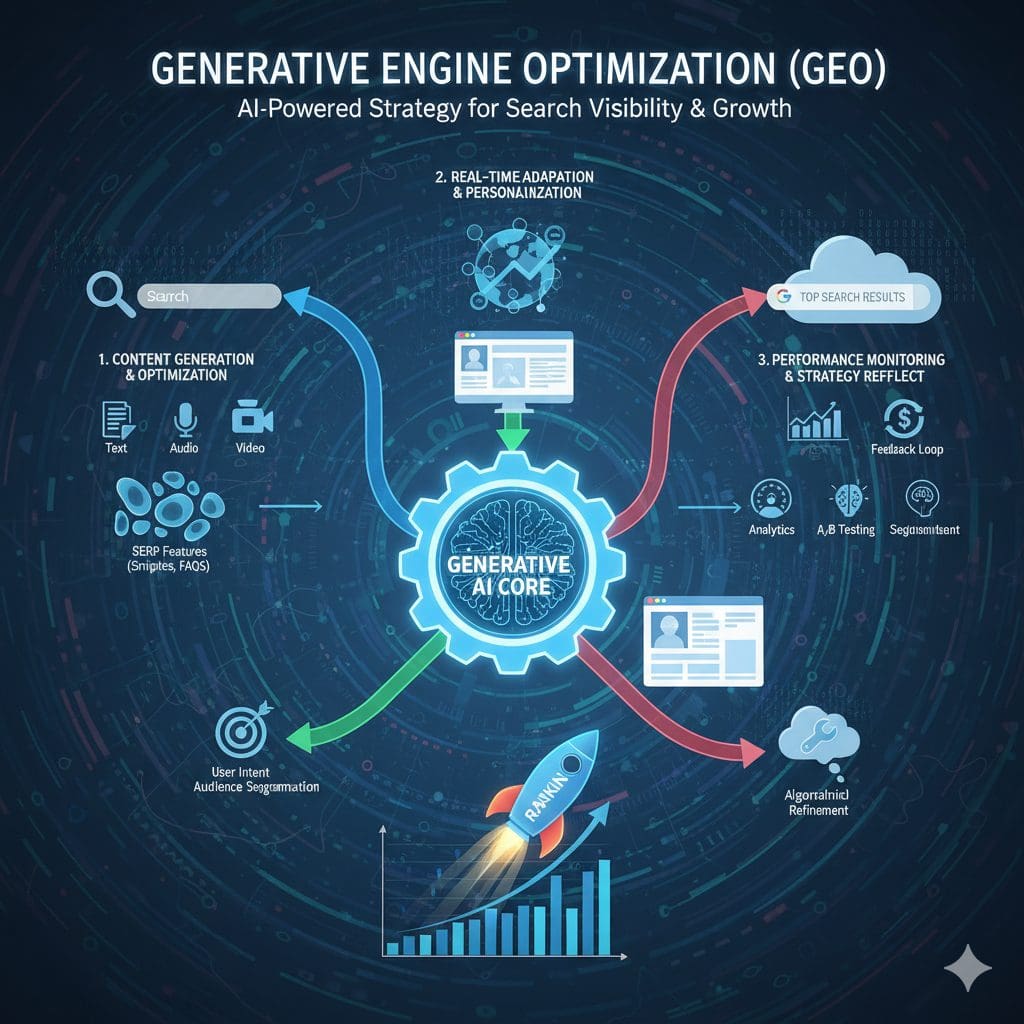
Generative engine optimization, based on AI, is slowly replacing more traditional SEO (search engine optimization) tactics that relied heavily on selecting keywords that reflected user intent when creating content, creating one of the two biggest marketing trends in digital marketing today.
By optimizing your content for these keywords, your content would rank better in SERPs (search engine results pages), which means you would garner more clicks to your website. These clicks, in turn, provided opportunities to engage with visitors in ways that helped you achieve your goals, whether that was conversions, subscribers, downloads, or new users.
In a world where search engines are focused on answering user questions, the engines tend to provide answers at the top of the results, with links ranked below these answers using the same algorithms used in traditional SEO. Importantly for achieving your goals, the answers are hyperlinked to the content you produced that provided the answer, which means you can still achieve your goal if you need users to visit your website. If not, the mere brand mention and other elements of the answer can support your offline goals.
To take advantage of generative engine optimization, you need to ensure your content is credible, discoverable by AI systems, and highly informative.
Why do you need a strategy for generative engine optimization?
Unless you want to see your search engine results continue to decline, you need a strategy for GEO that allows your content to show up in the answers provided to users’ questions by the search engine. In some ways, your generative engine strategy is similar to what you’re already doing to support your site’s SEO. In other ways, you’ll need to adjust the way you create content to appeal to AI-driven search results. Let’s start with similarities.
How is GEO similar to SEO?
- Just as with SEO, GEO relies on choosing keywords that represent user intent. Thus, you still need keyword research updated regularly to help you choose which keywords to focus on when crafting new content or editing old content to modernize it.
- You still need to provide a great user experience on your website
- Crafting authoritative, insightful, valuable content is equally important, if not more so. Focus on E-E-A-T or experience, expertise, authoritativeness, and trust.
- The technical aspects of your website, like speed and mobile-friendliness, still matter.
How is GEO different from SEO?
- While SEO focuses on search engine results, GEO also considers AI tools like Gemini and ChatGPT.
- There’s increased emphasis in GEO for creating clear, structured content that’s easily adapted for providing answers, such as lists, TOC, and short paragraphs that provide comprehensive answers. Synthesize information from multiple sources to provide depth and cite your sources via hyperlinks to reputable websites.
- To perform best with GEO, think about using schema, such as a how-to or FAQ section in your content.
Why do these differences matter?
As you can imagine, the differences between generative engine optimization and SEO mean you’ll improve performance when you generate content that takes advantage of those elements that work for both types of content optimization. That’s because users are already adapting (and loving) the changes they find when using search engines. Likely, more changes are on the way as technology advances and consumers continue adapting to changes.
Thus, GEO represents the future of search. With the declining effectiveness of social media as a source of traffic for your website, you’re left with the decision to either adapt your content marketing strategy or resign your business to declining visits, which limits your business’s online potential (and maybe its offline potential, as well).
While currently only available in the US, the generative search experience is rolling out to the rest of the world. Companies that develop a strategy now will have a first-mover advantage over other companies, potentially creating search value that’ll be hard to compete with in the future and allowing small companies with nimble strategies to pull ahead of their larger competitors. We saw that with the advent of social media marketing, when King Arthur Baking came from obscurity to compete with much larger brands and maintains that advantage even today.
How to add generative engine optimization to your strategy
You can use the principles of generative engine optimization to adapt your existing content to implement the principles of GEO or you can create fresh content that employs the principles.
In the how-to section shown below, you see both suggestions for implementing a GEO strategy in your business, as well as an example of a schema type that encourages AI-powered search engines to pick up my content. We’ll start with an implementation checklist.
Start with questions, not keywords
- Sure, keywords still matter, especially long-tailed keywords, as traditional SEO still impacts search performance. However, you need to consider the questions users might ask about where you want your content to show up. For instance, I would love for this content to show up when someone asks, “How can I add GEO to my search engine strategy?”

Image courtesy of Yoast
You can collect this information from sales calls, Google’s “people also ask” sections of results pages, or the questions you collect when training your Chatbot. Social media might also offer insights into the questions users might ask.
Generate and revise content for GEO
- You might consider revising your old content, especially posts that perform well, by adding schema, lists, and tables to those posts. You’ll also want to employ this strategy as you write new content.
- Consider how to answer the questions you think users might ask. Provide short paragraphs to address them, using clear headings/ subheadings to make the content stand out.
- Include hyperlinks to credible sources for the information in your post to build trust and credibility in your content.
Add structured data
Build trust and authority
Other aspects of building trust and authority are site-wide. For instance, include a bio for key contributors to your content.
Connect with traditional SEO
Test and improve
Conclusion
Generative engine optimization is the wave of the future. Follow this advice, then use the checklist to ensure you’re implementing it effectively, so you appear in search results sections that answer user queries. If you run a small business, you might start by implementing GEO moving forward, then slowly updating existing content to help it perform better.
Need marketing help to support business growth?
We welcome the opportunity to show you how we can make your marketing SIZZLE with our data-driven, results-oriented marketing strategies. Sign up for our FREE newsletter, get our FREE guide to creating an awesome website, or contact us for more information on hiring us.
Hausman and Associates, the publisher of MKT Maven, is a full-service marketing agency operating at the intersection of marketing and digital media. Check out our full range of services.
Discover more from MKT Maven
Subscribe to get the latest posts sent to your email.


