 logo

If you ever dreamed of becoming an entrepreneur, you’ll never find a better time to do it than the present. In other words, there’s never a perfect time to start a business, so every year you put it off, waiting for the right time is another missed opportunity. That’s not to say that entrepreneurs have it easy or that your business idea is a sure thing. You’ll face obstacles along the way, not just in the beginning. However, it’s those mistakes made at the outset that often set you up for failure. So, today, I address the common mistakes entrepreneurs make and how to avoid them.

Why become an entrepreneur
There are lots of good reasons for choosing to start your own business. There are also lots of reasons why you shouldn’t start a business. Let’s start with some reasons why entrepreneurship makes sense.
- It’s nice to be your own boss, although you’ll still report to a host of people, including investors, top management, and partners. Still, you have more control over the direction of the business and how it gets there.
- In general, small business owners earn more money than their employee counterparts, although this depends on a number of factors. In a small percentage of cases, entrepreneurs grow their businesses into major corporations, such as Adobe, Meta (parent to Facebook and Instagram), and others, to earn stratospheric income.
- You’re building a legacy that can be passed on to future generations.
- Being an entrepreneur gives you a higher standing in the community, especially if the company you built has substantial charitable investments.
- You can feel proud of something you built from scratch and the way it helps by employing others.
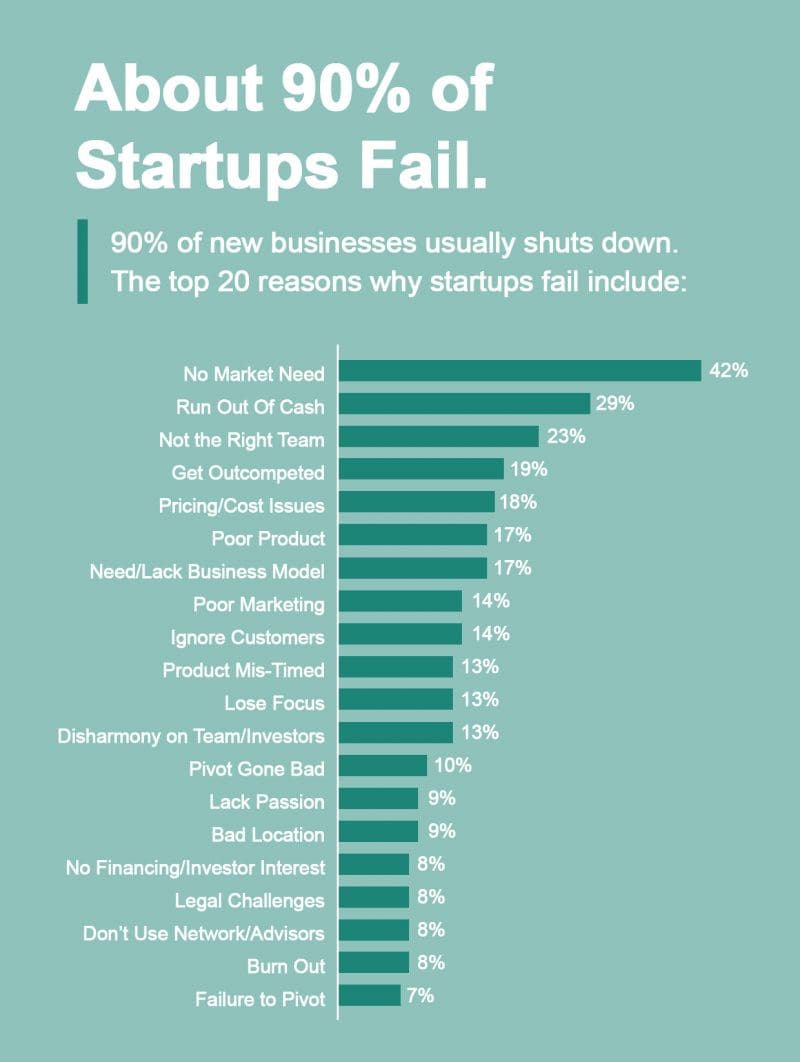
Of course, there are a myriad of other reasons why starting a business might not fit your goals, especially considering that most small businesses fail within ten years, as you can see below.

When you consider the following downsides of becoming an entrepreneur, you can better judge whether this path is right for you.
- High risk is part of the package when you own a small business. As you can see, the potential for failure is high and might cost you everything you’ve built outside the company. This is one reason why so many entrepreneurs are young (the average age of successful entrepreneurs is between 35 and 45). They don’t have much to lose and, yet, have enough experience to be successful.
- You’ll likely work insane hours, at least in the beginning. Don’t expect much in the way of work-life balance initially.
- Stress, stress, and more stress.
- Uncertainty
- A responsibility for others who depend on you.
But if, after this discussion, you still want to build your own business, let’s move on to discuss the common mistakes entrepreneurs make and how to reduce or eliminate their impact on your success.
Common mistakes entrepreneurs make
Poor or non-existent market research
As the graphic above shows, 42% of startups fail because there is no market need for their products. The proper research, research that’s thorough, sufficient, and unbiased, will quickly tell you whether there’s a need for your product. Asking a few friends isn’t enough to provide the insights necessary to determine whether your idea has legs. Sometimes, research requires more than simply asking folks if they’d like X because consumers often don’t know what they need. Instead, observe the problems they face (consumers buy solutions, not products) and the inadequacies in the products currently used to solve those problems.
Getting outcompete accounts for 19% of startup failures. Research also investigates the current competition in your market as well as anticipated entries into that market. Armed with this research, you can develop a niche where your business fits between competitors.
Inadequate planning
Starting any endeavor requires planning and starting a business requires rigorous planning. It would help if you took as much time as necessary to flesh out a business plan that includes the following:
- Research the current state of your market, including prospective customers (you should build personas like the ones shown below), competitors, the state of technology, legal factors that impact your market, and economic factors that impact spending.
 Image courtesy of Boag World
- SMART goals and objectives
- A marketing plan
- An operational plan
- Financial projections and funding sources
- A contingency plan
- Action plans

Not having the right people
One of the first things you need to recognize in business is that you can’t do it all alone. There are gaps in your skills and knowledge not to mention that there aren’t enough hours in the day to get everything done without help. Surround yourself with the best people to get the job done, whether that means adding staff or hiring outside agencies. While hiring an agency might seem too expensive, the cost of making a mistake because you don’t know what you’re doing is often much higher (see example below). Plus, you can use an agency for only the tasks needed, which is often less expensive than committing to a full-time employee. Guidance from an expert in your field, like Aby Galsky, is usually worth the investment for real estate investment companies.

If your needs require full-time staff, hire the best people for the job rather than whoever works the cheapest. Also, don’t hire an employee to manage diverse functions, as they likely don’t have the skills to do so effectively. Invest in quality staff, then train and reward them to keep them.
Not tracking finances
It is only possible to truly analyze a company by looking at the financial barometer. As such, you can only afford to leave accounting duties at the end of the fiscal year. Whether hiring an accountant or using bookkeeping software, you need to keep an eye on things at all times. Poor cash flow is a major source of failure, so keep a close eye on cash inflows and outflows. Arrange for a line of credit or factor your receivables to ensure you have enough cash on hand to pay your bills on time.
Ignoring consumer feedback
One of the biggest mistakes entrepreneurs make is ignoring customer feedback. Often, this isn’t intentional but a function of too much else distracting the owners from rising levels of discontent. Every business should take a client-centric approach. After all, customers have the power to determine whether the company succeeds or fails. Experts can help you master customer experiences. However, it’s not just about providing a friendly and prompt client support service. You also need to take their feedback on board and actively respond to it. Otherwise, they will fail to connect with the brand.
Because customers are crucial to your success, you should initially have one person (although you might need an entire team later) who is responsible for collecting customer feedback from various sources, such as social media, phone calls, letters, and comments to staff, and responding to issues promptly.
Failing to pivot or pivoting too much
A huge challenge for any business, regardless of size or maturity, is determining when what they’re doing isn’t working or when a new opportunity is worth exploring. Does a small downturn foretell a much bigger one? Does consumer excitement in a new product suggest you should explore creating your own offering in that market? Is the industry press hyping a trend, or is it real? It’s hard to know.
If you’ve ever played golf, you likely experienced a situation where you overpowered a putt to sail past the hole, only to underpower the next putt to fall short of it. That’s frustrating when you golf but deadly when you run a business.
Therefore, it is vital to focus on innovation and continue research into potential improvements. This can help unlock new products while keeping employees and consumers engaged with the brand.
Investing too little in marketing
Another of the common mistakes entrepreneurs make is ignoring marketing. In their minds, marketing is a bad word, something that consumes resources unnecessarily. And that couldn’t be farther from the truth. Marketing is your only tool to spread the word about your product effectively, influence consumer attitudes toward your brand, and improve market performance. Without marketing, your business is sunk before you get it off the ground.
Marketing has a poor reputation because the effects of marketing spending take time to show up on the bottom line, while the costs show up immediately. Too many firms do marketing wrong or fail to track the contribution of marketing to sales. Many companies value marketing so little, they don’t even hire marketing graduates to perform their marketing tasks. For instance, Proctor and Gamble hires engineers in product management roles commonly held by marketing graduates.
How much should you allocate to marketing? That depends on a number of situations, but here’s something you can use as a starting point.
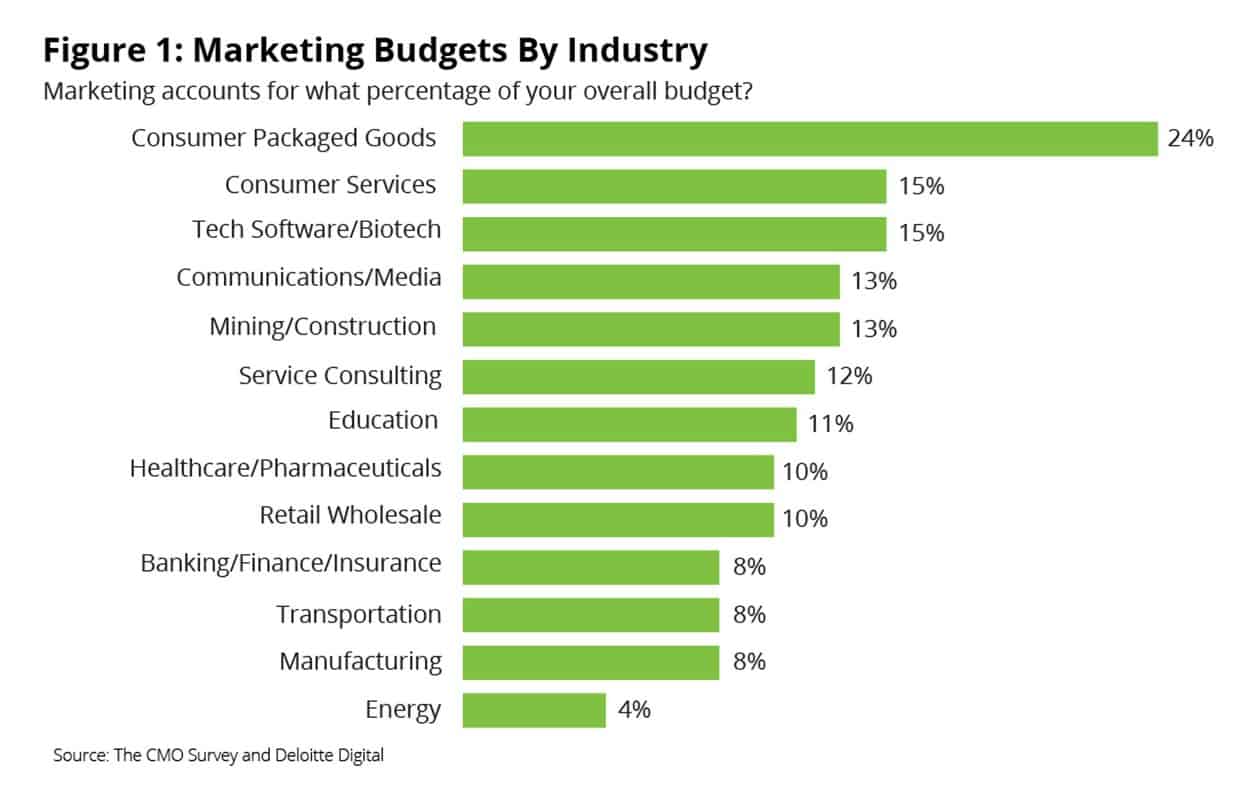
Of course, startups often need a higher budget initially than reflected in this image.
Not monitoring, measuring, and analyzing
You must constantly monitor key performance indicators like the ones below. You must also measure internal metrics related to your operation, manage your inventory effectively, and project future expenses and revenue.

Analyze your data frequently to build insights that help guide future decisions.
Conclusion
You can avoid these common mistakes entrepreneurs make by monitoring your operation for any of them. When you find you’re making one or more of these common mistakes, employ one of the solutions suggested in this post.
Need marketing help to support business growth?
We welcome the opportunity to show you how we can make your marketing SIZZLE with our data-driven, results-oriented marketing strategies. Sign up for our FREE newsletter, get our FREE guide to creating an awesome website, or contact us for more information on hiring us.
Hausman and Associates, the publisher of MKT Maven, is a full-service marketing agency operating at the intersection of marketing and digital media. Check out our full range of services.
Discover more from MKT Maven
Subscribe to get the latest posts sent to your email.


