 logo

Building brand awareness is often seen as a costly endeavor, but for small businesses, the challenge is finding affordable ways to make a big impact. The good news? You don’t need a massive budget to get your name out there. With the right tools and strategies, you can achieve remarkable results without breaking the bank.

Hundreds of businesses are fighting for consumer consideration in most market niches. As a new business, it can be hard to know where to begin in your efforts at building brand awareness, the first step in marketing to your target. After all, you want to get your name out there, but there are already so many businesses appealing to the consumers you want to target. Plus, building brand awareness goes beyond just choosing a catchy name and cool graphics to include generating a positive image for your brand.
Let’s dive into how small businesses can leverage cost-effective tools and creative approaches to boost brand awareness and grow their presence.
Building brand awareness
First, let’s look at the process leading to a purchase decision, often called the conversion funnel or the sales funnel, which looks like this:
Building brand awareness is the first step in this process, so conversion can’t happen without awareness. And the more brand awareness you create, the greater your conversion rate. A slight increase in awareness translates into a significant increase in revenue. Think about this process like the funnel the shape implies. The more you pour into the top (in other words, the more potential buyers know about your brand), the more there is to flow through to the bottom.
However, unlike your typical funnel, our funnel is inherently leaky. So, you need a sustained effort that supports your brand to optimize your ultimate conversion rate to the fullest extent possible. The funnel also isn’t linear but circular for every product except the most mundane impulse purchase. Hence, our funnel looks more like this:

1. Start with social media engagement
Social media isn’t just a platform for scrolling; it’s one of the most powerful tools to connect with your audience—for free. By actively engaging with users on platforms like Instagram, Facebook, and LinkedIn, you can foster a sense of community and loyalty.
A business that isn’t on social media isn’t making the most of the online marketing game. The top sites (Facebook, Instagram, etc.) host millions of users every day, and that is an opportunity for you to reach out to them. Social media also uses native advertising, a form of low-key messaging that supports your brand without being too salesy. The key to success on social media is to post valuable content on a consistent basis (see schedule below) and engage followers with your content so it spreads to their communities as well as your own. The shares, likes, and comments posted by users go a long way toward building trust in your brand.
Create a strong digital presence to find, communicate, and build relationships with your audience. These relationships are the bedrock of your brand, so don’t just let your nephew post content because he uses Facebook to share with his friends. Hire a professional with training in managing social platforms and understanding how to assess performance so they can optimize returns.
Here’s how to maximize social media:
- Respond to comments and messages promptly.
- Use polls, Q&A sessions, and interactive stories to spark conversations.
- Share user-generated content to build credibility and authenticity.
- Plan giveaways and other incentives to encourage
According to Foundr, engaging your audience on platforms they frequent is key to creating meaningful connections and increasing loyalty.
2. Create high-quality, shareable content
Content is king, and it’s a proven strategy to elevate your brand’s visibility. But it doesn’t have to be expensive.
Consider these content ideas:
- Blog posts that answer common questions in your industry.
- Infographics that present data in a visually appealing way.
- Short, engaging videos that showcase your products or services.
As Penji highlights, informative and valuable content can resonate with your target audience, driving both engagement and awareness.
3. Search engine optimization
Search engine optimization (SEO) involves producing valuable content that shows up near the top of search results for related queries. We call this traffic source organic, and it accounts for up to 73% of visits to business websites. Since a link’s rank seriously impacts clicks on your content (see below), the payoff for SEO efforts is enormous.
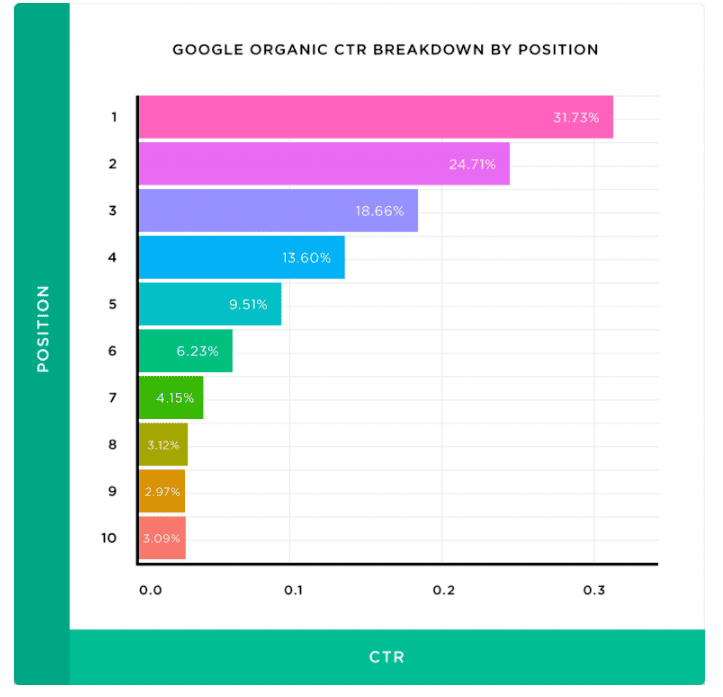
SEO rank is based on complex algorithms developed by search engines (the largest being Google) designed to deliver the best results to users based on their queries. Since search engines look for quality content, you should focus on crafting high-quality content and using specific tactics to demonstrate that quality to search engines. Among the most critical factors impacting your rank are:
- Crafting high-quality content on a consistent basis. Commonly, we’re concerned with website content (although some social media content might also show up in search results). Adding a blog to your website provides an excellent vehicle for ongoing content creation. By adding fresh content to your blog at least once a week, you are in a good position in the eyes of search engines.
- Keywords are a critical factor impacting your online performance, as you must choose keywords that match queries made by users when looking for your content. The challenge is finding keywords that represent a large number of searches with low competition for the keyword. Google’s Keyword Planner helps you find keyword options. Since you can only use each keyword once (otherwise, your content competes against each other), using long-tail keywords (of 3-4 words) helps reduce competition, bring in a more focused target market, and meet the needs of only using keywords once.
- Backlinks from other websites tell search engines a lot about the value of your content. When another website, especially a high-ranked website, links to your content, it says it values what you have to say. Engagement on social media platforms sends the same message.
- Image content makes your content more interesting and helps break up blocks of text, so it’s more inviting to read.
- Provide an excellent user experience by loading fast, offering easy navigation, and other valuable features.
4. Partner with businesses and events
Collaboration is a win-win. By partnering with businesses that complement your offerings, you can tap into new audiences without spending much.
For example:
- A coffee shop teaming up with a local bakery to cross-promote each other’s products.
- A fitness trainer collaborating with a health food store for a joint event.
Partnerships are an effective way to expand your reach while sharing resources.
Showing your face at events and hosting events in either physical spaces or virtual ones is an excellent way of getting your business’s name out there. You might even find other companies to connect and partner with, especially if you have a well-thought-out pitch! Larger metro areas often have groups that routinely host pitch events and contests that allow you to gain exposure to potential investors, team members, and customers. You can also expect to receive feedback to help improve your pitch and guide 2nd editions of your product.
After attending a number of these networking and business events, you could also host your own. Make it a memorable event by handing out promotional gifts at the end. You’ll need a venue and food for a physical event and a stable hosting platform (like Zoom) for a virtual one. For either type of event, you need careful planning to ensure you stay on schedule and handle contingencies that might arise.
5. Offer free resources and tools
Freebies don’t just attract attention—they build trust. Ebooks, templates, or checklists can position your business as a helpful and authoritative figure in your industry.
For example:
- A marketing agency offering a free social media calendar template.
- A financial advisor creating an ebook on budgeting tips for small businesses.
Giveaways are the perfect way to gain attention in the early days of a company’s life. Giveaways on social platforms help overcome reluctance to spend money on a brand-new business that they haven’t heard about before, but they won’t mind entering a giveaway! Not only does a giveaway, done right, provide content to share on social platforms that users likely find intriguing, but it might also generate some buzz for your brand. If the price of entry is sharing something, you increase your message reach; if it’s entering a contest with an email address, you build a subscriber list to fuel future marketing efforts. It’s a win for everyone.
Another great way to provide value is through thoughtful employee appreciation gifts. Recognizing your team not only boosts morale but also reinforces your brand culture, leading to positive word-of-mouth and a more substantial brand reputation. Check out these creative employee appreciation gift ideas that show gratitude while keeping your brand top-of-mind.
As Forbes suggests, providing educational content can help position your brand as a thought leader.
6. Engage in community building
Community engagement goes beyond selling—it’s about creating meaningful connections. Whether it’s hosting local events or participating in online groups, these efforts can foster loyalty and advocacy.
Here are some ideas:
- Start a Facebook group centered around your niche.
- Host virtual workshops or webinars.
- Organize a neighborhood clean-up event sponsored by your business.
Forbes emphasizes the importance of fostering a sense of community to build long-term loyalty.
7. Don’t overlook email marketing
Email marketing remains one of the most cost-effective ways to stay top-of-mind. By building and nurturing an email list, you can create personalized campaigns that drive engagement and sales.
Tips for email marketing success:
- Use a clear call-to-action (CTA) in every email.
- Personalize subject lines and content.
- Segment your audience for targeted messaging.
ConnectWise highlights email marketing as a proven strategy to consistently engage with your audience.

8. Measure and optimize your efforts
No strategy is complete without tracking results. Use analytics tools to monitor campaign performance and adjust as needed.
Metrics to track include:
- Website traffic and conversions.
- Social media engagement rates.
- Email open and click-through rates.
Analyzing web intent data can help tailor your efforts based on what your audience is actively searching for.
9. Paid advertising
Paid advertising is when you pay a search engine – for example, Google – to show your ads or pay a social media platform to share your posts. Paid advertising is an excellent way to gain attention from consumers, as there are over 5.6 search queries every day on Google alone (although Google accounts for the vast majority of online queries). Meanwhile, the average person spends 2 hours and 22 minutes per day (every day) accessing social media platforms.
The most common type of digital advertising is PPC (pay-per-click), where you pay the search engine every time a person clicks on your ad. Social platforms offer their version of PPC (although when experts use that acronym, they mean search ads) but also provide other payment triggers. In addition to a pay-for-results policy, digital advertising pays big dividends because you can target specific users based on demographic, geographic, and interest variables, making it much more productive than less focused traditional media options for advertising.
While digital advertising is a great way to get your name out there, especially in the early days, you should also get on board with local advertising. Marketing techniques like leaflets, local press, and local events are great ways to get the local public interested in and aware of your brand. Doing this is even more important if you are a local business selling to local customers.
Conclusion
Building brand awareness on a budget is entirely possible with creativity, effort, and the right tools. By leveraging strategies like social media engagement, content marketing, custom stickers, and community involvement, you can make a significant impact without spending a fortune. Remember, consistency is key—small, consistent efforts often lead to substantial results over time.
Ready to get started? Pick one strategy, dive in, and watch your brand awareness soar!
Need marketing help to support business growth?
We welcome the opportunity to show you how we can make your marketing SIZZLE with our data-driven, results-oriented marketing strategies. Sign up for our FREE newsletter, get our FREE guide to creating an awesome website, or contact us for more information on hiring us.
Hausman and Associates, the publisher of MKT Maven, is a full-service marketing agency operating at the intersection of marketing and digital media. Check out our full range of services.
Discover more from MKT Maven
Subscribe to get the latest posts sent to your email.


