 logo

Big Data analytics is like a cutting-edge tech that’s driving innovation and helping companies go digital faster. It boosts how well organizations perform, makes operations smoother, and opens up new growth chances by making use of real-time data insights. This tech uses AI, machine learning, and deep learning to find patterns and trends in data, helping businesses make better predictions. Plus, popular tools like Hive, Hadoop, Druid, Flink, and HPCC Systems use these same algorithms to get awesome results for their businesses.
Business leaders have been using big data solutions to give their companies a boost, adding cool new capabilities to different parts of their business and helping improve how they develop products. Big names like Google, Netflix, Microsoft, and Oracle have also been investing in these new techs, driving even more innovation. As a result, big data analytics is taking off fast, growing at about 14.6% per year across various industries. Experts predict that by 2029, the market for big data could hit around $226 billion.
In this article, we’re looking at this future-ready tech and the potential it has to grow. Going forward, it also… discusses how marketing teams can harness big data analytics to turn abundant data insights into a goldmine.
Data overload to data goldmine through AI
Without further ado, let’s discuss what data overload means and how transforming data overload into a data goldmine through AI can help businesses improve performance.
Marketers coined the term data overload to reflect a situation where you have a wealth of data, yet you’re drowning in data without developing insights. Without these insights, you can make optimal decisions, leading to increased operational costs, lower productivity, and missed business opportunities.
As a result, managing this data overload is a critical priority for enterprises that wish to succeed. In this scenario, AI technologies serve as the silver lining that can turn data overload into a data goldmine, bringing an upsurge in demand and business growth opportunities.
Marketers can capitalize on these potential growth opportunities by extracting data effectively to achieve actionable, real-time insights related to customer behavior, market trends, and competitor analysis, leading to a data goldmine.
Understanding the AI-powered big data solutions
Redefining the roadmap of data goldmine through the power of AI-integration involves comprehensively processing the market trends and actionable insights to target customers more effectively, provide personalized messaging, offer products that they need, and streamline your processes.
To fully leverage these benefits of big data solutions, let’s begin by understanding the 5 V’s of big data solutions.
 Velocity
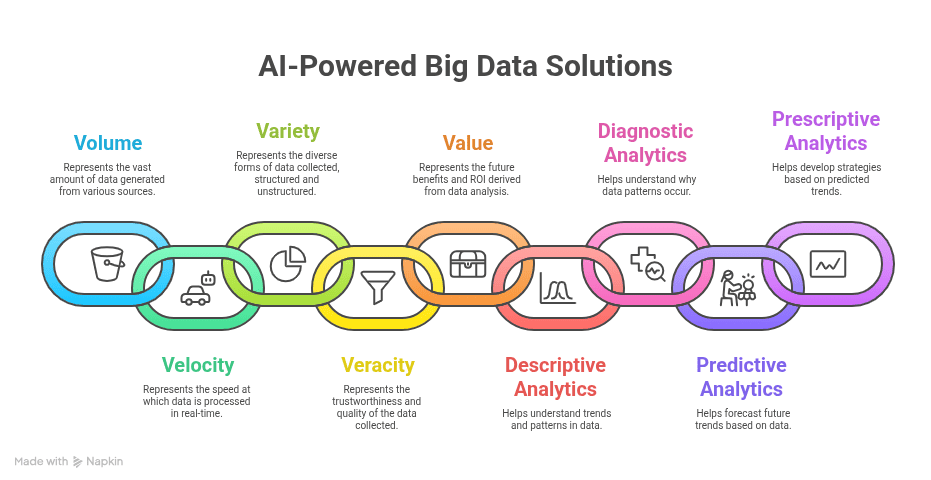
Big data comes at you very fast, and that speed increases as more devices get connected to the Internet (for instance, the Internet of Things -IoT). Marketers must become more adept at streaming data in real time from sources like Facebook, along with developing algorithms and dashboards that allow them to analyze the data quickly. Data visualizations and interactive dashboards significantly aid these efforts.
Volume
We’re drowning in data — data from our sales channel, from social media channels, from our sales force, from our CRM, from our newsletter, from market research, from industry studies … And IoT brings massive amounts of data from our connected homes, connected devices like smartwatches and activity trackers, and medical devices. Just keeping up with the volume of data streaming in requires significant planning on how to organize it into databases, how to store it, what to store, and how to make associations across databases, let alone how to make sense of all the data.
Collecting all this data is useless unless you have a plan for analyzing it. And, while the cost of storing data dropped significantly with services like Amazon’s S3, storing terabytes of data is still expensive.
Variety
Variety might be the most challenging part of big data — especially when you consider the vast amount of unstructured data in the form of video and images that comprises much of the data generated by consumers. IBM estimates 80% of data is unstructured and, unlike structured data, the tools available to analyze it are limited.
Veracity
I’d also like to add my own V to those mentioned by IBM — veracity. Too often, the data we collect is suspect for one reason or another. Among the reasons we might doubt the accuracy of our data are:
- Did we accurately assign sentiment to the utterance
- Was the data itself accurate
- Was the structure of the data maintained during collection, or might the data be corrupted or misaligned to cloud our variables
- Were the data truthful — ie, did consumers reflect accurately
- Was the data representative, or do we have skewed data
When we talk about veracity, data analysis becomes truly scary. If we try to make sense of data that’s corrupt, or worse, make decisions based on this data, we’re as likely to be led astray by our data. This clouds our understanding of what’s going on and leads to poor decisions.
Using AI to enhance big data solutions
While you’re drowning in data, without big data solutions, you’re still in the dark. Processing all that data using the right tools to provide the answers you need to build a sound marketing strategy means using the right types of analytics. In the image, you’ll see how each big data solution can help your marketing strategy and the tradeoffs you must make to obtain them.

Here are the ones you might consider:
a. Descriptive analytics – describe the data
Here, AI helps understand the trends and data patterns reflected from the volumes of data, such as the percentage of customer engagement in a month or the demographic makeup of those engaged.
In this aspect, AI assists in understanding why the data patterns reflect a certain trend. Various algorithms can also help compare two similar campaigns to understand why a particular campaign is showcasing better engagement.
c. Predictive analytics
Predictive analytics relies on building algorithms from your data to help predict future events. In this aspect, AI is leveraged to predict future trends based on data patterns. Global companies like Amazon utilize this analytics to forecast future demand and predict customer engagement trends.
d. Prescriptive analytics
Moving a step forward, prescriptive analytics assists in developing suitable strategies for enterprises based on the predicted trends. Thus, these AI-integrated analytics are valuable to understand and harness data smartly, leading to strategic decision-making.
The role of big data solutions and AI integration in the marketing industry
As quoted by Hal Varian,
The ability to take data — to be able to understand it, to process it, to extract value from it, to visualize it, to communicate it — that’s going to be a hugely important skill in the next decades.
Aligning with this thought, the marketing landscape has undergone a major transformative shift in its operations and metrics with the rise of big data analytics trends and technologies in enterprises. Marketers utilize technologies like AI, ML, Blockchain, and others to stay ahead in the industry. With developments like AI-driven analytics in digital marketing, brands measure their KPI’s more effectively. These KPIs may include the customer interactions index and advertising ROI. Furthermore, marketing companies are investing in Virtual Assistants, Chatbots, and AI Agents to improve their customer engagement through hyper-personalization.
Example: One of the leading Fortune 500 companies, Google, has invested in harnessing the potential of data analytics to refine its algorithms and launch more streamlined and personalized advertising campaigns. This has further improved the global enterprise’s user experience, driving its business growth exponentially.
Further, let’s dig into the potential of AI Integration in Marketing:
1. Improved pace of decision-making
Intelligent technologies analyze data speedily, delivering results with minimized human bias. These assist marketing companies in streamlining their workflows and improving their pace of decision-making. It helps enterprises seek new growth streams while equally focusing on building the existing ones through data-driven intelligence.
2. Enhanced accuracy
AI minimizes human error and bias, leading to improved data accuracy and reliability. As a result, enterprises can formulate better strategies, aiming towards achieving their goals.
3. Optimizing strategies through personalization
Marketers gain deeper, actionable insights into customer behavior patterns. This allows for more focused customer segmentation and targeting, and personalized strategies in businesses. Hence, they can optimize their strategies to deliver better and tailored customer experiences. An industry example of this aspect is the Netflix recommendations provided by the application based on the user’s choice of movies.
Additionally, marketers have witnessed an upsurge in conversions owing to precision marketing and better-targeted advertisements.
How big data solutions transform raw data into actionable insights
Marketers facing a peak of data overload due to fragmented data sources (scattered data) are seeking big data solutions that offer a meaningful resolution to this issue. These solutions critically help in churning raw data and providing data-driven insights. This process includes the following step-by-step approach:
1. Data collection
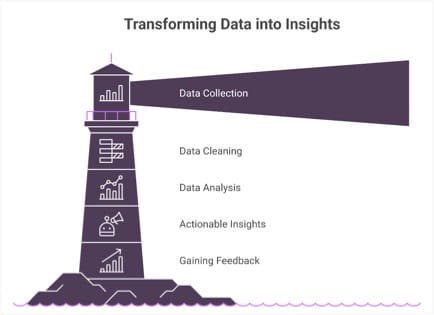
Begin by gathering data from reliable sources, which may include social media interactions, clicks, impressions, advertisements, and campaigns.
2. Data cleaning and integration
At this step, the data is cleaned thoroughly to ensure that there is no duplication of data or missing values. Further, once clean, marketing teams help in integrating data to provide a unified dataset for processing and analysis.
3. Data analysis
Now, work on various types of insights provided by analytics, such as descriptive, diagnostic, predictive, and prescriptive. These refine the data quality and provide meaningful insights to the decision-makers.
4. Actionable insights
Gaining deeper customer-based real-time insights, they can run tailored campaigns to target a segment of customers, aiming towards better conversions.
5. Gaining feedback
Additionally, AI has a learning mechanism of its own, which can further refine its processes based on decision-makers’ inputs. Moreover, marketers’ feedback helps enterprises incorporate more meaningful data insights into the business systems.
Hence, this approach is a guided mechanism, powered by the synergy of intelligent technologies and marketers, which helps in refining business goals and optimizing business outputs.
Emerging big data solution strategies followed by leading marketers
Management is adopting various well-defined big data solution strategies to fully optimize business processes and enhance data accuracy and reliability. Additionally, marketers contribute to this process by transforming data and delivering workable marketing insights. Hence, data is an important asset that is a foundation for a data goldmine in these marketing processes.
In this context, let’s study some of the strategies that can help businesses optimize their workflows.
a. Emphasis on data governance
- This aspect ensures that all the data collected related to social media engagement, customer behavior trends, and marketing campaigns is accurate and secure.
- Marketers must ensure that the data complies with legal regulatory bodies like GDPR.
- Furthermore, enterprises can also manage their governance and compliance regulations through leveraging AI-integrated technologies like cloud computing.
b. Data quality control
- Marketing is closely correlated with a divisional cost sheet that includes various expenditures like campaign management, email marketing, digital marketing, and so on.
- Professionals managing these costs are well-informed about the processing of clean and validated datasets. This mainly helps in minimizing human errors and optimizing the cost sheet to achieve the set goals within the defined budget.
c. Change management
-
- Given the dynamic nature of the marketing dimension, it is significant to focus on the culture of change management.
- To bring forth this culture, enterprises must invest in adopting new technologies and tools to maintain their frontier tech space and infrastructure.
- There is also a dire need to implement training sessions among the teams of marketers to deliver optimized results.
Advanced AI-integrated technologies implemented in big data analytics
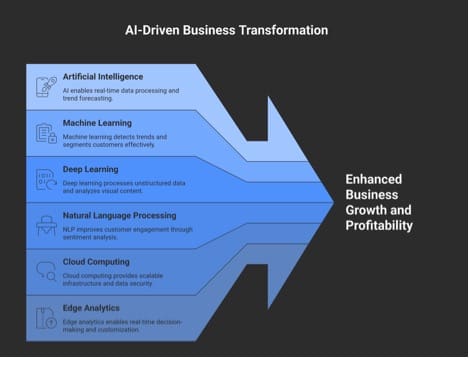
Technology integration drives digital transformation and innovative solutions, aiming to achieve increased profitability and more viable business solutions. Marketers focus on these goals and leverage the integration of AI in big data analytics to augment customer experiences. These technologies are immensely beneficial for businesses.
Let’s build an understanding related to their benefits as follows:
| Technology Leveraged | Core Benefits |
|
Artificial Intelligence |
|
|
Machine Learning |
|
|
Deep Learning |
|
|
Natural Language Processing |
|
|
Cloud Computing |
|
|
Edge Analytics |
|
These technologies efficiently drive business growth and profitability up the ladder, while assisting enterprises in achieving their business goals and objectives. For an augmented positive impact, organizations also opt for hiring data management services. These are specialized and trained to provide streamlined operations, enabling accurate and reliable decision-making, along with catering to data governance and quality control.
Use case of big data solutions
Sharing a relevant use case of the big data solutions, let’s explore how Amazon benefits from this technology. Amazon continuously tracks the customer’s digital interactions on its website and mobile app. Alongside, it also analyzes its derived traffic from backlinks on social media platforms in real-time. Based on these structured data records, it changes its listed product prices 2.5 million times a day. Moreover, their product recommendations are strongly developed based on these big data analytics, which helps them earn a share of 35% of their annual revenue.
Future of big data solutions in marketing
Elevating the understanding of the potential of big data solutions in ERP systems, forward-thinking leaders are investing in and deploying these modern technologies in their core business processes. Focusing on the scalability of business operations and an improved ROI, business systems are leading the way forward in the process of digital modernization.
The future of this industry is being led by smart marketers, who are adding value by deploying various modern techniques in businesses, as shared below:
Voice search optimization – This futuristic technology offers customers the choice of providing voice queries, thereby increasing the possibility of conversions on the company’s digital products.
Hyper-personalization – Marketers leveraging big data solutions can deliver tailored recommendations to users, aimed at improving their overall user experience.
Predictive search intent analysis – This technique predicts the list of recommended searches for a user, based on the past user history, optimizing their digital experience on the business platforms.
Real-time campaign monitoring – With this technique, enterprises can implement real-time changes to their campaigns, aiming at improving their ad rank and conducting an elaborate competitor analysis study.
Hence, these are some of the optimized techniques utilizing big data solutions that assist in setting higher performance benchmarks for the organization. Given their optimized benefits, they are certainly reshaping the future of big data analytics.
Conclusion
Conclusively, AI integration in big data analytics plays a pivotal role in churning raw data into actionable insights, which can be a source of a data goldmine for enterprises. A seasoned data management service provider can further improve the business framework, assisting in achieving ROI focused precision marketing and providing innovative business solutions.
Hence, enterprises are embracing these technologies with the intelligence of experts who can guide them in outpacing their competitors and improving their business reach among customers.
Need marketing help to support business growth?
We welcome the opportunity to show you how we can make your marketing SIZZLE with our data-driven, results-oriented marketing strategies. Sign up for our FREE newsletter, get our FREE guide to creating an awesome website, or contact us for more information on hiring us.
Hausman and Associates, the publisher of MKT Maven, is a full-service marketing agency operating at the intersection of marketing and digital media. Check out our full range of services.
Author BIO: Linda William is a technology enthusiast and content writer exploring the developments and breakthroughs brought in by the convergence of big data analytics in the marketing domain.
Discover more from MKT Maven
Subscribe to get the latest posts sent to your email.


