 logo

Do big data insights really help improve performance and grow your small business?
Yes, as you can see below from the University of Miami.
By leveraging the advantages of data analytics, businesses can make more informed decisions, improve operational efficiency, enhance customer experiences, and drive innovation. Data analytics has the potential to transform every aspect of a business.
Leveraging data analytics is no longer just an advantage but a necessity for sustainable growth and success. By investing in data analytics capabilities, businesses can unlock new opportunities, mitigate risks, and achieve their strategic objectives more effectively.
Well, not always. Big data doesn’t always yield significant insights, but increasingly we see it driving action. Big data insights translate into better decisions grounded in the data, but only when data is ethically collected, vigorously protected, and visualized accurately to enable analysts to build them effectively.
Currently, you’ll find debates all over websites and social media — some arguing that big data is causing significant problems, not the least of which is the perceived manipulation of consumers by using psychometrics against them. Others see big data ushering in an era where businesses have the analytics they need to optimize their returns on investment (ROI).
Big data insights
I recently wrote a post defending big data, so you know what side of the debate I’m gonna take. Data is never the problem, in my opinion; it’s the way you use big data that causes big problems. More on this later, but for now, let’s talk about just some of the ways that big data insights lead to higher performance that fuels growth.
Pattern recognition
Today’s companies, even small ones, generate massive amounts of data. Finding patterns embedded within that data leads to better decisions, resulting in higher performance. For instance, discovering patterns of consumer behavior on your website helps you create content that performs better. Similarly, finding patterns within your sales data helps you develop better, more accurate forecasts and time purchases more effectively, thus wasting fewer resources on stockpiling inventory (or facing a shortage) or overproducing (or underproducing) finished goods.
Combining data from various databases, both internal and external, allows you to find patterns across these different databases. Farmers use data from satellite images, weather predictions, and internal information to determine how much fertilizer or water to apply to a particular field, or part of the field, to optimize yield.
Predictive analytics

Until the advent of tools for developing big data insights, it was hard to do much more than generate descriptive statistics, such as means (averages), totals, and cost per unit. Diagnostic insights allow you to analyze cause-and-effect relationships, which provide insights that help with making better decisions.
Predictive analytics, the golden ticket of big data analytics, allows firms to build complex algorithms that predict what will happen if they take a specific action. For instance, you can predict what consumers are willing to pay for a new product you plan to launch based on their responses to similar products. Predictive analytics also allows you to use personalized marketing, adjusting your offer, messaging, and other key elements of your campaign to optimize the response of consumer segments.
Prescriptive analytics are also possible using big data insights. Prescriptive analytics allow you to go beyond forecasting, to optimizing operational elements to increase efficiency and reduce costs. For instance, you might use prescriptive analytics to determine the optimal layout for your manufacturing facility to make production more efficient.
Big data insights come from using your data effectively, which means you must analyze the data accurately. However, as you can see from our discussion so far, the benefits are enormous as today’s tools can analyze massive datasets in real-time.
Problems developing big data insights
Here are the major problems cited related to big data that we’ll discuss today:
- Manipulation of consumers
- Violating the privacy of consumers
- Failure to protect that data from bad actors
- Overwhelming volume, velocity, and variation make integration challenging
- Poor decisions due to interpretation, data quality, and bias
Let’s chat about these problems and how to fix them.
Manipulation of consumers
Recently, the social world was in an uproar over allegations that Cambridge Analytica used psychological profiles of INDIVIDUAL users obtained under false pretenses from their Facebook profiles to target messaging that impacted voter behavior in a recent election.
Now, let’s take this discussion out of the political arena and into the business world. Does using psychological profiles to craft individualized messages to prospective buyers violate some ethical compact?

We had this discussion in my digital marketing class yesterday and students seemed split on this question.
First, let’s understand that using psychographics (likes, values, attitudes, etc) isn’t a new thing — it’s been around for a while. What’s changed is the amount of information we have available today because social media records every interaction — like, post, share, etc. Recent academic and policy discussions make the point that, with just a few of these, you can categorize the personality of users. With more information, you can determine more detailed psychological traits, like the view of authoritarians. Again, helpful information.
In fact, if you’ve ever bought Facebook ads, you’re using one of the same databases used by the Cambridge Analytica team. Is that ethical?
One-on-one marketing also isn’t new. With technological advances, we can reach increasingly smaller groups with individualized messaging. And that’s valuable, according to the HBR.
Practiced correctly, one-to-one marketing can increase the value of your customer base or subscriber list. The idea is simple: one-to-one marketing (also called relationship marketing or customer-relationship management) means being willing and able to change your behavior toward an individual customer based on what the customer tells you and what else you know about that customer.

One-on-one marketing is just an extension of segmentation and this article highlights how using personality segmentation aids marketing efforts. It reflects that not all consumers want the same thing from products, so helping them see factors they value in your products improves market performance.
The ethical problem arises with the messages you send. If they are untruthful or misrepresent the true impact of your product, then it’s unethical regardless of whether you used psychometric evaluations to get you there. For instance, if you know a consumer is particularly interested in sustainability, it’s perfectly fine to send them messaging promoting your record on sustainability. It’s not ok to lie when you’re not, in fact, sustainability-driven or to highlight one positive action among a host of negative actions.
It’s also an acceptable use of big data insights to use them to add value to those targeted by your campaign. For instance, if you know that a particular consumer segment is most interested in one benefit you offer, while other segments might see this as noise, it’s acceptable to target only the likely buyer segment, which reduces the amount of messaging seen by consumers who aren’t interested.
Consumer privacy
For the most part, marketers aren’t hacking into sources of information (which is unquestionably unethical), but accumulating mountains of publicly available information. The problem occurs when these sources indiscriminately sell PII (personally identifiable information). Here’s a partial list of where this data comes from:
- Government sources such as DMV and property records
- Educational institutions — such as schools
- Biometric devices and other smart devices, such as Fitbits, Nest
- Smartphones
- Social networks
- Credit card transactions
- Gmail and other online sources, including browsers
The breach of ethics occurs when this information is obtained fraudulently by companies that aren’t vetted by the provider of the information or are using it for a purpose different from the one stated when obtaining the information.
As a consumer, there’s little you can do to protect your privacy other than appeal to Congress for new laws. You can attempt to stay “off the grid,” but you’ll have limited success. That said, you should still close your social profiles to only connections, use search engines like Duck Duck Go that don’t share information, and avoid devices that share PII internally or with other companies.
Good luck!
Protecting data integrity
Protecting proprietary data from bad actors is a perennial concern made greater each year as hackers become more sophisticated.

Not only do you have to protect your data from outside bad actors, but from employees who have no legitimate reason to access your data or share your data without authorization.
Overwhelming volume, velocity, and variation
This is almost the definition of big data, so using big data and big data insights is challenging. Storing and analyzing massive datasets is expensive, requiring specialized tools, highly trained analysts, and massive storage devices. All of these come with a cost.
A few years ago, businesses dealt with the 3V’s of big data by data mining to detect insights. Unfortunately, data mining turns up too many spurious correlations to be of much use.
Today’s tools are more selective, but still suffer from the signal-to-noise problem, which leads to more spurious correlations as the datasets become larger.
The volume of data also creates problems with data quality and veracity. The old notion of garbage in/ garbage out has never been more of a problem than when attempting to develop big data insights. Big data is not necessarily accurate data, especially when combining data from multiple databases.
Poor decision-making
The fundamental problem with big data insights comes from poor interpretation of the data, which comes in many forms. For instance, using existing data to make predictions may perpetuate bias inherent in these past actions. For instance, predicting the characteristics of applicants that make them excellent candidates based on the performance of existing employees perpetuates any racial or gender bias inherent among existing employees.
Similarly, humans are incapable of analyzing tables of numbers effectively. Instead, use data visualization tools, such as those in this list. Something as simple as color-coding the data (such as in this table) can make building insights more effective.
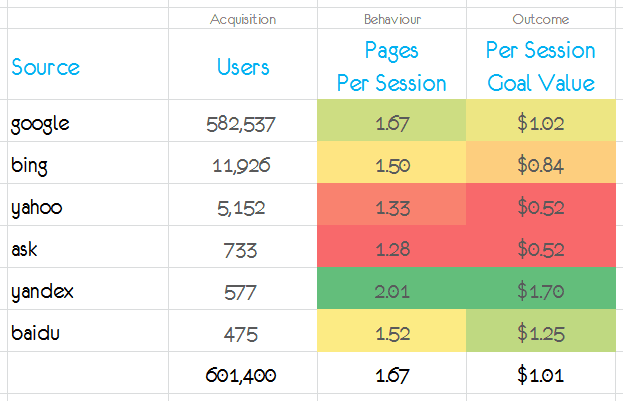
Using tools such as Tableau to generate the right data visualizations, such as the ones below, makes developing big data insights much easier, bringing insight out of obscurity.


Unfortunately, if you choose the wrong visualization, it further obscures interpretation, or worse, leads to an inaccurate interpretation.
Using big data insights
Of course, all this effort and cost is worthless unless you turn your insights into action. That means you must get buying from those responsible for making decisions. Data visualizations go a long way toward helping those without advanced business analysis training to understand the data and accept your insights.
Conclusion
We got into the weeds a little on this post, but hopefully, even non-analysts can understand the main points raised in this post. The biggest take-away is that you can use big data insights to boost performance by enabling better decisions only if you use your data ethically, understand the limitations of big data, and use proper visualizations to aid analysis and gain buy-in from decision makers.
Need marketing help to support business growth?
We welcome the opportunity to show you how we can make your marketing SIZZLE with our data-driven, results-oriented marketing strategies. Sign up for our FREE newsletter, get our FREE guide to creating an awesome website, or contact us for more information on hiring us.
Hausman and Associates, the publisher of MKT Maven, is a full-service marketing agency operating at the intersection of marketing and digital media. Check out our affordable coaching programs to help your business thrive into the future.
Discover more from MKT Maven
Subscribe to get the latest posts sent to your email.


