 logo

According to articles in the Huffington Post and Forrester, crafting a better customer experience has benefits flowing directly to your bottom line, including:
- reduced churn (going to a competitor) – 85% of this churn is preventable with better customer service
- cost savings – Sprint saved $1.7 billion through fewer service calls when it improved its customer experience
- increased profits – it’s 6-7X more expensive to replace an unhappy customer than to keep that customer happy
- higher revenue – 55% of respondents say they’re willing to pay more for a good customer experience
- less negative word of mouth – only 1 in 26 unhappy customers will complain, the rest leave and tell their friends about poor customer experiences,
- increased referrals – while 72% of happy customers share the brand with six or more people
- higher employee satisfaction and less turnover – no one wants to be criticized by customers
No wonder customer experience is the new battleground where brands fight for sustainable competitive advantage. Yet, most fail. And, for many others, they’re too business focusing on addressing customer complaints quickly rather than eliminating them (or reducing their frequency). The result is negative word-of-mouth that spreads five times faster than positive comments. However, Inc Magazine refers to it as a harmful wave effect that might easily destroy your reputation beyond recovery.
While it’s possible to survive and maybe even flourish despite negative co, poor customer experiences make the firm vulnerable to competition, substitutes, and alternatives. Once someone challenges a firm providing a poor customer experience, it’s nearly impossible to survive or recover, according to Forrester.
Ignore opportunities to provide a better customer experience at your peril!
Crafting a better customer experience
First, let’s identify what we mean when we talk about customer experience. According to Gartner, it is:
the practice of designing and reacting to customer interactions to meet or exceed customer expectations and, thus, increase customer satisfaction, loyalty and advocacy
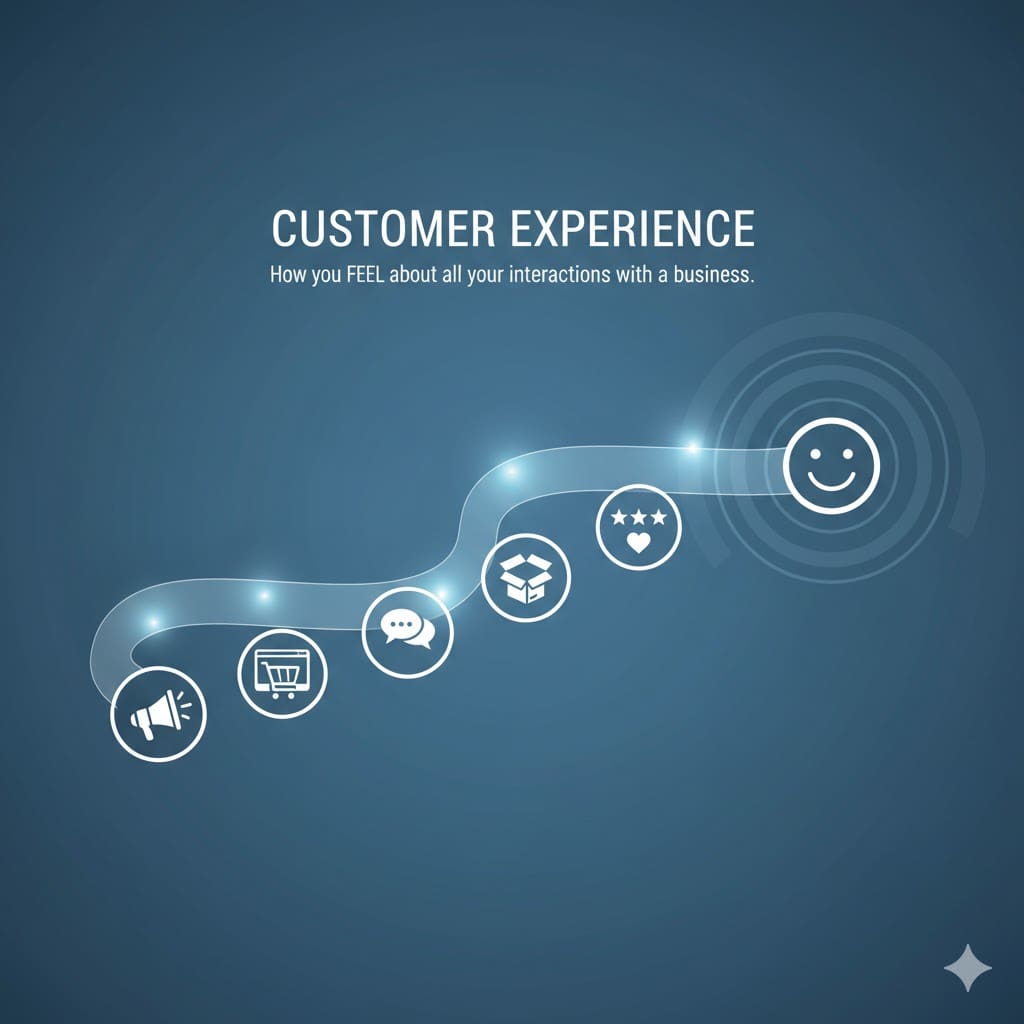
In layman’s terms, “customer experience” is simply how a customer feels about all their interactions with your business. It’s every single touchpoint, from seeing an ad, to browsing your website, buying a product, talking to customer service, and even receiving a follow-up email. It’s the overall impression and feeling they walk away with after dealing with you. If you’re to depict the customer experience in a visual format, it might look something like the image at the beginning of this post.
This definition implies that the customer experience follows the customer journey from beginning to end, from awareness to loyalty, with many stops, bumps, and exists along the journey. While most classic marketing texts show the customer journey or conversion funnel, with a funnel shape, this implies that it’s a linear process, which doesn’t bear any resemblance to what a customer journey really looks like. In my mind, the journey looks something like this: This depiction is anything but linear, instead involving circular movement that involves backtracks, forward leaps, and bumps that encourage movement or hinder it all along the way.

If you goal is creating a better customer experience, you need to build the following steps into your strategy:
Develop persona(s)
Craft a customer journey map or maps (if multiple paths to purchase)
Identify the critical path(s) through the customer journey, including the use of different devices and uncovering roadblocks
Optimize customer experience through a contact center and similar areas
Notice that I don’t include failure recovery strategies in my list of steps. That’s because providing a better customer experience DOESN’T mean just fixing problems when they occur, but rather eliminating or reducing the potential for customer failures.
Step 1. Develop persona(s)
You’ll never build a better customer experience unless you understand your customers — what’s important, how they live their lives, what devices they use and how they use them, etc. Don’t assume you know what they want just because you know what you want.
For instance, I recently had an accident that required many X-rays and medical treatments. It’s really cold in winter when your only clothing is a skimpy hospital gown. Sure, employees are comfortable with the temperature, but I’m freezing. Your experiences as a business owner or employee don’t necessarily reflect the experiences of your customers.
While you can understand customers without building a persona(s), this exercise benefits other customer outreach activities, so you might as well do it as part of your customer experience program.
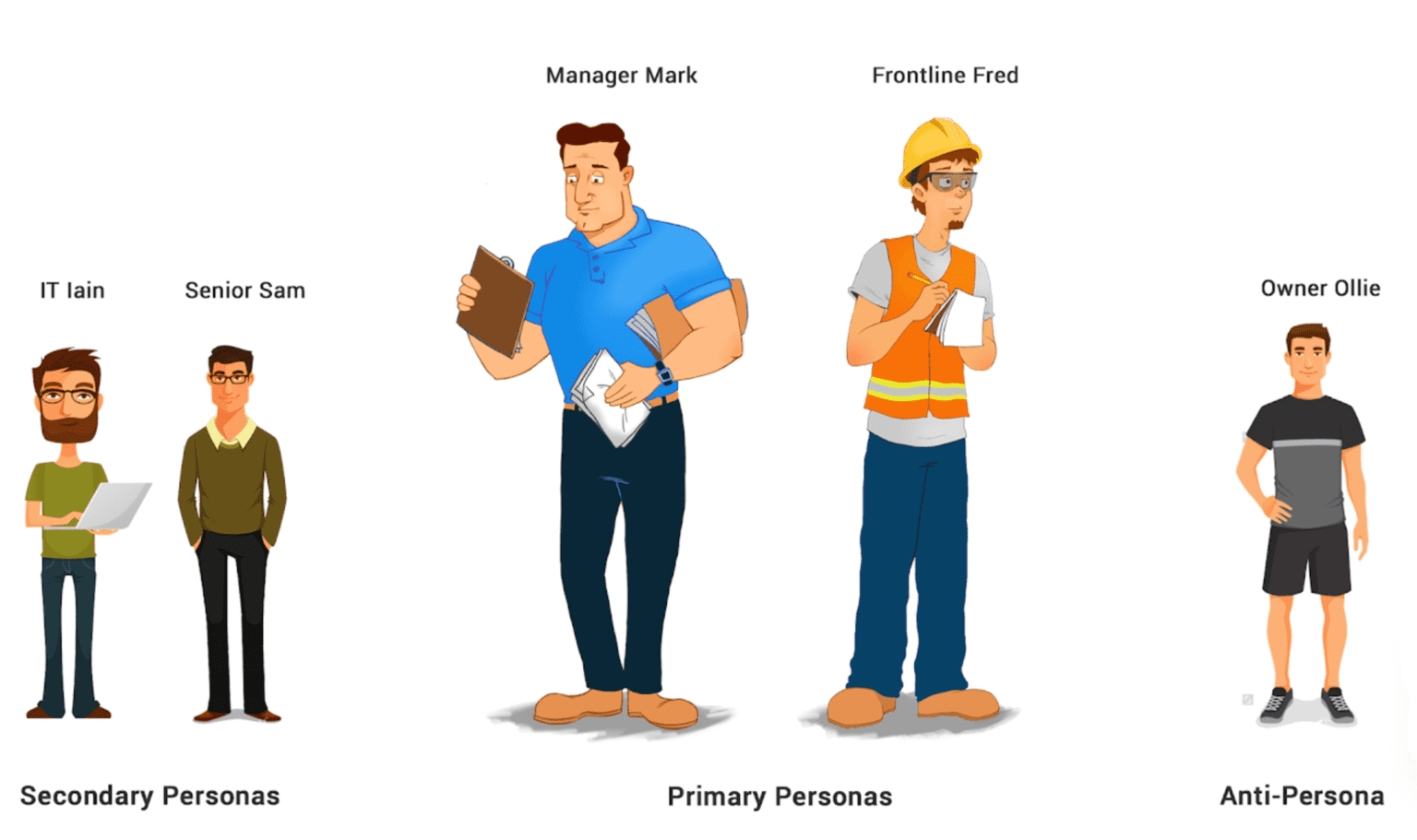
Why customer persona rather than target market? Industries developed target markets using relatively anemic tools, focusing on demographics rather than the more important psychographics that drive customer behavior. Today, with enhanced analytics and social media, we’re in a position to develop a richer picture of our target market, hence we call them persona(s). In the image above, you can see the primary personas and secondary personas for our hypothetical business. We also see an anti-persona representing the type of consumer that we aren’t particularly interested in. Armed with these clearer images of who we consider our best bet when it comes to buying our products, we can make plans that help use reach them and convince them to make a purchase.
You can’t create a persona or personas without doing some research. Sources of information include:
Digital analytics such as Google Analytics and Facebook Insights
Original research on customers using social media and/or traditional research methods
Asking customer contact personnel for insights
Hubspot offers a free template for creating buyer personas. However, research data for the template rather than filling it in based on your own perceptions, which are likely wrong.
Step 2. Customer journey mapping
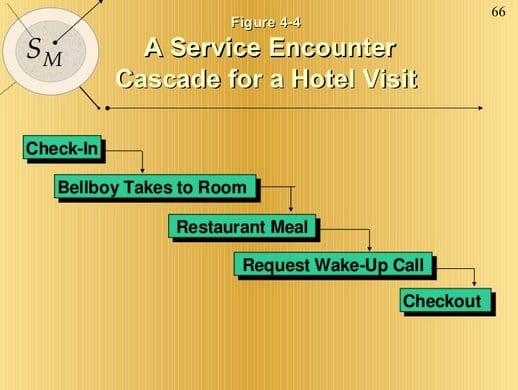
Here we see a customer journey map you might recognize as it involves a typical hotel stay. To build a better customer experience, you can identify critical elements in the process at each stage as the customer moves through their visit to identify potential weak points or points of possible failure.
Identify critical paths and roadblocks along the journey
Let’s continue with our example of a hotel stay for simplicity.
Your next step in crafting a better customer experience involves identifying how customers interact with your staff and other elements used to craft a great visit (in this case). For instance, take a step back to before checkin to determine how customers prefer to make their reservations. Do they want a fast, accurate website or an app to help them find suitable rooms for rent on the days of their journey? Or, to they prefer to find deals on marketplaces, such as Orbitz, or budget sites like Booking.com? Ensure each of these options has up-to-date access to your inventory.
Do customers expect to recieve a confirmation email to ensure their room is booked?
Will a welcome email reminding them about the trip a few days in advance lead to a better customer experience? How about sending the weather forecast and a list of upcoming events, along with a map to the hotel?
Once they arrive, can you do anything to make checkin easier? For instance, many travellers are tech-savvy so offering a variety of checkin options, including using a mobile device or a kiosk might speed things along, leaving your staff with time to deal with more complex issues.
At every step in the process, communication is vital. Simply improving communication goes a long way toward building a better customer journey.
I was once stuck in an airport for 8 hours. Customer service personnel had limited information and couldn’t estimate when the flight would take off. Certainly, bad weather makes such estimates challenging, but when controllable factors cause delays, such delays create poor customer experiences. Had I known I would be stuck in the terminal so long, I would have had options, but not knowing meant I had to stay near the gate — missing meals and enduring uncomfortable seating — when I could have left the gate to enjoy a meal in another terminal, shopped, or even left the airport and returned at a later time.
Here are just a few common issues that contribute to a good customer experience:
Logins – make logging in optional or easy for customers
Easy payment – often, I don’t have my credit card nearby when ordering online. Offering PayPal means I don’t have to retrieve my card. I also have protection from unscrupulous websites, which increases my trust in your site
Calling options – many customers use a mobile device to make calls. Using letters instead of numbers worked when people used landlines, but they’re a nightmare for mobile customers. Also, if done correctly, users can make a call by selecting their number from the website without having to copy and paste it into their phone. Make your contact information — phone, address, email — easy to find on your website.
Electronic options – searching for a place to print out your boarding pass, receipt, or ticket is annoying. So is finding an envelope and stamp. Or entering useless information multiple times on a form. Make sure you offer an electronic option for customers and save information from 1 screen to the next.
Atmospherics – if you’ve ever tried having a conversation in most restaurants today, you know it can be challenging. Between the hubbub in the kitchen, other conversations, and the ubiquitous music playing too loud, you can’t even hear yourself think, let alone hear fellow diners. Poor traffic flow means you’re constantly jostled, inconvenienced (think IKEA), or can’t find what you want. Long lines mean you can’t plan your time effectively. Poor lighting or layout in parking lots makes them a death trap. Inconsistent signage makes it difficult for customers to find you.
Optimize the customer experience
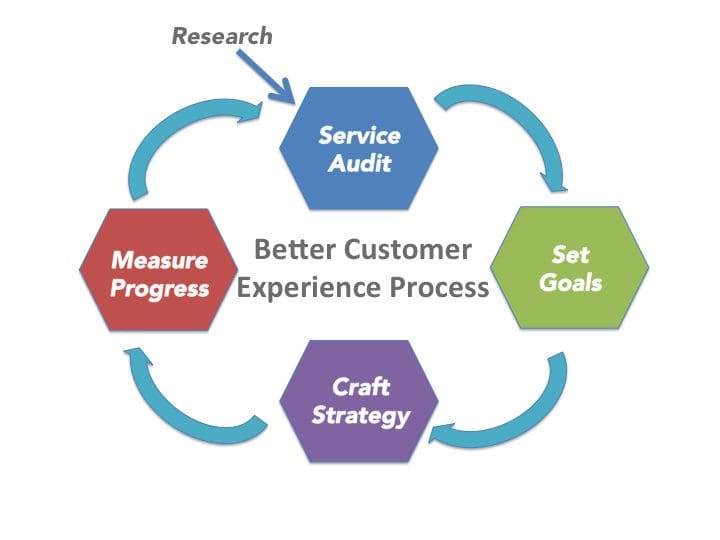
A service audit quantifies performance across points of contact in the customer journey — see why mapping is so important.
Here are examples of elements you’d include in the service audit of the Rail Europe journey displayed above:
how many clicks does it take to research and buy a ticket?
how long does it take to reach a customer service rep by phone?
what percentage of social media complaints are handled within 20 minutes?
what percentage of trains arrive on time?
what percentage of trains offer food?
what percentage of passengers rate the cleanliness of trains and stations as good or better?
how do customers rate the performance of the mobile website?
Once you have data to complete your service audit, your next step towards a better customer experience is to set goals, such as increasing on-time arrivals by 15%. Next, craft a strategy for reaching each goal identified and a plan for implementing it, including allocating the budget necessary. Finally, develop a plan to assess performance on a consistent basis.
Conclusion
Crafting a better customer experience should be the goal of every business because overcoming a bad reputation is exceedingly hard. It’s better to develop and maintain a good reputation from the start by following these tips for building a better customer experience.
Need marketing help to support business growth?
We welcome the opportunity to show you how we can make your marketing SIZZLE with our data-driven, results-oriented marketing strategies. Sign up for our FREE newsletter, get our FREE guide to creating an awesome website, or contact us for more information on hiring us.
Hausman and Associates, the publisher of MKT Maven, is a full-service marketing agency operating at the intersection of marketing and digital media. Check out our full range of services.


Hey Angela
Excellent article I must say! The interface layer of web has brought businesses much closer to their audience but at the same time it has increased competition too and so are customer expectations! Data is undeniably a valuable resource in this digital age, but without right data you can’t convert customer service into customer experience and that’s why first party data must be the first consideration for businesses rather than third party data.
Kathy Spencer