 logo

Current state of illustration technology
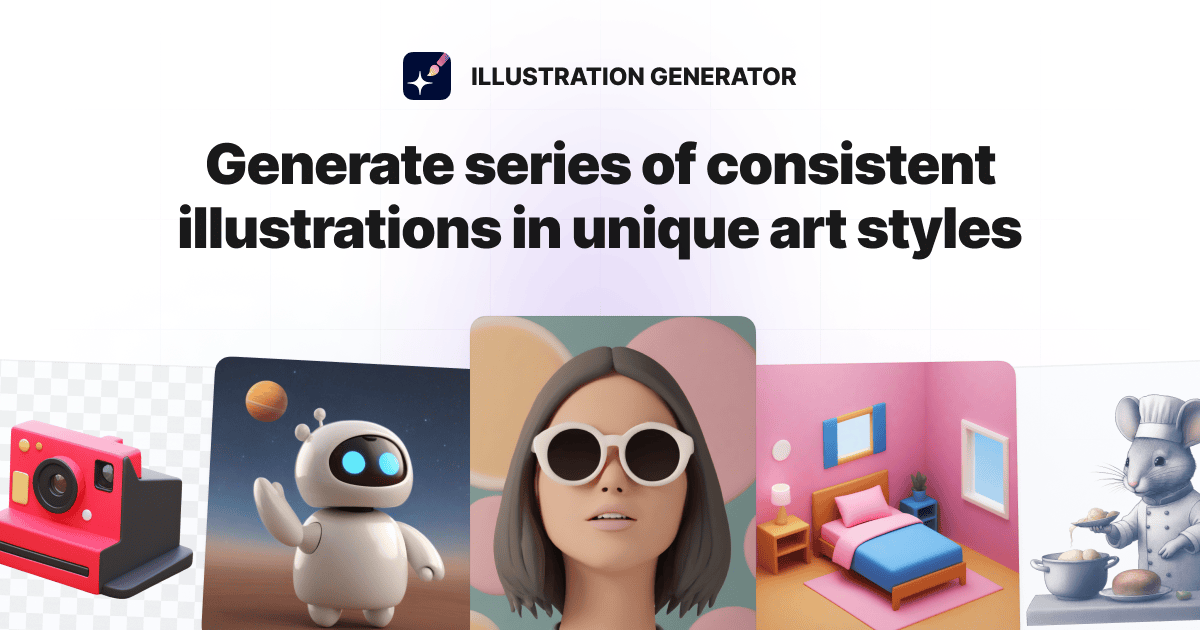
The visual communication landscape is fraught with significant challenges that many professionals encounter daily. Organizations that lack dedicated design departments, individuals who don’t have formal artistic training, and projects constrained by tight budgets all struggle to incorporate custom illustrations effectively. However, Icons8’s Illustration Generator harnesses the power of artificial intelligence to turn these obstacles into opportunities. By providing an innovative solution that simplifies the illustration process, this tool is not only a game-changer for design but also a necessity for professionals across various disciplines. Embrace this technological advancement and elevate your projects to new heights!
Market context and historical perspective
Traditional approaches to acquiring illustrations typically fall into three categories, each with distinct limitations:
- Custom-commissioned artwork delivers high-quality, perfectly tailored results but requires substantial financial investment, extended timelines, and often complex revision processes. While ideal for flagship projects, this approach becomes prohibitively expensive for comprehensive visual communication strategies.
- Stock illustration libraries offer immediate access and moderate affordability but severely restrict customization possibilities and create risks of visual redundancy as competitors access identical assets. The generic nature of these illustrations often undermines brand distinctiveness and weakens message clarity.
- Template-based solutions provide structured frameworks for non-designers but drastically limit creative expression and result in homogeneous outputs that rarely align precisely with specific communication objectives.
The Illustration Generator emerges against this backdrop as a fourth option. It utilizes artificial intelligence to address the limitations of these traditional approaches while introducing unique capabilities previously unavailable at scale.
Operational mechanics and system architecture
Unlike conventional design tools that require manual manipulation of visual elements, the Illustration Generator employs natural language processing to interpret user prompts and generate corresponding illustrations. This operational paradigm represents a significant departure from traditional design workflows:
Input methodology: Users articulate their visualization needs through descriptive text rather than technical instructions, removing the requirement for specialized design vocabulary or technical expertise.
Processing framework: Advanced neural networks explicitly trained on illustration principles analyze these inputs and generate visual assets based on semantic understanding rather than template matching.
Output refinement: Interactive adjustment tools allow non-technical users to modify specific aspects of the generated illustrations without requiring proficiency in professional design software.
This approach changes the relationship between user intent and visual output, allowing concepts to be translated into illustrations without requiring extensive technical expertise.
Professional application frameworks
Strategic communication enhancement
Corporate communications departments have implemented the Illustration Generator to develop consistent visual narratives across internal and external channels. By establishing prompt libraries aligned with brand guidelines, these organizations ensure visual consistency while enabling diverse teams to create materials without centralized design bottlenecks.
Internal data from several Fortune 500 companies indicates reduced production times of 65-70% for routine visual communications, allowing their design specialists to focus on high-impact creative challenges rather than routine illustration tasks.
Educational content development
Academic institutions and educational content developers have adopted the tool to address critical representation challenges in learning materials. The ability to generate culturally diverse characters and scenarios has proven particularly valuable for:
- Creating inclusive representations across educational materials
- Developing region-specific versions of core educational content
- Illustrating abstract concepts that resist photographic representation
- Producing consistent visual sequences for procedural instruction
Analysis from educational psychology researchers indicates that materials utilizing these custom illustrations demonstrate 23-27% improvements in information retention compared to text-only or stock-image presentations.
AI for illustration systems are transforming product development workflows by enabling rapid visualization of concepts during early design phases. This capability allows product teams to evaluate visual aspects of user experiences before committing resources to final implementation.
Marketing asset production
Digital marketing teams face continuous pressure to produce visual content across multiple platforms with consistent brand representation. Implementation of the Illustration Generator in these environments has revealed several advantages:
- Campaign consistency across distinct platform requirements
- Rapid A/B testing of different visual approaches
- Customization of core visual themes for specific audience segments
- Reduced production time for supporting visual elements
Engagement metrics from multiple marketing departments indicate 28-34% higher interaction rates with custom-illustrated content compared to stock photography alternatives, with powerful performance improvements in competitive sectors where visual distinctiveness drives recognition.
Technical performance assessment
Independent technical evaluation of the Illustration Generator reveals several distinctive performance characteristics:
- Semantic comprehension: The system demonstrates 83% accuracy in translating descriptive prompts into appropriate visual elements, significantly outperforming comparable tools in the market.
- Generation efficiency: Complex illustrations can be completed in 15-30 seconds, enabling rapid iteration and experimentation during conceptual development phases.
- Style consistency: When generating multiple illustrations within defined style parameters, the system maintains 92% visual coherence across elements, including proportions, line treatments, and color applications.
- Output resolution Quality: Generated illustrations maintain clean vector-like qualities suitable for implementation across print and digital media without degradation.
These technical capabilities combine to create a robust platform suitable for professional implementation rather than merely casual experimentation.
Implementation frameworks for professional environments
Organizations achieving optimal results with the Illustration Generator typically implement specific operational frameworks:
Tiered implementation model
The most effective approach positions the tool within a stratified production ecosystem:
- Tier 1: Rapid concept visualization – Utilizing the generator to produce multiple concept iterations during initial project phases
- Tier 2: Secondary Asset Development – Creating supporting visual elements that maintain consistency with manually crafted primary visuals
- Tier 3: Customization Platform – Enabling controlled customization of established visual frameworks for diverse applications
This tiered approach maintains quality control while maximizing production efficiency across organizational functions.
Cross-functional integration protocol
Forward-thinking organizations have established structured protocols for cross-departmental utilization:
- Centralized style and parameter guidelines established by design leadership
- Department-specific prompt libraries developed for routine visualization needs
- Review workflows integrating design expertise at appropriate intervals
- Asset management systems capture generated illustrations for organization-wide access
This integrated approach ensures quality control while democratizing illustration creation capabilities.
Case analyses and implementation Outcomes
Educational publishing transformation
A major educational publisher faced the challenge of updating their science curriculum materials with diverse, engaging illustrations within severe budget constraints. Traditional commissioning would have required approximately $120,000 and 6 months of production time. By implementing the Illustration Generator, their content team produced over 400 custom illustrations across 12 units in 7 weeks. The resulting materials demonstrated significantly higher engagement metrics, particularly among students previously underrepresented in standard scientific illustration.
The project achieved 82% cost reduction while simultaneously improving content effectiveness and accessibility.
Financial technology user experience evolution
A financial services application serving diverse international markets required culturally specific illustrations for their user onboarding process across 14 regional variants. Traditional approaches would have necessitated separate commissioning processes for each market. Using the Illustration Generator, their product team created region-specific illustration sets displaying appropriate cultural representations while maintaining functional consistency.
This approach contributed to a 22% improvement in new user activation and significantly higher trust ratings in post-onboarding surveys.
Non-profit communication capacity building
A humanitarian organization with limited design resources needed to develop comprehensive visual materials for a significant fundraising campaign. With a minimal budget for external design services, they implemented the Illustration Generator as a capacity-building solution. Their communications team created a cohesive visual narrative across multiple channels, resulting in 43% higher donor engagement compared to previous text-focused campaigns.
Subsequently, the organization integrated the tool across all program teams, enabling consistent visual communication without expanding their design department.
System limitations and appropriate application boundaries
Professional evaluation reveals specific constraints that inform appropriate implementation strategies:
- Stylistic parameters: While diverse, the available illustration styles exist within defined boundaries that may not accommodate highly specialized artistic approaches or traditional cultural art forms.
- Compositional complexity: Illustrations involving intricate spatial relationships occasionally exhibit inconsistencies that require manual refinement for precision applications.
- Technical accuracy requirements: Highly specialized fields such as medical or engineering illustration may require expert modification to ensure absolute factual precision.
Understanding these limitations allows organizations to position the tool appropriately within broader visual production ecosystems rather than expecting universal application.
Ethical considerations in implementation
Professional implementation requires consideration of several ethical dimensions:
- Representation responsibilities: Organizations must review generated illustrations for appropriate and inclusive representation, particularly when depicting diverse human subjects.
- Creative economy Impact: Responsible implementation balances efficiency gains with continued support for the professional illustration community, particularly for signature visual elements.
- Attribution transparency: Clear communication about AI-assisted illustration creation maintains trust with audiences increasingly concerned about authentic communication.
These considerations should inform organizational policies regarding appropriate implementation contexts and communications practices.
Future capability development
Analysis of development patterns and industry trajectories suggests several promising evolutionary directions:
- Enhanced contextual understanding: Improvements in the system’s comprehension of relationship dynamics and narrative sequences will enable more sophisticated storytelling visualizations.
- Animation integration: The incorporation of motion parameters will extend the application into dynamic content environments beyond static illustration.
- Expanded style frameworks: Development of additional artistic approaches will broaden the tool’s applicability across specialized visual domains and cultural contexts.
- Collaborative enhancement tools: Systems enabling seamless transition between AI generation and professional refinement will strengthen integration with existing creative workflows.
Strategic implementation recommendations
Organizations considering implementation can maximize value through several strategic approaches:
- Conduct visual communication audits to identify high-volume illustration needs suitable for generation assistance
- Establish transparent style governance to maintain brand consistency across generated assets
- Develop prompting expertise through systematic training and prompt libraries
- Implement appropriate review processes for different application categories based on visibility and precision requirements
- Create asset management systems that capture and organize generated illustrations for enterprise-wide accessibility
These structured approaches transform the tool from an interesting technology into a strategic communication asset with measurable organizational impact.
Resource allocation transformation
The Illustration Generator fundamentally alters resource requirements for visual communication. Traditional illustration commissioning typically costs $300-1500 per image and has multi-day turnaround times. Stock illustrations provide faster access at $10-50 per image but have significant customization limitations.
The subscription-based model combined with rapid generation capabilities (typically 1-5 minutes per illustration) creates entirely different economic calculations for visual content strategies. Organizations report not only direct cost reductions but also significant benefits from compressed production timelines and enhanced iteration capabilities.

Conclusion: Assessment of technology impact
The Illustration Generator represents a notable advancement in visual content creation technology. Addressing barriers of specialized expertise, time investment, and costs enables more comprehensive visual strategies across various functions and use cases.
For professionals working in environments with complex visual requirements, this technology provides additional capabilities for their workflow. Practical implementations position the tool as complementary to creative expertise rather than a replacement, handling routine visualization needs while allowing creative professionals to focus on complex visual challenges that require human aesthetic judgment.
Like many technological advancements, the impact extends beyond efficiency improvements to enable new approaches to visual content creation. Organizations implementing these capabilities systematically can develop more consistent visual narratives across their communication channels through appropriate technology applications.
Need marketing help to support business growth?
We welcome the opportunity to show you how we can make your marketing SIZZLE with our data-driven, results-oriented marketing strategies. Sign up for our FREE newsletter, get our FREE guide to creating an awesome website, or contact us for more information on hiring us.
Hausman and Associates, the publisher of MKT Maven, is a full-service marketing agency operating at the intersection of marketing and digital media. Check out our full range of services.
Discover more from MKT Maven
Subscribe to get the latest posts sent to your email.


