 logo

When you are starting a business, there’s a lot of uncertainty. The biggest source of uncertainty lies in whether or not your business is successful. Certainly, you can’t expect to start making a huge profit on day one, but you need to seek out signs of early business success to help with making critical decisions about your business, such as:
- Am I on the right path?
- Are there elements of my business I should adjust to improve performance?
- What’s working and what isn’t?
- Was this a mistake?
You need metrics to help you answer these questions and know how to proceed. We have some metrics you should consider as signs of early business success (or failure) to guide you.
 Are you on the path to success?
The path to success is neither straightforward nor clear. That path starts with building a thoroughly researched business plan based on current data and thoughtful analysis. If you didn’t do that, you’re likely on the path to failure rather than success.
Next, shop your business plan around for input. Many cities offer networking events that allow prospective business owners to present their ideas or discuss their business plans. Some even offer competitions, such as pitch events, that result in investments for the winners. Sometimes, prospective owners are afraid to participate in these events for fear that someone will steal their idea. Just remember that there are no unique ideas under the sun. Besides, turning an idea into a business takes a lot of effort, money, and time, which makes stealing an idea unattractive. The benefits of the feedback you get more than compensate for any danger you face.
If you don’t have access to these events or you’re still too afraid to share your idea in an open platform, consider sharing your business plan with prospective investors or bankers to get their feedback. These folks see hundreds of business plans so they’re a great resource to make insightful comments that make yours better. Besides, you may end up with some capital to help you get started.
Clear signs of early business success
1. Profitability
As I said, it’s unlikely you’ll see massive profits early in your startup, but you should see signs that point to profitability in the future. For instance, look for month-over-month revenue increases or reduced expenses. Another financial sign of early business success is when your actual revenue and expenses closely match your projections for these metrics. You can’t expect every month to show a bigger profit (or higher revenue) than the month before, but you should see an upward trend when you graph profits and/or sales over time.
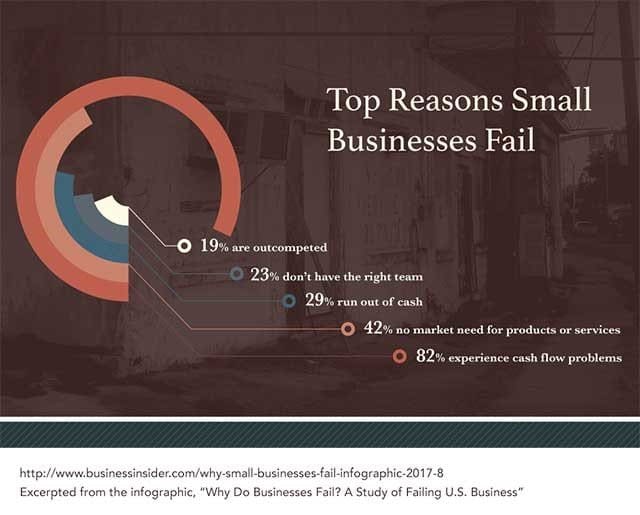
Similarly, monitor cash flow, as more businesses fail due to poor cash flow than poor sales (82% of failures come from this problem, as you can see in the graphic below).
If there is a strong showing of financial health right from the start, that is the kind of thing that helps your business a great deal, and you will find that you are a lot more likely to really notice its effect.
2. Investor interest
Investors are pretty savvy about analyzing startups as they see hundreds of pitches for funding. If they’re interested in your startup, it’s a clear sign of early business success.
Start by evaluating who might fund you. It pays to be as specific as possible, whether that means going through a SaaS investor list or something more relevant to your market niche. This will ensure that you gain insights from these folks and have the money you need to effectively get your idea off the ground.
3. Customer growth and other signs of early business success from marketing
The sooner you have strong marketing in place, the better, since marketing effectively is the only way to sustain your business beyond once you run through your initial working capital.
Customer growth is one marketing sign you should look for. Again, you might not see a substantial increase in month-over-month customer numbers but you should see a general upward trend when viewed over time.
Other metrics to consider as signs of early business success from marketing are:
- positive reviews
- repeat purchases
- an increase in average order value
- penetration of existing markets and expansion into new ones
4. Great product
Perhaps most importantly, make sure that you have a great product in place, one that you are going to be able to make use of and which customers are going to respond to well. If you have that, it’s going to mean that your business is going to have much better sales and a better reputation, both of which are great signs in themselves that a business will succeed. So, that is something that you should definitely focus on if you want to have a strong business.
5. Online metrics
Online metrics like follower growth, time on site, new subscribers, visitor growth, and many more are good signs of early business success. And, since these metrics are easy to gather, updated every day, and have established benchmarks, you can quickly establish how well you’re doing. Since the metrics correlate with business success, if you only track KPIs (key performance indicators) rather than getting sidetracked by irrelevant vanity metrics, you have signals of business success.
Below is a list of KPIs that allow you to assess early business success, as well as monitor performance as visitors move down the funnel from awareness (see) to conversion (do) and beyond. This emphasizes that assessing early business success shouldn’t focus entirely on the end result (sales) but all the stages before that lead to conversion.

6. Reputation

Developing a stellar reputation is key to long-term success, so you must monitor it starting before your product launch and going forward. According to Forbes, your reputation is synonymous with trust and credibility, which leads to loyalty and positive recommendations.
While your reputation among customers and prospects is important, don’t forget the value of a stellar reputation with supply chain partners, your community, and others in your industry, including the media. You must work hard to not only embrace your role as a responsible corporate member through sustainable practices, giving back to your community, and acting ethically in all aspects of your business but actually demonstrate these characteristics in every interaction.
7. Employee satisfaction and retention
Your staff is (or should be) one of your most valuable assets, so you must strive to build a workforce that’s satisfied. A satisfied workforce is:
- more productive
- works collaboratively
- generates customer satisfaction
- lowers your staffing costs through lower absenteeism and by staying with the company so you don’t lose the tacit knowledge they possess
One effective way to boost team morale and collaboration is by organizing corporate retreats. A well-structured team retreat planner can help design an engaging experience that fosters teamwork, enhances communication, and reinvigorates employees. Retreats provide a break from routine, allowing employees to reconnect with company values while strengthening workplace relationships.
How do you develop a satisfied workforce that stays with your company over the long run? Here are some options (choose as many as possible):
- offer challenging, meaningful work
- provide meaningful opportunities to advance
- support them through training and flexibility
- hire team players who work well together
- pay them equitably based on the value of their work and offer a good benefits package
- be transparent
- ensure managers treat all employees fairly and provide useful feedback to improve the performance of employees who aren’t meeting standards
- and offer a good work/life balance
8. Maintain operational efficiency
A good sign of early business success is when your operation runs smoothly without work disruptions. Also, monitor operational costs to seek out waste and inefficiency.
Conclusion
As you can see, there are many early signs of business success; you only have to look. So, set up a regular time to assess these signs and commit to making changes when you see signs of weakness before it’s too late. However, be wary of making changes without a clear pattern to indicate changes are needed or even which factors you should address to improve your situation to avoid over-correcting.
Need marketing help to support business growth?
We welcome the opportunity to show you how we can make your marketing SIZZLE with our data-driven, results-oriented marketing strategies. Sign up for our FREE newsletter, get our FREE guide to creating an awesome website, or contact us for more information on hiring us.
Hausman and Associates, the publisher of MKT Maven, is a full-service marketing agency operating at the intersection of marketing and digital media. Check out our full range of services.
Discover more from MKT Maven
Subscribe to get the latest posts sent to your email.


