 logo

Are you making any of these landing page mistakes? If so, we’re here to help you both evaluate your landing pages and help you avoid landing page mistakes by crafting them better. Landing pages are those you add to your website in hopes of stimulating conversion, but poorly designed landing pages can not only depress conversion, they might also result in damage to your brand image. So, read on!

Avoiding landing page mistakes
The perfect landing page is visually appealing, loads quickly, and is easy to find, so it fuels your conversion and helps your business explode. Beyond these qualities, a perfect landing page seamlessly guides visitors toward the actions you want them to take; actions that support your marketing goals without appearing heavy-handed or awkward.
One of the biggest landing page mistakes, one that underpins everything related to your landing page strategy, is not having a clear image of your ideal customer in mind for each individual landing page. That’s because there should be a clear relationship between the content of your landing page and the persona targeted by it. Hence, if you haven’t developed rich personas to represent each of your target markets, now’s the time to do so. Otherwise, everything you do to develop your landing pages is likely to fall flat, costing you valuable conversion opportunities.

For each of the personas shown above, you need to flesh out personality (such as pain points, influencers, values, personality traits, and lifestyle), behavioral (buying habits and media patterns), geographics (where they’re located), and demographic (including age, gender, education, and household income) elements. These rich personas provide the basis for creating landing pages aimed at the individual persona, which results in much higher conversion rates.
Because of the need for precise targeting when crafting landing pages, you often have multiple landing pages for the same product. The results of this strategy are evident. For instance, websites with 21-40 landing pages result in 300% higher conversion rates and those with more than 40 landing pages result in 500% more leads [source]. Thus, one of the biggest landing page mistakes is to take a one-and-done approach to crafting them.
Elements of high-converting landing pages
One of the secondary landing page mistakes is ignoring the elements necessary for high-converting landing pages. Below are the elements you should add to each of your landing pages:
- A compelling headline since this creates the first impression of your landing page and is the element shown to users in search engine results and on social media. Aim for one that’s clear, concise, and highlights the primary benefit provided through purchasing the product. If you can add a sense of urgency or create curiosity, you’re ahead of the game.
- Meaningful value propositions show the problem solved by your product, since consumers buy solutions, not products. How will your brand make the consumer’s life better? How do you provide unique value over what other companies offer?
- Crisp, high-quality visuals show your products in their best light to make them appealing in a way words can’t. Before selling to Amazon, Zappos found that simply changing the angle of the shoe image resulted in higher conversion rates.
- Show benefits, not features. Buying a new electronic device shows this landing page mistake most clearly. When the device shows storage capacity in gigabytes, for instance, what does that mean to consumers? Is that enough to store a novel or the Library of Congress? How much do I need for my normal activities? Who knows? Instead, you might state that the device easily stores 600 images or 209 videos.
- A strong call to action is essential to success. Offering a vague call to action is another of the biggest landing page mistakes, as it fails to convey what action the visitor should take if they want to purchase or learn more about the product. Using a button for your call to action is 28% to 127% more effective than using a link for your call to action. Only include a single call to action on each page.
- Trust signals, such as ratings, reviews, and the number of products purchased, lend credibility to your landing page that many visitors look for as social proof before they consider a purchase.
- An uncluttered design helps with conversion by focusing visitors on key elements, such as images and the call to action.
- Mobile responsiveness ensures your landing page looks great regardless of the user’s screen size.
Avoid landing page mistakes by assessing them
Including all these elements isn’t enough to optimize landing page performance. You must test and optimize them, updating them periodically if performance drops. A/B testing is essential when first crafting a website. By testing critical elements of the landing page, such as call to action (button text, color, placement), headlines, and images, you ensure the initial design optimizes conversion.
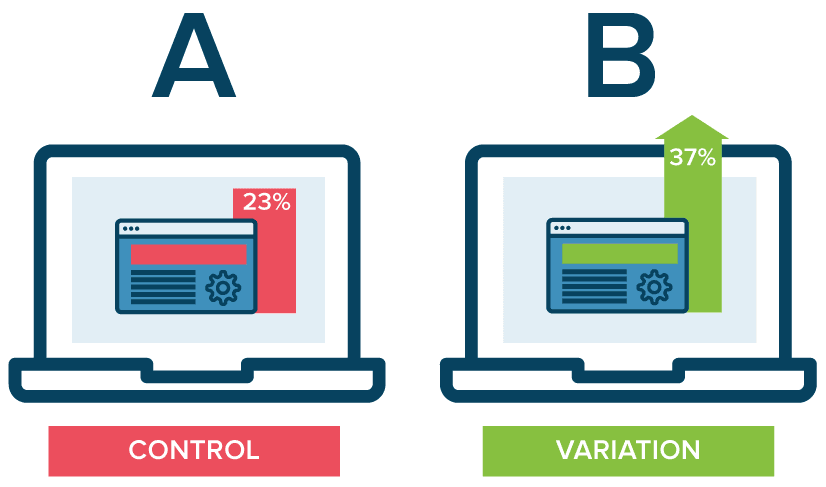
Over time, it’s essential to continue assessing your landing pages to ensure they are still optimized. One of the biggest landing page mistakes is thinking of them as a one-and-done deal. But how do you assess your landing pages? That’s our next topic.
How to assess your landing pages
We’ve discussed conversion rate as if the only type of conversion involves sales. Of course, revenue is the ultimate goal of every business, so this is an important type of conversion. Other types of conversion are also important as they lead to ultimate conversion over time. We call these intermediate goals, while sales is a terminal goal.
Thus, how you assess your landing page depends on your goal for it. Because sales is a process, we should establish intermediate goals for some of our landing pages (for B2B businesses where sales are facilitated over time through interactions with your sales staff, leads may be the terminal goal of interest). The general decision-making process looks a little like this, with consumers cycling through the stages before ultimately converting.

Quantitative metrics to assess landing pages
- Conversion rate reflects the percentage of visitors who complete the desired goal. Obviously, since you have intermediate and terminal goals, you’ll have multiple types of conversion rates. With Google Analytics, you can set these up as events to quickly assess your success. You’ll want to break down your conversion rate to get more nuanced insights. For instance, you might want to assess gender differences in conversion rate or the conversion rate for different sources or even individual campaigns or posts on those platforms.
- Bounce rate assesses the percentage of visitors who leave the landing page without taking action. A high bounce rate suggests the need for further optimization.
- Average time on page is another metric that reveals the appeal of your landing page. However, this metric can mean many things. A short time might indicate you’re getting your message across quickly (which often is better for some types of consumers), while a long time on the page might indicate the content is hard to understand or doesn’t allow visitors to find elements of interest quickly, but it might also indicate a high level of interest.
- Traffic source, as well as campaign source (which you can find by tagging posts), helps you understand what communication strategies are working best. You can even follow visitors from each source through to conversion, as mentioned earlier.
- Click-through rate assesses how inviting your call to action is. Often, one of the landing page mistakes is assigning too much meaning to this metric.
- Cart abandonment rate reflects a serious failure in your overall marketing strategy. When visitors leave a product in their cart, it often reflects unexpected costs that show up during conversion, a cumbersome process (especially one requiring too much personal information), unattractive payment options, or distractions (such as popups) that interrupt the process.
Qualitative analysis of landing pages
With qualitative analysis, we get into the why of landing page performance, which helps immeasurably in making improvements. Here are some tools for qualitative analysis:
- Heatmaps show where users are clicking, moving their mouse, and how far they scroll down the page.
- Session recordings provide anonymous data on how users navigate your pages.
- Scrollmaps indicate what percentage of visitors see each section of your landing page.
- Primary research, such as polls and surveys, provides rich information about how visitors think about your landing page, your brand, and its products. Adding a pop-up containing a few questions can provide great insights.
- Usability testing observes real users as they navigate the landing page, along with their thoughts during the process.
Predictive analytics take these assessments one step further by attempting to predict future behavior based on what you’ve experienced in the past. Big landing page mistakes occur when you don’t use the right metrics to build your predictive model, as you can see in the cartoon below.

Essential tools to assess landing pages
You’ll find a wealth of powerful tools to help with assessing landing pages. Some are free, others involve a subscription; some of these are inexpensive, while others are quite costly. Here are some options:
| Tool Category | Examples | Key Functions |
| Web Analytics | Google Analytics 4 (GA4) | Tracks key metrics like conversion rate, bounce rate, traffic sources, and user demographics. |
| User Behavior Analytics | Hotjar, Crazy Egg, Microsoft Clarity | Provides heatmaps, session recordings, scrollmaps, and on-page feedback tools. |
| A/B Testing Platforms | Unbounce, Instapage, Google Optimize | Allows you to test different versions of your landing page elements (headlines, CTAs, images) to see which performs better. |
| AI-Powered Analyzers | Various emerging tools | Offer automated analysis of your landing page, providing suggestions based on best practices for conversion rate optimization (CRO). |
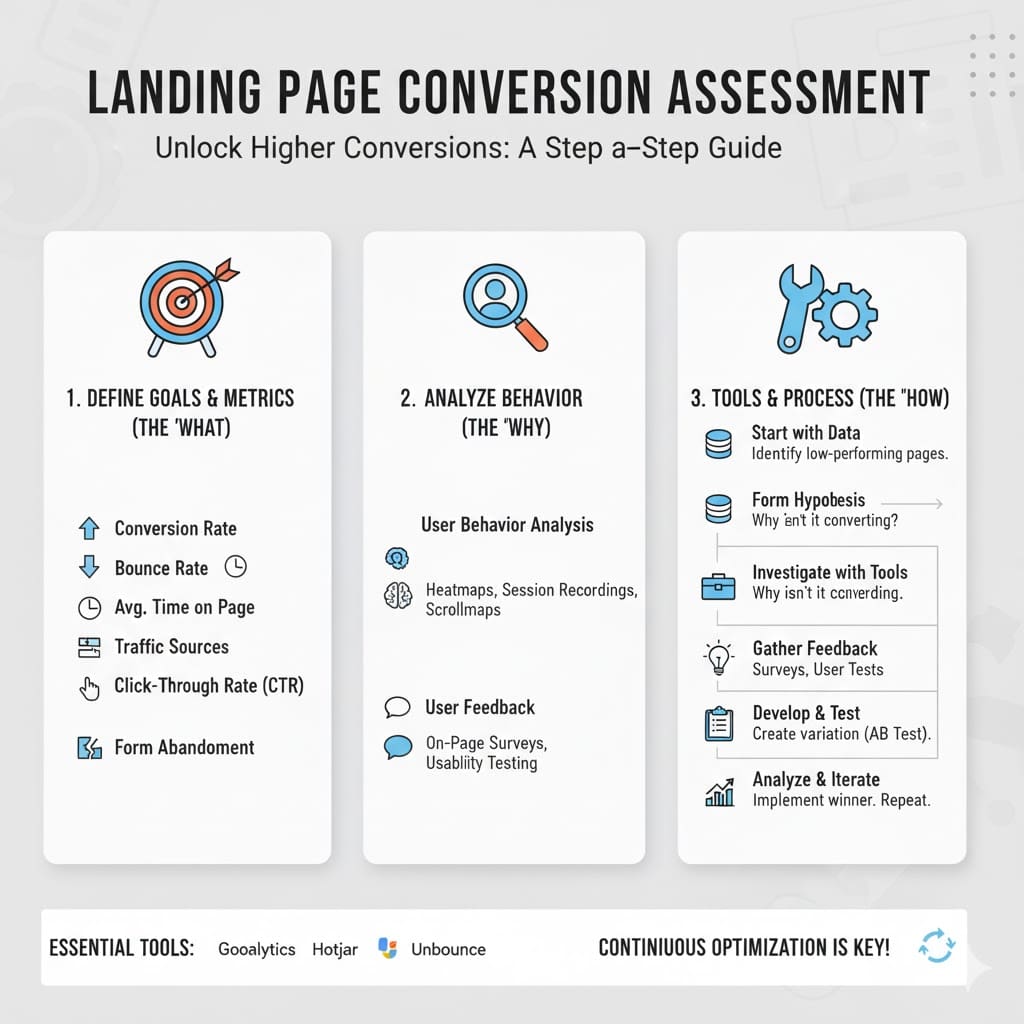
Step-by-step process for identifying conversion opportunities
Start with the data
Gather as much data as possible from your various campaign tactics. Identify low-performing landing pages and compare them to high-performing landing pages. Also, assess whether the page is effectively converting the persona you are targeting with the page by segmenting performance.
Form a hypothesis or several to explain poor/ high performance
A hypothesis is, by its very nature, an assumption as to why your landing pages perform as they did relative to expectations, past performance, or other landing pages. Each hypothesis involves a yes or no answer, which tells you whether your hypothesis was right or wrong.
The role of qualitative tools
Qualitative tools help you build hypotheses when you don’t have clear insights to use.
Develop and test variations based on true hypotheses
In the old days, you could perform A/B testing to assess the performance of variations of your landing pages. Today, multivariate testing allows you to test multiple elements on the landing page at once.
Analyze the results and iterate
Once you’ve determined the optimal landing page, continue to assess its performance over time. If performance drops, you should go through this process again.
Conclusion
If you avoid these common landing page mistakes and continue assessing and optimizing landing page performance over time, you’ll soon find your conversion rate exploding, turning more visitors into valuable customers.
Let me know how this post helps you run your business by entering your comment in the section below. Good luck!
Need marketing help to support business growth?
We welcome the opportunity to show you how we can make your marketing SIZZLE with our data-driven, results-oriented marketing strategies. Sign up for our FREE newsletter, get our FREE guide to creating an awesome website, or contact us for more information on hiring us.
Hausman and Associates, the publisher of MKT Maven, is a full-service marketing agency operating at the intersection of marketing and digital media. Check out our full range of services.
Discover more from MKT Maven
Subscribe to get the latest posts sent to your email.


