 logo

Crafting great marketing content takes time, costs money, involves effort that might distract your staff from other tasks, and consumes resources. If this content isn’t good enough to enthrall your target market, generate positive emotions and attitudes toward your brand, and motivate consumers to buy from you, then you’ve just wasted scarce resources. Using content marketing tools and tactics effectively, however, not only reduces your costs in time, money, and opportunity, but also attracts the attention of your target market and entices them to make a purchase.

If your business struggles to produce a sufficient amount of content or faces challenges when it comes to effectively reaching your target market through your content, then this post is for you. In this article, we focus on content marketing tools that will help you achieve your goals without breaking the bank or stressing your staff with unreasonable content demands.
Let’s start.
Content marketing tools and tactics you need
Content marketing, including website posts, email broadcasts, and social media posts, is the foundation for your business. Content marketing drives SEO (search engine optimization), which accounts for 53% of all website traffic. Although AI may have reduced 60% of the traffic to your website by answering a search query without requiring the user to visit your site, those who do visit are likely more interested in what you have to say, as they’re further along in their customer journey, according to Forbes. Even if you don’t operate an e-commerce store, these content marketing efforts still impact your business by bringing customers into your store or generating calls for service.
Several of the content marketing tools suggested in this piece are free or involve a simple change to your normal procedures. Others involve a small monthly charge. You don’t have to use every one of them, but you should choose the ones that offer the best opportunity to grow your business.
Of course, you may find that you need specially trained staff to manage your content marketing, even with these content marketing tools. If nothing else, the time demands required to do content marketing well can easily swamp a staff member already burdened with other tasks, forcing them to scimp on their efforts directed at content marketing or skip creating sufficient content to address the business’s needs.
So, here are 14 content marketing tools and tactics to consider as you build your marketing plan for next quarter.
1. Set a schedule and stick to it
One of the hardest things about content marketing is keeping up with the demand for fresh, valuable content and, while there aren’t any content marketing tools that will do this for you, you’ll find a bunch of them to make your life easier. I’ve listed some of these great content marketing tools and tactics below.
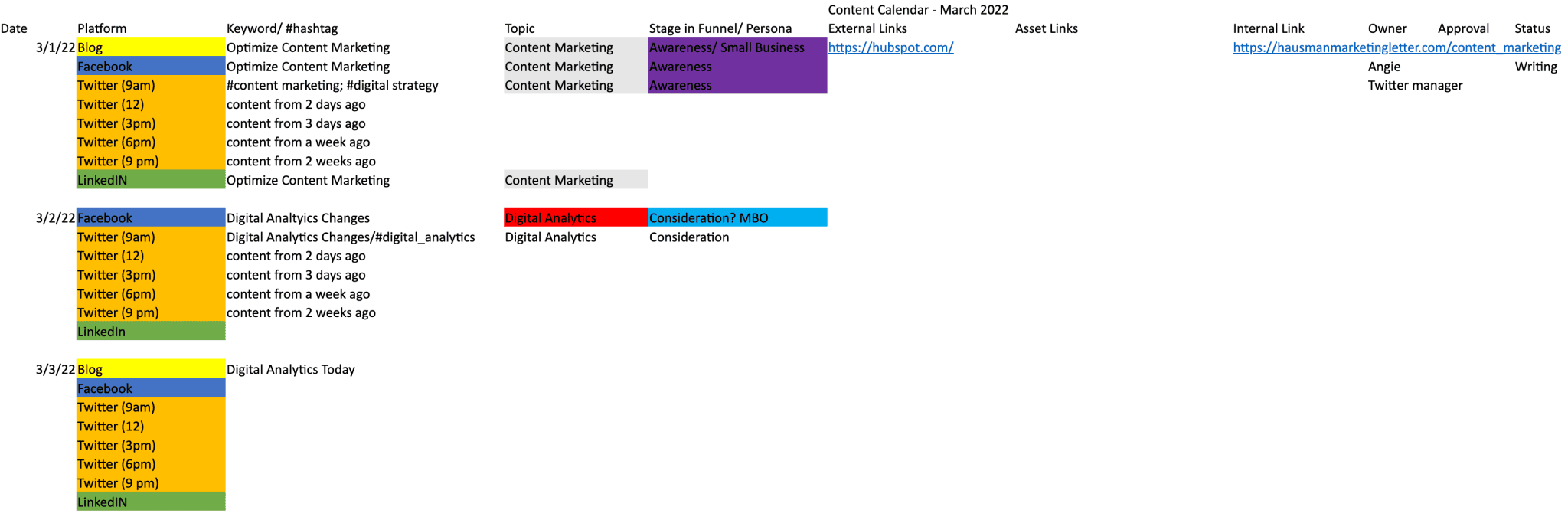
- One of the best content marketing tools is a content marketing calendar. To get you started, I’ve created a downloadable template like the one below. Simply fill in as much information as you can. Using this calendar, you never face a situation where you forget to post something or forget a channel, you’re staring at a blank screen with nothing to post, or ignore key elements of your strategy by not posting to the right customers, with the right products, at the right time.

- Know when and how often to publish content to your various channels. For instance, you should aim to post on your website at least once a week (more frequent posts generate more leads), on most social media platforms at least daily, and on YouTube at least once a week. Content marketing tools like marketing automation from Buffer help ensure you stick to the schedule by allowing you to set up posts that get published on your schedule. These tools also analyze your performance to suggest the best times to post.
2. Use content marketing tools to produce various types of content
Publishing the same old boring content day after day is a recipe for disaster. Most social media platforms use visuals as their foundation, so posting without them is a mistake. Moreover, while websites and email messages don’t require visuals, they perform better when they contain not only visuals, but a variety of content. Here are some examples to consider:
- Graphs
- Case studies
- Statistics, especially data visualizations
- Quotes and references to niche authorities to lend credibility
- Client testimonials
- Product images, videos, etc.
3. Write like a pro
In addition to including a variety of content, you must write like a pro. While most of this section is written to improve website content, some also applies to content created for other platforms.
- Create a compelling title. Many SEO tools offer suggestions for improving your title.
- Writing like a pro means crafting a conversational style that considers your target market.
- You also need impeccable grammar, which is where content marketing tools like Grammarly come in.
- Use headings and bullet points to make it easier for visitors to get what they need quickly.
- Focus on your introduction, as this helps determine whether visitors will read the rest of your post. Keep it short, identify the topic, and promise value to the reader.
- If you’re not a subject matter expert, consider working with one. It’s the best way to cover a subject online and build your reputation, especially if you are trying to rank on a search engine, because subject matter experts understand a subject inside out. They have “first-hand” experience in a matter, which is also required by Google’s E-E-A-T standards.
- Focus on unique images and other graphics, as well as covering a topic in depth. Your content shouldn’t read like an abstract.
- Use AI tools judiciously. Sure, ChatGPT and other AI models are great content marketing tools, making your job much easier. However, copying content generated by these tools often results in using duplicate content (which hurts your SEO) or writing in a way that sounds less natural. Instead, use AI tools to write your first draft, as you’ll likely find aspects of the topic that add to your original idea. Rewrite these drafts in your voice, adding images and hyperlinks to other great content.
4. Analyze your old content’s performance
Your future content will eventually become old, so ensure you are hitting the spot this time and not firing aimlessly by developing a content strategy. A content strategy is a roadmap that guides you to understand what kind of content you want to create, what kind of keywords you want to target, and which topics you want to cover. It may not matter for a startup, but it eventually will: A simple blog content strategy can help set goals, clarify your perspective, and allocate resources effectively.
Start by analyzing the performance of your old content, using the Google Analytics tool G4 (which really helps with analyzing other aspects that improve performance. This free content marketing tool takes a little effort to learn, but Google offers a free training class or you can sign up for one from a reputable online school. You’ll find similar reporting tools on most social media platforms and email providers.
It’s especially important to note content that performs well and compare it with content that doesn’t. Here are some things to look for when comparing best/ worst performers:
- How engaging is each post? You’ll find metrics such as the number of comments and shares helpful. Content marketing tools like SEMrush offer more nuanced metrics like average engagement time per user and bounce rate.
- How much traffic did it generate? On social media and email messages, track the clicks from a post to your website. On your website, track page views and clicks to other pages on your website, especially those reflecting the conversion process, as well as the conversion rate.
- How many users did you reach with each? You’ll find this impression metric on most social media platforms.
On a broader level, you might also want to analyze the content from an SEO perspective, using a content marketing tool like Google Search Console. Based on this analysis, you might want to update old content, especially if the value offered to readers is minimal or the content is outdated.

Conduct a thorough analysis, collect relevant data, and compile a comprehensive report. This report will give you a clear view of what you were doing and what you may have missed.
5. Conduct SERP analysis
SERP (search engine results page) analysis is invaluable when updating old content. Use this to explore content that shows up at the top for the keywords you’re using. This provides insights into how you can improve your content, including:.
- Fixing grammar
- Updating outdated information & covering recent trends
- Adding relevant & removing irrelevant information
- Covering missed headings & subheadings
- Covering missed topics & subtopics
- Improving keyword density & adding missed keywords
- Adding statistics & quotations to support your statements
- Linking to sources
- Adding examples & testimonies if you missed them previously
- Adding visuals and removing the ones that add no value
- Fixing the tone and voice of the content
- Incorporating ideas your competitors are using
Analyzing SERP will guide you to know what the audience is looking for and how it is, allowing you to find ideas and gaps in your competitor’s work and ensure that your content covers them.
6. Optimize for SEO
If you don’t know, SEO stands for search engine optimization. It is the practice of making a piece of content search engine-friendly so that it ranks well on SERP. Since most clicks (nearly 70%) accrue to content in the top positions on these pages, you need to consider ways to ensure your content ranks well for keywords related to your content. Below is a simplified graphic of the SEO process.
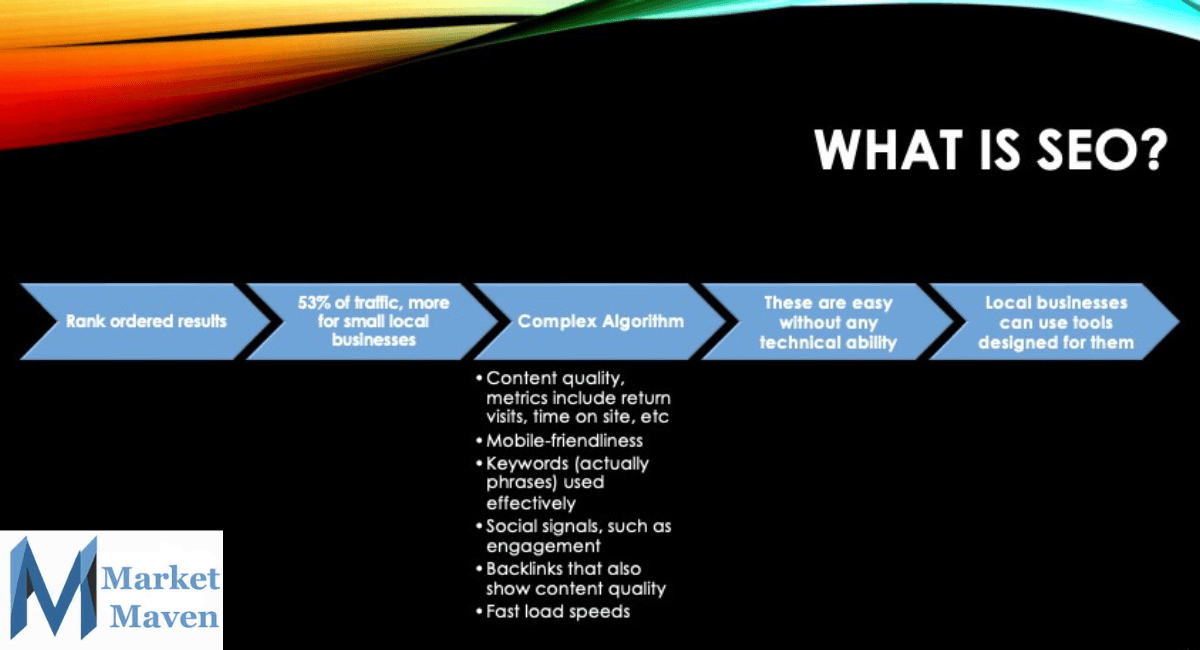
You’ll notice a section on my content marketing calendar template designed to help you optimize your content for higher rankings. This includes using unique keywords, rotating keywords across posts, and incorporating assets such as images and hyperlinks to high-quality content, which can improve your rank.
Improving search rank is hard and takes time, so don’t give up if you don’t see results right away.
7. Remove or redirect dead content
While Google no longer penalizes your website for content with bad hyperlinks, it’s still a good strategy to remove them or redirect visitors to a better hyperlink. You’ll find several content marketing tools to help you identify bad hyperlinks so you can determine the best strategy. I use Broken Link Checker. You may also find you want to remove your own content and redirect visitors who find the old link to new content. This ensures you don’t lose that traffic or face some threat to your reputation when visitors don’t find your content.
Here are some scenarios in which redirecting or removing a post might be a better solution than updating it:
- Your targeted audience has changed
- The user personas have changed significantly
- The content cannot be updated and is damaging the business’s reputation
- A better post on the same topic already exists on your website
- The overall structure of the content is no longer relevant to your needs and should be changed
Conclusion
If you’re looking for content marketing tools and tactics that can elevate your content, generate engagement, educate your target market, and bring in customers, you’ll find this post fits that bill. And, if you find this valuable, consider reading related posts highlighted at the bottom of this one. If you have questions, please ask them in the comments section.
Need marketing help to support business growth?
We welcome the opportunity to show you how we can make your marketing SIZZLE with our data-driven, results-oriented marketing strategies. Sign up for our FREE newsletter, get our FREE guide to creating an awesome website, or contact us for more information on hiring us.
Hausman and Associates, the publisher of MKT Maven, is a full-service marketing agency operating at the intersection of marketing and digital media. Check out our full range of services.
Discover more from MKT Maven
Subscribe to get the latest posts sent to your email.


