 logo

Have you ever wondered why a customer chooses one product over another? Or why does someone fill their online cart only to abandon it at the last second? It isn’t random. Every purchase follows a specific psychological journey. There are five stages of buying, termed the customer journey or the consumer decision-making process.

For small business owners, understanding this “Consumer Decision-Making Process” is the closest thing you can get to a superpower. It allows you to stop guessing what your customers want and start meeting them exactly where they are. By influencing the customer journey, not through manipulation, but through providing the right information in the right way, you can increase your revenue and grow your business. Here is a breakdown of the five stages of the buying journey and how you can optimize each one to increase sales.
Stages of buying
The image above shows my version of the customer journey. Note that this image involves concentric circles rather than the more traditional funnel version of the customer journey. My rationale is that consumers don’t proceed through a purchase decision in a linear fashion. Instead, consumers proceed through the buying process in fits and starts. That’s because they have to live their lives and they’re not totally focused on making a decision.
Another factor that influences the stages of buying is the type of products purchased. For instance, consumers are unlikely to spend a lot of effort to make a decision about purchases they make frequently, like bread and milk. Marketers call these types of products convenience goods. Often, buying these products is more a function of habit. In contrast, buying an expensive product, like a home, may involve an extensive effort. We call these types of products Specialty goods.
These types of purchases not only reflect a lot of risk, but also are the types of products consumers purchase infrequently. Thus, they require extensive effort in decision-making. It may take a consumer multiple cycles through the customer journey to make this kind of purchase decision. Thus, the product category greatly impacts the stages of buying. Not only how quickly a consumer moves through the process, but also whether they hit all the stages of buying or skip some of them.
A variety of other factors also impact the stages of buying. For instance, not every consumer makes decisions the same way. We all know a friend or family member who seems to take forever making the simplest decision. Or the person who makes a seemingly important decision almost as if by impulse. You also find that situations impact the stages of buying; also, who you’re buying for impacts how you make decisions.
Finally, most representations of the customer journey fail to consider loyalty and advocacy. These are important aspects of the customer journey, especially from a business standpoint, because they represent future buying intentions by a consumer. We know that loyal customers not only represent future sales, but retaining a customer is five times less costly than attracting a new customer.
Here are the five stages of buying:
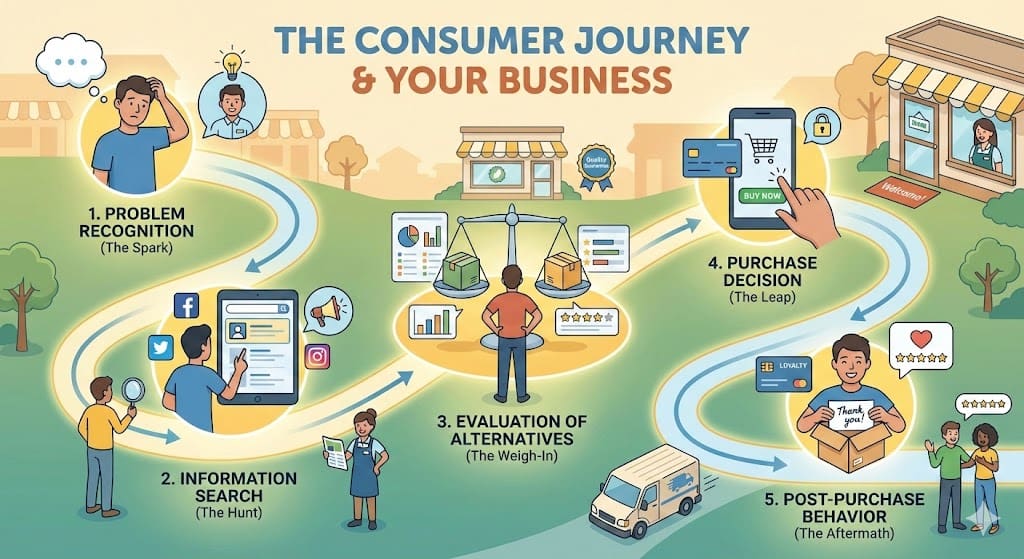
Stage 1: Problem Recognition (The “Spark”)
In the problem recognition stage, consumers recognize a gap between where they are and where they would like to be. This can be an emotional gap, such as I need a night out, or functional, such as I need a dress for an interview next week. Consumers are basically problem solvers. Instead of buying products, they’re buying solutions.
From a business standpoint, we call this the awareness stage. Consumers become aware of a problem through a variety of ways. For instance, they might see your ad and decide that they have the problem defined in the ad. Or, they might see a post on social media where a friend is vacationing and decide that they also need a vacation.
At this point, focus on defining the problem rather than positioning your product as a solution. That happens in the next stage. All you can hope to do at this stage is make consumers aware of a need and motivate them to prioritize efforts to find a solution, since most consumers face a perpetually growing list of needs.
Stage 2: Information Search (The “Hunt”)
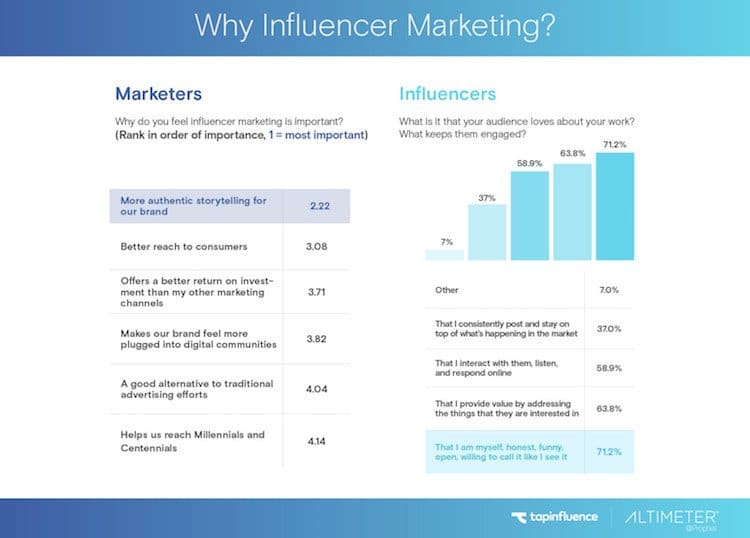
In 2025, most information searches begin online, as you can see in the image below. That means, as a business, you must capitalize on your ability to reach your target market online. SEO (search engine optimization) and GEO (generative engine optimization) are tools that help your business stand out when consumers search for the types of products you have available. Social media is another tool that’s great for helping consumers find your solutions to their problems.

Local SEO is a powerful tool for small businesses, since most likely your target market is a local customer. Setting up and optimizing your Google Business Profile helps you show up when local users search for products like yours. Local searches often display businesses like yours, along with enhanced listings that include a map, ratings, hours of operation, and phone number, displayed before other results, helping your business stand out.
Stage 3: Evaluation of Alternatives (The “Weigh-In”)
At this stage in the process, consumers have defined a consideration set of products that are suitable for solving their problems and, potentially, an inept set of products that don’t fit their needs. Often, price is a factor in whether a product is included in the consideration set, but it becomes less important when comparing products within the set. For instance, evaluating two cars that differ by $1000, we find that price is often meaningless. Consumers then compare products within the consideration set by looking at features and other aspects of the product, such as brand reputation, ease of buying, quality signals, and reviews.
In the evaluation stage, consumers may circle back to the information search stage or may find that another need is more salient at the moment, delaying a decision on this particular purchase. That’s why the stages of buying look more like concentric circles rather than linear funnels.
How can businesses influence consumers to buy one of their products at this stage?
- Providing social proof to reduce the fear of making a mistake. Reviews and ratings ease this concern.
- Offer a clear, meaningful value proposition. This requires a focus on features that are unique to your product or where your products outperform your competition.
- Value is more important than price, so emphasize value.
- Reputation of the brand.
- Even goods, like a car, have service components, such as warranty, the helpfulness of your staff, and customer support.
- Others influence decisions at this stage in the process. Friends, family, and online influencers, as well as commercials, influence buyer decisions.
Stage 4: Purchase Decision (The “Leap”)
This is the moment of truth. They are ready to buy, but they can still be derailed by friction, doubt, or a complicated checkout process.
- Simplify the checkout process by eliminating as many steps as possible. Don’t require more information than is needed to complete the purchase. Don’t require buyers to create an account.
- Don’t introduce surprises at checkout. Be clear about shipping costs and delivery options prior to checking out.
- Offer multiple payment options, including easy financing approval for high-priced purchases. In addition to credit cards, consumers like Apple Pay and Google Pay as more secure alternatives. Also, an increasing number of consumers like to pay with cryptocurrency.
- Influence consumers to make fast decisions by creating a sense of urgency, such as limited-time offers, limited quantities, or by offering discount pop-ups upon exit intention.
- Reduce risks by offering trials, liberal return policies, and guarantees.
- If consumers don’t complete the sale, add their email for future lead generation efforts so you can potentially close the sale in the future.
Stage 5: Post-Purchase Behavior (The “Aftermath”)
Post-purchase behavior includes satisfaction with both the product and the buying process, so don’t stop with making the sale. Another post-purchase behavior is rating, reviewing, and recommending your products to encourage others to make a purchase. To capitalize on the post-purchase stage, follow up once the consumer makes a purchase to ensure that the product delivers everything you promised. Enable chatbots and human customer service to handle questions or deal with problems effectively and quickly. Encourage buyers to leave a review or rate their experience, maybe offering an incentive to those willing to expend this effort.
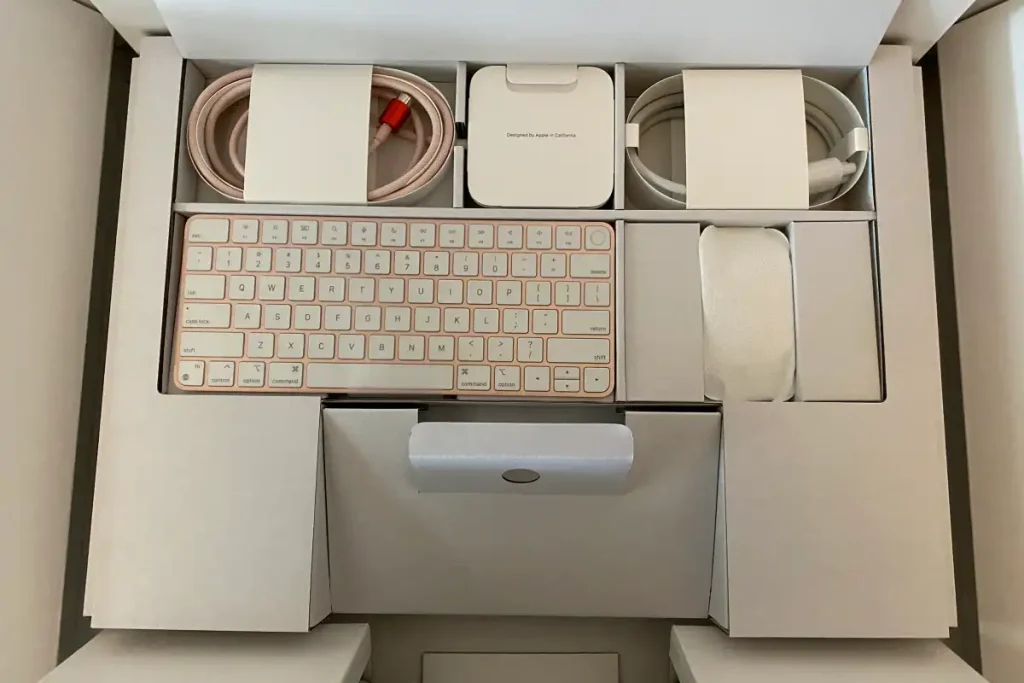
Including a little thank you note or a token gift in the box when customers order products online is a great way to build customer loyalty and encourage positive emotions about the experience that result in recommendations. A great package says you value your products and want to ensure they reach the customer intact. For instance, look at the care Apple takes when sending out its iMac to customers. It says they value their brand.
Conclusion
By understanding the stages in the buying process that consumers move through and the factors impacting their decisions, your company can ethically influence these decisions in your company’s favor to increase revenue. By aligning your marketing efforts to ensure you offer the information and incentives they need at each stage in the decision-making process, you’ll capture more sales. That means creating multiple landing pages and monitoring where each consumer is along the journey to provide what they need to make a decision.
Need marketing help to support business growth?
We welcome the opportunity to show you how we can make your marketing SIZZLE with our data-driven, results-oriented marketing strategies. Sign up for our FREE newsletter, get our FREE guide to creating an awesome website, or contact us for more information on hiring us.
Hausman and Associates, the publisher of MKT Maven, is a full-service marketing agency operating at the intersection of marketing and digital media. Check out our affordable coaching programs to help your business thrive into the future.
Discover more from MKT Maven
Subscribe to get the latest posts sent to your email.


