 logo

Is your marketing falling flat with your target market? Do you find your business struggling to attract attention in an increasingly crowded retail environment? Today, we’ll focus on how to host the perfect marketing event, whether online or in the real world, to build excitement, create engagement, and break through the blandness of your competitors’ marketing efforts.

Why hosting a marketing event works
Modern marketing efforts are often heavily focused on the online world to the point where a lot of business owners neglect traditional forms of marketing. But some of those tried and tested methods are still incredibly effective, especially when it comes to those that build excitement and create engagement, such as hosting a marketing event, whether it’s a party, networking event, launch, or trade fair. There are a few reasons you might decide to put on a marketing event of your own.
If your sales are slipping and you’re struggling to reach potential customers online, you might decide you want to put on an event to attract new customers. Unlike bringing customers to your store, with its focus on purchasing, a marketing event attracts prospective buyers to learn more about you and your product in a non-threatening environment.
Plus, you don’t have to host a marketing event solo. Consider bringing in non-competing brands that might share a similar target market. Thus, it’s also a good way to make connections with other business owners that you might want to work with in the future, perhaps on a joint marketing campaign, for example. By joining forces with these brands, you also share the burdens of promoting, attracting attendees, managing the event, and paying for it. It’s a win/win for everyone, including consumers who have fun and learn about solutions to their problems.
A lot of businesses also put on events when they’re launching a new product, so they can showcase it and build a bit of a buzz around it.
How to host the perfect marketing event
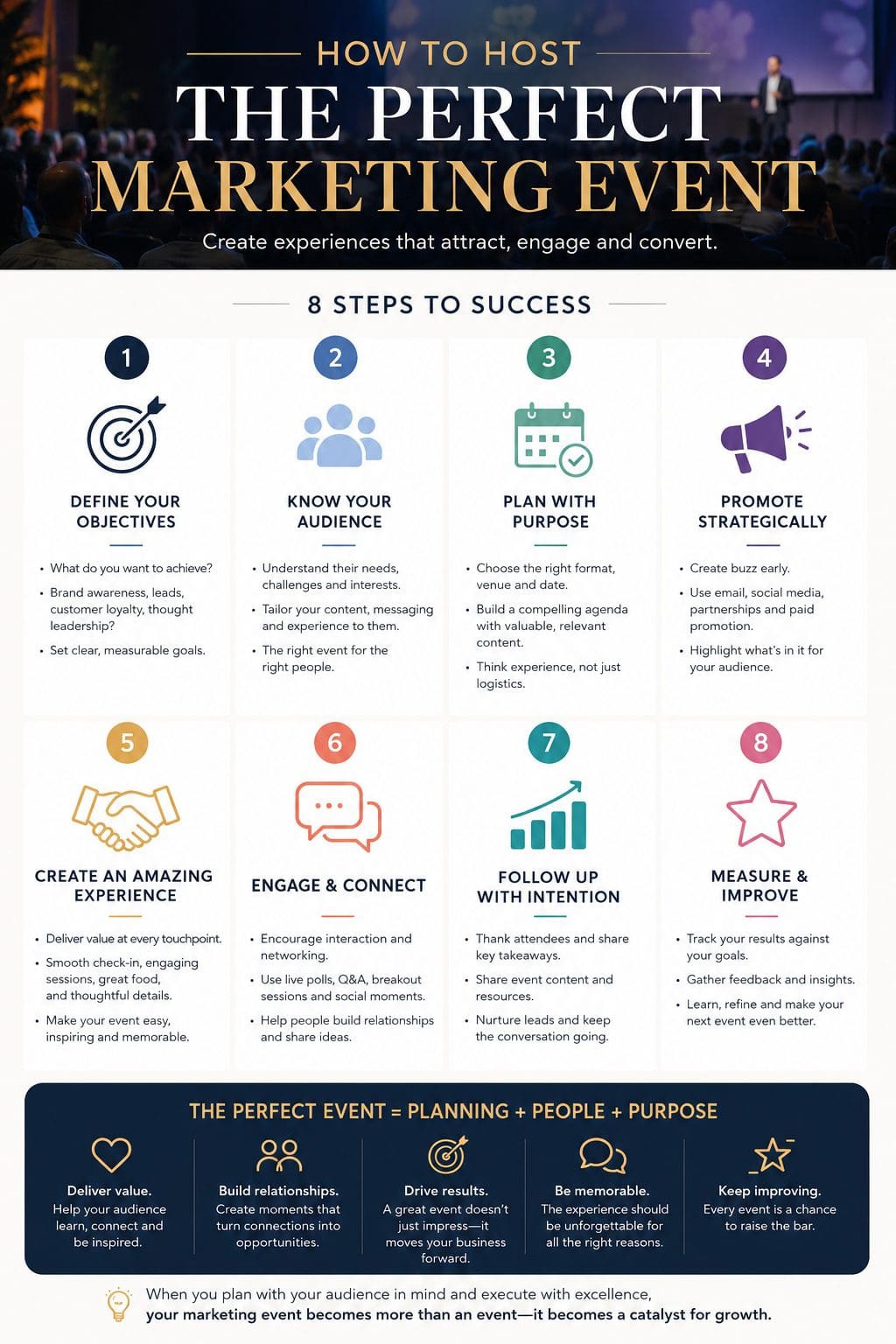
1. Define your goals
Creating a goal is so important because your event will be different depending on your end goal. The people you choose to invite also depend on what you’re trying to get out of the event, so you need to know what your goals are before you start planning. SMART goals ensure you’ve defined your goals effectively.
Are you launching a new product you want to publicize?
Do you want to meet other business leaders and form relationships with manufacturing companies or even find somebody to do a joint marketing campaign with?
Maybe you just want some more new customers, and you think that an event might help you reach a different demographic?
Your product might require some hands-on or a demonstration to show prospective buyers the value it offers. Steve Jobs was the master of the demo, even going so far as to fake a product feature that wasn’t working at the time scheduled for the demo.
Whatever your goals are, you need to have them clearly defined before you put the event on. If you can’t do that, you need to question whether you actually need to put an event on or whether you’re doing it for the sake of it.
When coming up with goals, you need to be specific about them, as well. Don’t just say, we want to make business connections. Instead, say, we need a new manufacturer because our current one is costing too much and the quality of the product isn’t good enough. Having these specific aims will help you to plan the event more successfully and will also make it easier to measure whether the event was a worthwhile way to spend your money or not.
2. Know your audience
Inviting the right people sounds like an obvious task, but you’d be surprised how many businesses get it wrong. One of the main reasons that you need to have clear goals for your marketing event is that the goals will help you decide who you need to invite.
For example, if you’re looking for new marketing opportunities with other businesses, you need to invite local business leaders who operate in a relevant industry. There’s no point in inviting members of the general public or your existing customers.
However, if you’re looking to increase sales and find new customers, you do need to invite members of your target market and you don’t really need to bother inviting other business owners or folks that don’t have the characteristics required to be part of that market. If you’re doing a new product launch, your focus should be mainly on your existing customers, since those folks represent low-hanging fruit.
It’s also important that you start inviting people early on and don’t leave it until the last minute. People aren’t going to drop all of their plans at the last minute just to attend your event, so you need to give them plenty of notice. It’s also a good idea to send people reminders in the lead-up to the event so they don’t forget.
3. Planning is crucial
Putting on an event takes a lot more work than people realize. You need people to set up the venue, build stages if you’re having speakers (and arrangements for them), and deal with security, guest lists, food, etc. If your event is going to run smoothly, you need to hire people who have expertise with these kinds of things, and you also need to make sure you organize your people properly.
You should make use of scheduling software as much as you can because it will help you keep all the moving pieces on track so the event runs seamlessly, and everyone knows exactly what they’re doing and when. It’s can be a big mistake to think that you don’t need professionals because you can just do all of that stuff on your own. You won’t be able to handle the workload in addition to conducting your normal business and the event will be a disaster. Create a PERT chart to ensure everything will run smoothly and consider a dry run to test everything before the event.
The timing of the event is something that a lot of people forget to consider, but it’s so important. If your event clashes with a public holiday, for example, it’s likely that a lot of people will already have other plans, and you won’t get as many people attending. The same goes for other business events that are happening nearby. If a rival company is also hosting an event, you shouldn’t do yours on the same day because it’s likely that people will be interested in both and there’s always the chance that they’ll pick the other event over yours. If you want to maximize the number of people who attend, you need to pick a time when people are likely to be free, and there are no other competing events going on at the same time.
It’s also important that you think about the nature of the event and the time of year. For example, if you’re hosting an event that is mainly outside, you need to ensure that you do it when the weather is nice, not in the middle of winter. Bad weather is something you can’t plan around, but it may have a negative impact on attendance. We spent a lot of time, money, and effort planning a launch event, resulting in a bunch of folks registering to attend. On the night of the event, there was a severe thunderstorm and our “no-shows” far exceeded our attendees.
4. Promote effectively
Promoting your marketing event starts long before the event itself. Instead, you need a multi-channel marketing strategy that combines email marketing, advertising (online and physical), social media, promotions (such as early bird offers of promotional items or limited-time discounts on purchases) to create FOMO (fear of missing out), User your partnerships with speakers, providers of the space, food, and other elements of the marketing event, and sponsors as a means to promote the event.
The goal is to create buzz early and keep folks excited until after the event is over.
5. Create a valuable experience
People hate to wait. So, ensure your check-in process is fast and efficient. Plan for how to handle folks showing up who haven’t registered by collecting the necessary information fast, such as collecting a card to enter later or offering an online form they can fill out quickly using their phones. That also implies you need WIFI.
Keep the program moving, allowing lots of time for networking, enjoying the refreshments (and keep them coming), and keep the formal aspects of the program light and fun. Don’t overdo the promotional aspects of your program. If you’re demoing a product, ensure you have lots of them around so folks don’t have to wait their turn.
Focus on problem solving, demonstrations, networking, and fun rather than making the event a long, boring sales pitch. Mix up the program to keep things interesting.
Keep to your schedule without dead space between elements. If you need time to set up the next portion of the event, serve food or have some music to keep the audience entertained. And, end on time. If your marketing event extends past the point where attendees are interested, you’ve damaged rather than improved your brand image.
6. Engage
Consider adding fun activities to your marketing event. Setting up a photo booth (along with costume elements) is a great idea, and if you automatically share the photos with attendees’ social media, it’s a great way to spread the word beyond the event. Consider adding games, offering prizes, and encouraging feedback through polls. The idea is to make the event fun.
Don’t forget that your marketing event doesn’t finish with the end of the event. Consider ways to connect with attendees for follow-up after the event. For instance, the ubiquitous fishbowl is a great way to collect information for follow-up, and by offering random drawings, you encourage participation.
7. Follow-up
Be sure to maintain communication with attendees after the event. For instance, you might send a thank you to those who showed up and express your willingness to provide information for those who couldn’t make it. However, don’t be overly pushy or you’ll find it hard to get folks to come to your next marketing event.
If you promised an attendee something, such as a product brochure or a free sample, send it promptly.
Add attendee information to your email marketing or CRM system to nurture leads.
Post images from the marketing event on social media, write a blog post summarizing the high points, and send out a press release highlighting the event.
8. You haven’t finished yet
A marketing event isn’t commonly a one-off. Likely, you want to host more marketing events in the future, plus your finance department wants to ensure the spending results in an adequate return. Thus, you need to gather information on how effective you were in reaching the goals of the marketing event.
Did you gain enough leads to reach your goal?
Was spending on the event within budget?
Were there issues that arose that made the event less enjoyable? How can you fix them so they don’t occur next time?
Conclusion
If you can make sure to get these things right when you’re planning and hosting your own marketing event, it should be a huge success.
Need marketing help to support business growth?
We welcome the opportunity to show you how we can make your marketing SIZZLE with our data-driven, results-oriented marketing strategies. Sign up for our FREE newsletter, get our FREE guide to creating an awesome website, or contact us for more information on hiring us.
Hausman and Associates, the publisher of MKT Maven, is a full-service marketing agency operating at the intersection of marketing and digital media. Check out our affordable coaching programs to help your business thrive into the future.
Discover more from MKT Maven
Subscribe to get the latest posts sent to your email.


