 logo

What’s the secret sauce for digital marketing success? I did a podcast interview on Friday—I’ll share the link through my social networks and with my email subscribers once it’s live—and that was one of the questions asked. I was a little flummoxed because, to digital marketers, that’s like asking the secret to life. It’s a big question with lots of different answers from different people.

It was easy for me to come up with three things that make up the secret sauce for digital marketing success.
- Analytics
- Content marketing
- Engagement
Simple, direct, and to the point. I could stop here, but Google requires a minimum of 900 words for good SEO, so I’ll expand on these three things a little bit.
The secret sauce of digital marketing success
Analytics – KPIs
Sure, analytics are a cornerstone of digital marketing success (or success in any other aspect of business), so I include them in my secret sauce in big doses.
You can’t just use any old analytics to make the secret sauce for digital marketing success. You need the right analytics, the metrics that make a difference in your market performance. We call these KPIs or key performance indicators. You can pitch vanity metrics like fan/ follower counts in the trash because that’s what they are — garbage. Sure, in the old days when organic reach existed on Facebook (current organic reach on Facebook is a mere 1.37%, which won’t help you succeed) and Twitter wasn’t a stream whizzing by so fast no one could possibly read it, the number of fans or followers you had made a little bit of difference. A larger fan base reflected your potential to succeed, but engagement (as we’ll discuss later) is the real secret sauce for social media. The larger your ENGAGED fan base, the more successful you’ll be. Of some meaning is the growth in your fan base over time, since that metric suggests your content appeals to social media users.
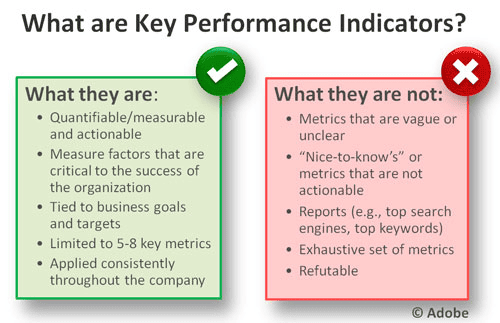
If you want to understand the difference between vanity metrics and KPIs, here’s a handy graphic.
Since most of my readers represent small businesses, I list some suggestions from Occam’s Razor, written by Kaushik, who is a guru from Google Analytics, as well as some I gleaned from other experts and my own preferences. Click the link to see his recommendations for Metrics to Rule Them All for businesses of various sizes. Here’s his list for small businesses:
- Cost per acquisition
- Bounce rate, which reflects the percentage of visitors who leave after viewing a single page of your website. This reflects poor content or other problems with the user experience provided on your website. Google also uses this metric as a significant ranking factor in the SEO algorithm.
- Shopping cart abandonment reflects a missed opportunity for success.
- Conversion rate
- ROAS or return on advertising spend
- Visitors and unique visitors, although these metrics are more meaningful when measured longitudinally
- Engagement is another key metric and a key ranking factor for SEO. Engagement on your website reflects metrics such as time on site, depth of page views, and returning visitors. Engagement on social media refers to likes, shares, comments, and other types of interaction with users. Click rates represent engagement through email marketing.
- Backlinks. The more backlinks you garner and the better the websites that link to you, the more traffic search engines will send to your site.
- Domain authority, which reflects your website’s ability to rank well.
- Site speed. Website visitors expect a website to load in just a few seconds and will bounce if it takes longer. Google also uses this as a ranking factor.
Analytics – the conversion funnel
Businesses tend to focus on the bottom of the funnel, like sales, leads generated, and email sign-ups. Sure, bottom-of-the-funnel metrics tell you how well you’re doing at moving folks all the way down the funnel where the cash register starts ringing, but they’re not very good at showing you what you need to do to get more folks down the conversion funnel.
If you face too few users at the bottom of the funnel, it may reflect your inability to pour enough folks into the top of the funnel. Of course, the notion that consumers flow through a porous funnel doesn’t truly reflect the actual behavior of consumers, which looks more like this
 where consumers start in the top ring and move in the general direction of the bottom ring, but may backtrack, delay, or even skip rings as they move toward conversion. Of course, many consumers never reach the purchase stage and very few will repeat their purchases over time. Despite this newer conceptualization, the fact remains that the more users you start at the awareness stage, the higher the absolute number who reach each subsequent stage.
The solution to the reality of too few users entering the first ring is to create broader awareness by creating content that your target market finds valuable and encouraging engagement with that content. Also doing some advertising (maybe a little PPC campaign or some Facebook sponsored posts), reaching out to influencers and asking them to share positive things about your brand (I get free stuff like this all the time from folks hoping I’ll mention something about their brand in my blog or on my social networks; trips to Jamaica, front row seats on the 40-yard line at the Redskins games, cool clothes, etc), or maybe creating a contest that encourages customers to share about your brand (through user-generated content, for instance).
But if your problem is that your product doesn’t make it past the consideration stage, you have an entirely different problem on your hands. You’re not making it into their consideration set. Now, the solution involves figuring out why folks don’t view your product very favorably. Maybe you’ve had some problems with product quality or maybe your customer service folks just aren’t doing a good job of addressing customer issues, or perhaps you’ve really pissed off an influencer who’s bent on damaging your brand.
See, once you get past the bottom of the funnel metrics (or, I guess technically before), the questions seem to multiply.
Start your analytics plan by understanding your KPIs. That’s a good starting point. Now, think of all the activities that support your KPIs and add metrics to assess them to your list. Finally, create goals for each metric, establish a system for collecting and analyzing the metric, and then get it to the decision-maker who needs the information, preferably visually.
Content marketing
Content marketing is a big part of the secret sauce for digital marketing success. The Google Algorithm used to rank content contains multiple factors that assess the quality of the content you share. In the past, digital marketers played lots of games to get their websites to rank well, bringing with it a wealth of organic traffic from searchers looking for their brands. Google algorithm changes closed many of those loopholes, so you must focus on consistently creating valuable content for your digital marketing. Now, content is king — as it probably always should have been. Content is now the driver determining your ranking on search.
How much does ranking impact digital marketing success? Take a look at this graphic to find out.
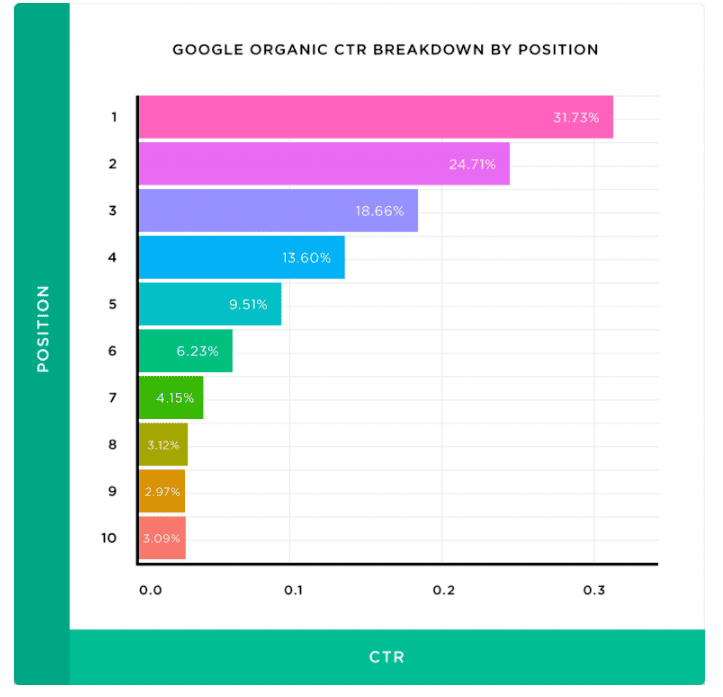
Since organic traffic accounts for over 50% of all traffic visiting a business website (more for B2B brands), you can’t afford to ignore the role of content as part of your digital marketing success. But that’s not all. Great content builds your reputation as a trusted provider — which translates into more conversions. Hence, content marketing is both a top-of-funnel and bottom-of-funnel strategy.
Because content marketing is so crucial for digital marketing success, add metrics representing content marketing to your analytics plan. You’ll need metrics including which posts perform best, which headlines perform best, demographics related to folks who read posts (to ensure you’re reaching your target demographic—new to Google Analytics), and even the progression from content down the funnel to sales (with Google’s funnel available in Analytics). A/B testing helps create a fuller picture of how content impacts your digital marketing success. Armed with insights derived from these metrics, you can optimize your content to reach your target market and increase conversions.
Engagement
Uploading content to already-crowded social networks and creating more pages on your website is not enough. You need to fire up your target market for digital marketing success, and that means engagement.
Engagement involves using digital technologies to find, listen to, and mobilize a community to support a brand or issue. Notice this definition starts BEFORE you see any consumer actions, so it involves more than getting clicks, likes, shares, follows, etc.
Engagement involves creating a community in the first place, then listening and responding to them with content that mobilizes them to promote your brand. Engagement amplifies your message, enabling you to reach many more folks than you might otherwise. But more importantly, engagement adds an element of trust to your communications, which is important for digital marketing success.
Think about it. You might not rush out to buy that new widget just because you saw a commercial or a post from the company on Twitter (now X). But when your friend Sally shares a message about her positive experience with the brand, you’re much more likely to buy because you know Sally and trust her. You figure she wouldn’t share something if the product wasn’t any good. Even strangers have more ability to promote purchases than brands.
Don’t believe me.
Remember the old Blockbuster stores? You’d wander the shelves looking for a movie to rent. Often, someone would walk past, see the titles you were looking at, and recommend something or warn you not to waste time watching a particular movie.
Verbal communication isn’t required. You might order a particular dish or visit a particular restaurant after seeing the food on other diners’ plates. Restaurants with outdoor seating entice diners with not only the image of delicious food on diners’ plates but also the aromas—we’re hardwired to respond more to visual and olfactory clues than auditory ones.
Creating engagement also drives your target audience down the hierarchy of effects—a fancy name for a process that drives more folks into your conversion funnel and increases the chances they’ll convert.
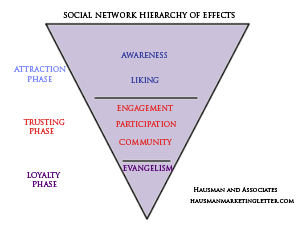 At its highest level, the hierarchy of effects creates evangelists—in this case, evangelists aren’t promoting a particular religious belief but a brand. Evangelists keep the brand top of mind by mentioning it frequently, but they go well beyond simply sharing information. They encourage others to buy and defend the brand when others say harsh things about it. They craft user-generated content and answer questions to improve the user experience of other consumers.
When I was back in my doctoral program, I did a project looking at the Disney community. Evangelists in that community increased park visits by:
- Creating a norm supporting multiple visits to the parks each year
- Encouraging visitors who were on the fence about visiting the parks
- Answering questions to speed visitors through the lines at the park, where to stay, and how to get there
- Deflecting detractors who said bad things about the parks
- Providing valuable feedback to Disney to improve the parks
Digital marketing success
That’s all you need for digital marketing success.
Period.
You might disagree with me, and that’s fine. Just add your opinion to the comments below.
If you think about it, everything else that makes digital marketing successful falls into one of three buckets: analytics, content marketing, or engagement. Try it.
Need marketing help to support business growth?
We welcome the opportunity to show you how we can make your marketing SIZZLE with our data-driven, results-oriented marketing strategies. Sign up for our FREE newsletter, get our FREE guide to creating an awesome website, or contact us for more information on hiring us.
Hausman and Associates, the publisher of MKT Maven, is a full-service marketing agency operating at the intersection of marketing and digital media. Check out our full range of services.
Discover more from MKT Maven
Subscribe to get the latest posts sent to your email.


