 logo

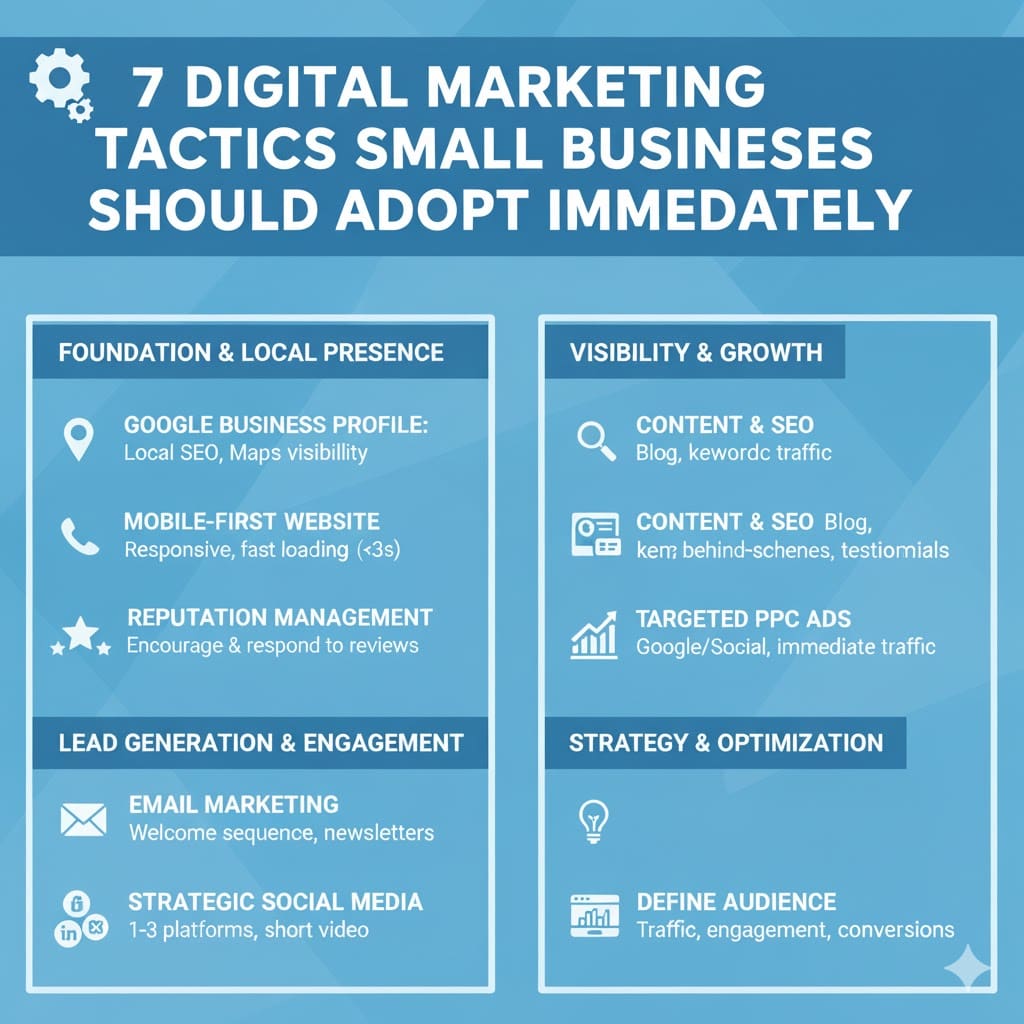
Over the last decade or so, I’ve shared many digital marketing tactics with you. As a small business owner or manager, perhaps you find it confusing to prioritize these tactics as you develop your marketing plan to optimize performance with the limited resources available. Your small business success requires that you choose from among these tactics to build the perfect combination. Hence, today, we developed this post on the ten must-have digital marketing tactics for small business success.
What is small business success?
Before we get started with the must-have digital marketing tactics, let’s explore what we mean when we talk about small business success. You may be slapping your forehead over this question because, to you, small business success is obvious. A small business is successful when it makes money. While that’s true, it isn’t the whole story. To be successful, a small business must achieve many smaller goals that contribute to making money, growing, and surviving long-term. That’s why more than half of all small businesses fail within the first five years, many (21%) within the first year. By year 10, 65% of small businesses fail.
These failures are due to a number of reasons, chief among which are cash flow problems. However, even this problem can be traced to poor marketing, either in terms of underestimating demand or failing to stimulate demand with effective marketing tactics or to adapt their marketing tactics to changes in the environment. Poor inventory management (which is also a piece of marketing) also fits in the top 10 reasons small businesses fail, according to the U.S. Chamber of Commerce. The remaining failures of small businesses are often due to poor management.
Small business success, contrary to popular belief, isn’t primarily a function of having sufficient capital. It’s being effective in managing your marketing from the beginning (product development) to the end (conversion). In between these two endpoints are a host of marketing tactics that bridge the gap to ensure small business success. This success starts with devoting sufficient budget to your marketing efforts. Below, you can see the average marketing spend for small businesses in a variety of industries.

Tactics that ensure small business success
Since digital marketing offers the highest return on investment (ROI) and 87% of consumers start their product search online (since this number is from 2018, this percentage is likely higher now), we’ll focus on digital marketing tactics.
1. Target marketing and value propositions
No business, regardless of its size, can succeed without these two core marketing concepts being fully implemented. Let’s get into them one at a time.
A target market is that segment of the population most likely to buy your products (goods and/or services). That’s because they have four characteristics:
- They need your type of product. For instance, a person needs food (wants determine how they satisfy this need, ie, a turkey sandwich). While needs for food, clothing, and shelter dominate our drives, other needs are also important, such as friendship. Choose to market to people who need your products and encourage them to want what you offer.
- Authority means the consumer can acquire your product. For instance, a child can’t acquire products without an adult’s permission because they lack authority.
- Money is required for any purchase. If a consumer doesn’t have enough money to buy your product, you can help them make a purchase if they have sufficient credit or something to barter.
- Desire comes into play because consumers don’t always buy products that satisfy the first three criteria. For instance, I may need a new blouse for an event next week. I have the authority because it’s my money, and I can drive myself to the store (or use online platforms to buy it), and the money to afford the blouse. However, I don’t have a desire to go shopping right now.
Attempting to sell to consumers who lack any of these four criteria is a waste of marketing resources. That’s why companies must identify their target market (based on demographics, geographics, psychographics, and behavioral characteristics) to optimize their marketing spend. Next, they position their offerings to appeal to this market.
A value proposition reflects those benefits most likely to appeal to the target market. Focus on the important benefits that make your brand unique compared to competitors. For instance, maybe you offer higher value than other brands or your products are more stylish, durable, possess enhanced functionality, or are easier to use.
2. Mobile-first, fast website
Regardless of your business or industry, a great website is a top must-have for small business success. While AI search is shifting focus to branding as an important tool for building awareness and interest in your products, traditional SEO (search engine optimization) is still critical for reaching and convincing consumers to make a purchase. Plus, even AI won’t benefit your brand if you don’t have exceptional content online to train the AI models that deliver answers to users’ queries. If you don’t have a website, make this a priority as you develop your marketing plan for 2026.
To help control your budget, I even developed an ebook that steps you through the process of building your own website without writing a single line of code. You can build a mobile-friendly website using the plethora of screenshots and resources I share in that book. Even better, it’ll only cost you about $150 for a domain, hosting, and a template that creates a responsive website, while the ebook is free!
You’ll also need fast hosting if you want to appear near the top in search results and AI-generated answers. The ebook recommends some great options.
Once you have your website, test it across different devices to ensure it looks great on all of them.
3. Local SEO
Since most small businesses are local businesses, small business success requires you to dominate local SEO. Do this by crafting a business profile on Google My Business, which is free. Be sure to fill out all the information requested and ensure you keep your information up-to-date. Nothing is worse for your reputation than sending a prospect to your business only to turn them away because it’s closed or no longer offers the products shown on the profile.
To flesh out your profile, encourage customers to rate your business and add current, high-quality photos. If you do this well, you’ll show up when local users search for the products you offer with enhanced results, such as this:

4. Manage your reputation
Building and maintaining a stellar reputation are central to small business success because consumers care about what your customers say about your brand. Check out these stats from Wharton:
- 86 percent of consumers read reviews for local businesses
- 95 percent of people ages 18 to 34 read local business reviews
- Consumers read an average of 10 reviews online before they feel they can trust a business
- Consumers value recent reviews — 40 percent only take into account reviews written within the past two weeks, a 22 percent year-over-year increase
- 57 percent of consumers will only buy from a business that has four or more stars
- 91 percent of 18-to-34-year-old consumers trust reviews online as much as recommendations from friends and family
Given how important reviews and comments are to your brand, you should dedicate your business to managing your online reputation, as well as that of your local brand.
- Start by providing the highest-quality service possible and offering only high-quality products that you wouldn’t be embarrassed to give to your family.
- Next, monitor mentions of your brand with Google Alerts, but never try to hide negative comments. Instead, address the underlying problems that created the negative experience. Own the problem, implement fixes, apologize for your failure, and be transparent in how you will fix the problem or the compensation you’ll provide to the consumer. Designating an employee to monitor mentions routinely ensures you respond quickly, which is the key to reducing the damage to your reputation.
- Asking for reviews from satisfied customers will ensure the negative comments have less impact on purchase decisions.
- Highlight positive reviews in your marketing channels to draw attention to the things you’re doing right.
5. Lead generation and nurturing
As we alluded to earlier, conversion is a process (customer journey) that looks something like this:

Unlike the linear funnel you might have seen in other marketing advice, including on my pages, this circular format is closer to reality, based on my extensive experience in marketing. It’s important to recognize that different marketing channels are more effective at one stage of the customer journey than another. That’s part of why you need a mixture of marketing channels to achieve small business success.
- Social media and SEO are most valuable at the awareness stage because these tactics allow you to reach a broad audience. Because you can use keywords and other tactics to limit your reach to consumers in your target market, digital marketing makes perfect sense. You can also use advertising on local radio, newspapers, and some streaming services that also allow this targeting.
-
- Choose between one and three social media platforms that attract a high percentage of your target market. For instance, TikTok and Instagram Reels attract a younger demographic, Facebook, an older one, and LinkedIn, a more affluent audience.
- Consider PPC (pay-per-click) advertising to reach your target market with personalized advertising at an affordable cost. With the decline of organic reach on social media platforms, paid advertising is often the solution.
- To use SEO, as well as generative engine optimization, you need to produce great content that establishes your expertise, experience, authority, and trust on your website, which likely means a blog. By writing about topics of interest to your target market and using appropriate keywords, you optimize your content so it shows near the top in search results and your brand shows up in AI-generated query results that drive awareness. Create valuable content consistently (such as once a week) and vary the content with images, video, and clear headlines that entice visitors to explore your products.
-
- Email marketing is perfect for lead nurturing, as it allows you to develop a relationship with prospective buyers and maintain one with your existing customers. Due to privacy laws, this is a two-step process, whereby you first acquire subscribers and then send targeted, personalized messages to them. You’ll need an email service provider to help manage subscribers and send messages. This marketing tactic delivers the highest ROI of any digital marketing channel (see below).

Image courtesy of Maven Marketing Lab - Landing pages help turn awareness into interest by providing benefits, highlighting reviews, and answering questions that turn browsers into buyers.

6. Conversion tactics
Once you’ve developed prospects to the point of making a purchase decision, you need to work to get them over the last hump to actually purchasing the product. To enhance conversion rate, try:
Using clear, enticing calls to action (CTAs) that stand out on the page with contrasting colors, buttons, and short words Add support tools such as live chat (utilizing a chatbot to ensure 24/7 availability), FAQs, clear and accurate descriptions, and 360-degree images. Ensure a seamless shopping experience with intuitive navigation and easy shopping cart experiences. For every click taken out of the conversion process, you’ll see the conversion rate increase.Use remarketing to reach users who left items in their shopping carts. Use A/B testing to improve conversion rates.
7. Monitoring, testing, tweaking
Identify key performance indicators (KPIs) so you can monitor performance on variables that actually contribute to small business success. Include KPIs from all stages of the customer journey if you want to ensure optimal performance. Below are some website KPIs to monitor that match the various stages in conversion.
 Armed with KPIs for your various marketing tactics, you should create a dashboard using data visualization so you can identify at a glance how each platform and campaign is performing. Use insights gleaned from this analysis to tweak performance until you achieve small business success.
Conclusion
Small business success doesn’t happen overnight and you don’t need every one of these digital marketing tactics to achieve this success. Choose ones near the top of this list to implement first, ensuring you’ve dedicated sufficient resources to allow effective implementation. Monitor your results and use insights for data-driven decisions that improve performance. This can easily take months, so don’t give up too soon.
Then, slowly add additional tactics depending on your budget and bandwidth until you’ve implemented all seven of these digital marketing tactics that build small business success.
Need marketing help to support business growth?
We welcome the opportunity to show you how we can make your marketing SIZZLE with our data-driven, results-oriented marketing strategies. Sign up for our FREE newsletter, get our FREE guide to creating an awesome website, or contact us for more information on hiring us.
Hausman and Associates, the publisher of MKT Maven, is a full-service marketing agency operating at the intersection of marketing and digital media. Check out our full range of services.
Discover more from MKT Maven
Subscribe to get the latest posts sent to your email.


